Tour and ascent of Roc Campanyà via the Vauban trails

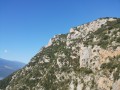
Roc Campanyà or Campagnia rises to an altitude of 1,134 metres, just above the Mas de Lastourg campsite in the Têt Valley, very close to Villefranche-de-Conflent. Its pointed, aggressive silhouette and the chaos of the Sant-Pere massif on which it is perched suggest that it is inaccessible without climbing equipment... But it's not. With a good pace and a good sense of direction, hikers can reach the summit in just 3 hours.
Read the comments carefully before setting off on this route. Don't hesitate to turn back. There is a way out of the route between (10) and (5): return via the Vallon des Horts, a hike described here on visorando. The point (10) on this route corresponds to the point (4) on the other route.

Details

343109
Creation:
Last update:
Last review:
  • Walking
    Activity: Walking
  • ↔
    Distance: 10.13 km
  • ◔
    Duration according to the author: 4 hrs 
  • ▲
    Difficulty: Extremely difficult

  • ⚐
    Back to start: Yes
  • ↗
    Ascent: + 964 m
  • ↘
    Descent: - 961 m

  • ▲
    Highest point: 1,250 m
  • ▼
    Lowest point: 452 m

Photos

Description of the walk

Park your vehicle in the dirt car park on the right of the N116 as you descend. The start of the hike is just opposite, at the foot of a small oratory.

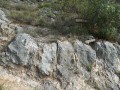
(S/E) Take the path that climbs along a huge stone wall up the mountain.
The trail, marked with large white paint strokes, is very well maintained by volunteers from the Notre-Dame-de-Vie association and winds its way up the mountainside. It's impossible to get lost as there is only one trail.

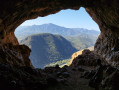
(1) After about ten minutes, you will find a small cave on your right (reserved for non-Muggles...). The few false trails that deviate from the main trail are clearly marked by piles of stones, indicating that they are not the right way.

(2) After 20 minutes of climbing (approximately 800m horizontally), with the mountainside mainly on your right, turn sharply to the right and continue climbing with the mountain on your left for about 10 minutes (400m horizontally). In half an hour to 45 minutes, you will reach the esplanade of the chapel.

(3) Descend to the fork in the first hairpin bend, where a wooden sign indicates "Notre Dame de Vie".

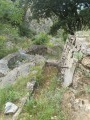
(2) Take a very small mule track on the right, which is much less well maintained but still bordered and supported by old dry stone walls. This is an old military surveillance path known as "Vauban", which is not signposted.

(4) Follow this poorly maintained path for a good half hour, littered with stones and scree that have fallen from the mountain or the walls, to reach the main path, known as "Chemin Vauban" (which climbs from Fort Libéria in Villefranche-de-Conflent, marked in purple on the IGN map). Pass just before the foot of a metal sculpture depicting the silhouette of a bird of prey in flight and a memorial plaque. Take the Chemin Vauban (unmarked) which climbs very easily for 4 hairpin bends.

You will reach a platform similar to those at the previous bends, where another clearly marked path leads into the undergrowth towards the nearby ridge. Do not take this path, as it will be the crossing point for the return journey, after the climb and the tour of Roc Campagna.

(5) Continue climbing to the right along the hairpin bends of the Chemin Vauban. Reach an altitude of 1,100 metres.

(6) Look for an unmarked trailhead on your left.
NB: This is a shortcut to the trail leading from the Chapelle Saint-Etienne to the Pla d'Aussa. If you cannot find this fork, you can take the longer route.
Rejoin the place where the track from the Chapelle Saint-Etienne to Pla d'Aussa becomes a path.

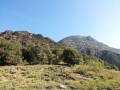
(7) Continue along this unmarked path on the left along the contour line to the place called Flagels, where the path suddenly climbs in several hairpin bends, gaining more than 70m in altitude. Reach the Pla d'Aussa, a vast moorland of low Mediterranean vegetation dotted with a few shrubs.

(8) Continue along the trail towards Roc Campagna, marked on the ground by a small cairn and a wooden stake painted red and yellow (like a snow stake used for road signs, but only 80 cm high). There are several ways to find it: either use GPS or look for a group of three distinctive trees on the edge of a clearing, then head straight east towards the Sant-Pere precipice to find it.

Then take a small path, which is also unmarked but marked with a few cairns, which descends gently and then climbs back up to the summit of Roc Campagna, which can be seen through the trees and bushes.

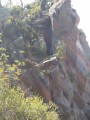
(9) Proceed with caution, using your hands, to reach the first of the Roc Campagna peaks.
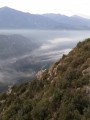
From there, you will have a magnificent 360° view of the Têt and Rotja valleys.
You will also notice another peak, slightly lower, about a hundred metres ahead of the first one. It can be reached in a few minutes, again with caution. This peak is overgrown with large clumps of thorny vegetation, the likes of which I had never seen before. From here, you can see the villages of Serdinya and Villefranche, and the Mas de Lastourg campsite, with its swimming pool surrounded by ornamental trees.
You can then make out two other more modest peaks of Roc Campagna. So there are a total of four peaks, indistinguishable from each other from the valley, which form "Le" Roc Campagna.
Descend to the west (to earn the "Tour du Campagna" label) on a fun, fairly passable scree slope, but very steep (a drop of nearly 250 m over a distance of just 400 m) and without any path or markings.
At the end, keep well away from the south of the base of Roc Campagna (No. 4), cross the end of another Vauban trail coming from the west (barely visible) and look for the large rock with a large white arrow and a large dot painted on it, indicating the passage to the west.

NB: at the bottom of the scree, you can climb down directly to point (10), but it is better to veer west as indicated on the route.

(10) Then look for a small path on the slope, marked by several orange adhesive tape marks (and others in yellow) affixed to the vegetation and tree trunks. Head east down the slope, then generally north-east, almost on the contour line, taking particular care to stay on the path, which sometimes disappears into the vegetation or scree. Over a distance of about 750m between the 1000m and 900m contour lines, the route will reach the cliffs that block the path to the north-east.

NB: This part of the route is the most difficult, as the path is poorly marked (there are numerous adhesive markings, but they are arranged randomly and not in a standard pattern; sometimes there are red or yellow paint markings) and vegetation and scree have made it difficult to see over the years. Furthermore, unlike other parts of the hike, there are no longer any dry stone retaining walls on either side of the trail.

However, beneath the cliffs, this path joins another old Vauban path (in very poor condition). This path ends by skirting around a rocky outcrop. As you pass, you can clearly see a chasm on the right-hand side of the path (which may have been used as an ice house, as there is a low wall supporting the ledge in front of its entrance).

(5) Then return to the main Chemin Vauban at the end of a hairpin bend on a small platform (marked on the way there). Finish the tour of Roc Campagna here, following real paths, even though from the valley these slopes appear untouched by human passage! Turn right and descend the same path as on the way there (except for the chapel). Return to the car park where you started (S/E).

Waypoints

  1. S/E : km 0 - alt. 452 m - Car park N116
  2. 1 : km 0.31 - alt. 537 m - Small cave
  3. 2 : km 0.76 - alt. 641 m - Leave the main trail at the sign - Turn right
  4. 3 : km 0.91 - alt. 689 m - Chapelle Notre-Dame-de-Vie (Fuilla)
  5. 4 : km 2.01 - alt. 830 m - Rejoin the Chemin Vauban ppal - Turn left
  6. 5 : km 3.01 - alt. 958 m - Chemin Vauban ppal - Continue to the right
  7. 6 : km 3.85 - alt. 1,082 m - Leave Chemin Vauban - Turn left
  8. 7 : km 4.21 - alt. 1,136 m - Rejoin the main trail - Turn left
  9. 8 : km 5.53 - alt. 1,230 m - Red and yellow stake - Continue straight ahead
  10. 9 : km 5.7 - alt. 1,199 m - Roc Campagna 1st peak set back
  11. 10 : km 6.3 - alt. 971 m - Start of orange adhesive markings
  12. S/E : km 10.13 - alt. 452 m - Car park N116

Notes

Notes on this hike:
It follows ancient paths built either
- either to give pious men access to the spiritual joys of the Catholic hermitage (Notre-Dame-de-Vie),
- or to allow soldiers to enjoy the material pleasures of defending France, particularly the fortresses of Villefranche and Fort Libéria, just after the Treaty of the Pyrenees was signed by Mazarin during the reign of Louis XIV on 7 November 1659.
So, loads of paths, walls and steps have been built into the rock over the centuries by our ancestors.

This hike takes place in the heart of nature in a rather challenging environment: steep slopes, rocky outcrops, escarpments, scree, scree slopes, thorny vegetation and, in some places, a complete lack of signposts. It is therefore reserved for experienced hikers with a good sense of direction. A GPS device may also be very useful.

Apart from the small cave (1), a few rock shelters at the foot of the cliffs and the chapel forecourt (3), there is no shelter on the route and no water. You must set off fully equipped.
Wear good hiking boots for walking on scree.
If you are worried about scratches, wear hiking trousers. Bring a good hat and sun cream if the weather is sunny.

Please note: another hike by the author is described on this website: Roc Campagna (1,134 m) from Mas de Lastourg (Sant Pere/Massif Mont Coronat), but the end is more difficult and you reach summit no. 3.

Place names

Between 2014 (when this hike was created) and 2025, IGN modified its maps and now uses Catalan names rather than French ones, which explains some differences between the names used in this hike and those on the map.

Campagnia/Campanya = countryside in English. This is a surprising name when you consider that the word campagne/campanya is used (in French and Catalan) to refer to a "flat, open expanse of land (as opposed to woods, mountains, etc.)" or fairly flat and inland (as opposed to mountains, seaside, towns, etc.)", source: etc.) or fairly flat and inland (as opposed to mountains, seaside, city)", source https://tradukka.com/dictionary/fr/ca/campagne/389156.

"Very difficult" variant:
To avoid passing between (5) and (8), there is a variant that runs along the side of Sant-Pere in the middle of nature, completely off the trail, in a dry coume (ravine) overgrown with vegetation.
On the way up, at point (5), leave the Chemin Vauban and take the return trail on the left. Head to point 42.5876°N - 2.34739°E, then climb directly towards the ridge, heading west-northwest (bearing ~280°).
This will take you to point (8). You won't really save any time, but you will cover fewer kilometres.

Worth a visit

Don't miss the beautiful Pyrenean landscapes and the view of the Canigou massif!
With a bit of luck, you may spot marmots, wild boars and even chamois, whose footprints and droppings can be seen throughout the first half of the hike.

Louis XIV, Vauban and the Treaty of the Pyrenees:
In 1659, the Peace of the Pyrenees brutally imposed a new border to separate the two warring kingdoms of France and Spain. This created a need for unification, a new spatial dimension and a new sense of belonging. The treaty restored Artois, four strongholds in Flanders and the province of Roussillon, including Cerdagne, which opens onto the Col de la Perche and marks its western boundary, to France. The Catalan Sicart family, owners of the Cal Mateu farm (now the Museum of Cerdagne in Sainte-Léocadie), were appointed viguier by the King of France to administer the local population. At the same time, Vauban was sent to this territory to mark this new region with the French royal seal and protect it from possible Spanish incursions. He designed the line of fortifications along the border. Depending on their strategic usefulness, some medieval sites were dismantled, while others were redeveloped, such as Villefranche-de-Conflent. In Mont-Louis, he created a stronghold to block access to France, Spain and the Mediterranean. Internet link

Reviews and comments

4.2 / 5
Based on 6 reviews

Reliability of the description
4.3 / 5
Ease of following the route
3.5 / 5
Route interest
4.7 / 5
Lola 66
Lola 66
• Edited:

Overall rating : 3.7 / 5

Date of your route : Mar 11, 2023
Reliability of the description : ★★★★☆ Good
Ease of following the route : ★★★☆☆ Average
Route interest : ★★★★☆ Good
Very busy route : No

Our group of nine arrived and climbed up to Roc Campagna without any problems, then we began the descent down the scree slope, which we found to be neither "fun" nor "suitable for hiking" as described in point 9 of the hike description. It was dangerous with every step, as stones tumbled down the slope (a drop of nearly 250 metres over a distance of barely 400 metres), with the risk of injuring those in front. At the end of the scree, we decided to turn back because it was too dangerous to continue on the trail. Three people arrived after us and they also turned back. We climbed back up the "fun and passable" scree slope and headed for Fort Libéia to finish the hike. It was the first time I had ever turned back on a hike, but we made the right choice.

Machine-translated

mimi6645
mimi6645
• Edited:

Overall rating : 4 / 5

Date of your route : Jan 04, 2023
Reliability of the description : ★★★★☆ Good
Ease of following the route : ★★★☆☆ Average
Route interest : ★★★★★ Very good
Very busy route : No

Hello,

A beautiful hike to do in dry, clear weather.
The views are remarkable.
However, you need to be careful and don't hesitate to turn back if necessary.
For my part, as part of a group of 10 people, we stopped at point 8 at around 1 p.m. and turned back as we couldn't recognise the section described as difficult. We made our way back down via Fort Liberia (at point 4 on the way down).
When passing point 5, I followed the return route for several dozen metres and noticed that the path is only marked on the ground. I plan to reconnoitre the section between points 9, 10 and 5 and will keep you informed of my findings.
Also, the "Roc Campagna (1,134 m) from Mas de Lastourg (Sant Pere/Massif Mont Coronat)" route mentioned by Marc for the escape route: the climb to the rock is not marked and it is easy to get lost. I say this because I have done this route several times, so make sure you follow the route in the correct direction (4-5).

Best regards

Machine-translated

polpez
polpez
• Edited:

Overall rating : 3 / 5

Date of your route : Feb 15, 2022
Reliability of the description : ★★★☆☆ Average
Ease of following the route : ★★☆☆☆ Disappointing
Route interest : ★★★★☆ Good
Very busy route : No

Hello,

I did this hike a few months ago, in February of this year, and I wanted to tell you to be very careful after point 10 in the description.
As the author of the route clearly states: "NB: This part of the route is the most difficult because the path is poorly marked, it is not clearly signposted (there are numerous adhesive markings, but they are arranged randomly and not in a standardised manner; sometimes there are red or yellow paint markings) and vegetation and scree have accumulated over the years, making it difficult to see. Furthermore, unlike other parts of the hike, there are no longer any dry stone retaining walls on either side of the trail."

The situation is worse than described because the yellow/red markers are particularly difficult to see, vegetation has completely taken over and the trail has disappeared. In addition, the GPS route on the app is not/no longer correct: at several points I was ON the red route but in reality I was not on the trail.
I come from the mountains of northern Italy, I have been hiking in all kinds of natural environments for over 20 years, I am in good physical shape and I am a very organised person, especially when I go hiking on my own, but for the first time in my life, I got lost on this hike.
I had to call for help, and they came by helicopter to get me out of there. The rescuers themselves told me afterwards that quite a few people had got lost in the area!

I should have turned back before I got lost, but I was confident in my abilities and thought I would find my way back. It's a lesson learned for next time :-)

This is just to explain the state of this trail. Do it at your own risk!

Obviously, the author of this route is not responsible for the maintenance and safety of the hike.

Machine-translated

j.julien
j.julien
• Edited:

Overall rating : 4.7 / 5

Date of your route : Apr 24, 2019
Reliability of the description : ★★★★★ Very good
Ease of following the route : ★★★★☆ Good
Route interest : ★★★★★ Very good

On the descent from the scree, at an altitude of around 1,070 metres, head a hundred metres further west to avoid a steep descent down the rock face.

Machine-translated

vezian
vezian
• Edited:

Overall rating : 5 / 5

Date of your route : Nov 30, 2017
Reliability of the description : ★★★★★ Very good
Ease of following the route : ★★★★★ Very good
Route interest : ★★★★★ Very good

A challenging hike with a group of 15 experienced hikers.The short climb up the rock face is easy, and the long descent down the scree slope is fun. At the end of the descent, it is easy to spot the trail, although it is in poor condition, which branches off to the left along the mountainside between two rocky outcrops. On this section of the return journey, which is generally on the same contour line, there is one section where you need to be very careful and there are some vertiginous parts, but there is no real danger.
In short, this is an unusual hike reserved for "adventurers".

Machine-translated

joducapcir
joducapcir
• Edited:

Overall rating : 4.7 / 5

Date of your route : Sep 12, 2016
Reliability of the description : ★★★★★ Very good
Ease of following the route : ★★★★☆ Good
Route interest : ★★★★★ Very good

I could give you my opinion once I've tried it...
This hike looks very interesting.

Machine-translated

Other walks in the area

For more walks, use our search engine .

The GPS track and description are the property of this route's author. Please do not copy them without permission.