Circular route via the Bau de Quatre Aures and the Croupatier

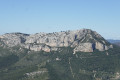
This challenging walk allows you to explore some of the features of these hills overlooking Châteauvallon—whose silhouette is ever-present when you live in the western Var—including the Croupatier and the Bau de Quatre Aures. This route shares a few sections with another walk that includes the Bau, but in the opposite direction, and extends partly along the northern slope towards Le Broussan. Furthermore, we have chosen to take the Pas de la Cavale on the way up and make this the starting point of our route.

Details

4115702
Creation:
Last update:
Last review:
  • Walking
    Activity: Walking
  • ↔
    Distance: 11.03 km
  • ◔
    Average duration: 4h 50 
  • ▲
    Difficulty: Difficult

  • ⚐
    Back to start: Yes
  • ↗
    Ascent: + 581 m
  • ↘
    Descent: - 578 m

  • ▲
    Highest point: 571 m
  • ▼
    Lowest point: 272 m
  • ⚐ Country: France
  • ⚐ District: Toulon (83200|83100|83000)
  • ⚑
    Start/End: N 43.160332° / E 5.897151°
  • ❏
    IGN map(s): Ref. 3346OT
  • Hour-by-hour weather

Photos

Description of the walk

From Toulon, take the road leading to Le Broussan via the Col du Corps de Garde, starting from Avenue des Fils Marescot, which later becomes the D62.
You’ll soon come across a sign for “Baou des Quatre Aoures – Vue Panoramique”, which leads you onto the Chemin du Baou de Quatro Ouro.
In a right-hand bend, on the left, there is a bare plot of land enclosed by a green fence with a green metal gate, on which there is a water tank and a Veolia utility room. Opposite, on the right, is the junction with the old road from Toulon to Evenos, which you take.
After a straight slope followed by two hairpin bends, we arrive near a reservoir, beyond which the road is unpaved.
There is a lay-by here where several cars can park.

(S/E) We take the path that runs along the left-hand side of the reservoir enclosure. We climb this rocky path, ignoring any paths branching off to the left, and continue with the cliff always on our left.

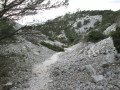
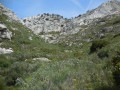
(1) You will then arrive at the Pas de la Cavale, a relatively stable scree gully. However, you must remain vigilant for any falling rocks caused by the person in front of you, whom you should follow at a safe lateral distance.
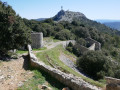
For most of the ascent, you climb in a straight line up a slope of around 60%, right through the scree. Then, near the summit, you’ll find a well-maintained, switchbacking path reinforced with sturdy dry-stone walls.

(2) This brings you to the summit of Cap Gros, where you can see the remains of military structures.
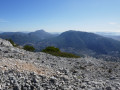
You then set off along the gravel track that descends towards the west, with constant beautiful views over Toulon and La Seyne.

(3) Just below a bend to the left, you can see a vast esplanade which is the catchment area for the Rouvière Plane cistern. Take a path on the left which leads you beneath this structure; pass through the gate in a beautiful masonry wall, and descend the Vallon des Bagnards, heading south.

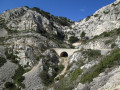
(4) At the mouth of the Vallon des Bagnards, you reach the bridge overlooking the Vallon des Bonnes Herbes, and take the track on the right which initially climbs very gradually, with a constant view of the Vallon des Bonnes Herbes and a southern slope where you can see old terraces.
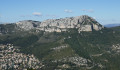
You come to a cistern and turn right, leaving to your left the track that descends towards Le Détras and then towards Châteauvallon. You climb, with a view to the left of Le Détras and La Courtine and, soon, to the right, a view of the track you have just left and, in the distance, the southern slope of Le Bau de Quatre Aures.

(5) On reaching the pass, you’ll find theGR® on your left; take this to follow the Croupatier ridge line westwards.

(6) You pass under a high-voltage power line. In the open area, you can see a path to the south leading down to the main cave of the Croupatier, which is an ideal spot for a picnic break.
To the north, a well-marked path leads to the trail that takes us to Le Broussan. But we don’t take it and continue a little further west. In fact, we stay on the GR®.

(7) Here, theGR® turns right and descends steeply.
If we were to go straight on towards the west, we would reach the Chappe telegraph station via Les Bornes.
So we turn right and stay on theGR®, for a descent of about 200 m.

(8) You’ll find a path branching off horizontally to the right, whilst theGR® heads left. Take the path on the right, heading north-east towards Le Broussan. The path descends gradually as it follows the Destel Valley.

(9) You reach the Destel, which usually has very little water (take care in stormy weather!).
Cross the river and follow it upstream until, as the first houses of Le Broussan come into view, you find a path leading up to the right.

(10) Take this path, which climbs eastwards, overlooking the village of Broussan.

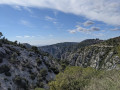
(11) Staying on this path, you arrive in the Vallon du Corps de Garde where you find a track, which becomes a path, and climbs up the valley towards the Col du Corps de Garde, with the stream below, which is sometimes in gorges, and on the other bank the D62 road which runs from Le Broussan to Toulon via the pass.

(12) Once at the pass, take the forest track marked with a sign bearing the inscriptions “V 36” and “Protection Incendie – Corps de Garde”. Follow this relatively level track to the Croix du Signal, then descend gently southwards, passing alongside the reservoir to reach the car park (S/E).


Waypoints

  1. S/E : km 0 - alt. 320 m - Car park near the reservoir
  2. 1 : km 0.31 - alt. 410 m - Arrival in the Pas de la Cavale corridor
  3. 2 : km 0.63 - alt. 552 m - Cap Gros/Baou de Quatre Ouro
  4. 3 : km 1.47 - alt. 510 m - The Rouvière Plane cistern
  5. 4 : km 2.19 - alt. 355 m - The bridge at the junction of the valleys
  6. 5 : km 3.83 - alt. 494 m - Junction with the GR 51
  7. 6 : km 4.63 - alt. 467 m - High-voltage power line
  8. 7 : km 5.12 - alt. 422 m - Junction with the signpost route
  9. 8 : km 5.33 - alt. 372 m - Junction with the Broussan trail
  10. 9 : km 7.13 - alt. 272 m - Crossing the Destel at the ford
  11. 10 : km 7.37 - alt. 277 m - We head up to the right before Le Broussan
  12. 11 : km 8.19 - alt. 313 m - Junction with the Corps de Garde valley
  13. 12 : km 9.24 - alt. 392 m - Col du Corps de Garde (391m)
  14. S/E : km 11.03 - alt. 319 m - Back to the car park

Notes

Water sources... well, there aren’t any! You absolutely must bring a water bottle, because you’ll get thirsty!

Hiking boots are essential, if only for climbing the Pas de la Cavale couloir; and further on, the tracks are very stony and the paths often cross areas of sharp limestone pavement, which are merciless on feet and ankles. Fortunately, there are a few sections of earthen paths where you can rest your feet.

Hiking poles are just as essential, in my humble opinion as a humble hiker.

This hike should obviously be avoided in wet weather, and even more so during a storm, as the rocks become slippery underfoot, sometimes coated in clay picked up from the few earthen sections: a real hazard. Not to mention the Destel, which swells visibly when it rains and may then prove impossible to cross.

It should be noted that in summer, the Var’s forest areas, including this one, may be subject to preventive closures due to the risk of fire.

A brief aside regarding the name of the Bau de Quatre Aures (the spelling I have opted for): one can see that this poor rock has its name spelled differently depending on the map, document, road sign, etc. I have even seen “Bau de Quatre Heures” on Michelin maps in the past. Obviously, its name has nothing to do with a clock; in Provençal, it means ‘Rock of the Four Winds’ (or ‘Four Airs’), hence the variations in spelling depending on accents and pronunciation.

Worth a visit

On this sort of walk, there is so much to see and experience that you can never “walk aimlessly”.

Firstly, the rich panoramic views, both of Toulon and its harbour and of Evenos, and further afield, Saint-Cyr and La Ciotat. Don’t forget your IGN map, if not to guide you, then at least to familiarise yourself with the surrounding villages and terrain.

Then there is the vegetation: although the foliage varies little from one season to the next, the flowering is very rich and ever-changing; not to mention the scents and the relatively unspoilt insect life. Finally, the mineral aspect, with the distinctive and rugged beauty of this karst landscape.

Not to mention the appeal of visiting these places at different times of the year, as each season has its own charm. It can be very hot or very cold, and there is something for everyone.

You’ll never get bored on the hills of the Western Var.

Always be cautious and plan ahead when you're outdoors. Visorando and the author of this route cannot be held responsible for any accidents occurring on this route.

The GR® and PR® markings are the intellectual property of the Fédération Française de Randonnée Pédestre.

Reviews and comments

4.3 / 5
Based on 5 reviews

Reliability of the description
4 / 5
Ease of following the route
4.6 / 5
Route interest
4.4 / 5
Magic mike
Magic mike

Overall rating : 5 / 5

Date of your route : Apr 15, 2024
Reliability of the description : ★★★★★ Very good
Ease of following the route : ★★★★★ Very good
Route interest : ★★★★★ Very good
Very busy route : No

A lovely walk, with some stunning views.

Machine-translated

Léo Bas
Léo Bas

Overall rating : 4 / 5

Date of your route : Mar 22, 2024
Reliability of the description : ★★★★☆ Good
Ease of following the route : ★★★★★ Very good
Route interest : ★★★☆☆ Average
Very busy route : No

A lovely view, but the walk down is a bit of a slog.

Machine-translated

trotignon
trotignon

Overall rating : 4.7 / 5

Date of your route : Oct 04, 2023
Reliability of the description : ★★★★☆ Good
Ease of following the route : ★★★★★ Very good
Route interest : ★★★★★ Very good
Very busy route : No

A lovely walk with stunning views, first of the harbour, then of Evenos and Mont Caume...
A physically demanding hike, and not just at the Pas de la Cavale!
Note that between points 7 and 8, the route and the description do not match: the route (which I followed) goes straight on and is no longer the GR. Once there, it’s quite clear, so there’s no risk of getting lost!
Between points 8 and 9, as decphil pointed out in his review, you need to be a bit careful not to stray from the route: follow the track!

Machine-translated

tsamat
tsamat

Overall rating : 4 / 5

Date of your route : Feb 25, 2022
Reliability of the description : ★★★★☆ Good
Ease of following the route : ★★★★☆ Good
Route interest : ★★★★☆ Good
Very busy route : No

A lovely walk to see Toulon and the western side; I even found the cave...

Machine-translated

stjo
stjo

@decphil The Pas de la Cavale is a relatively stable scree slope.

Machine-translated

decphil
decphil

Overall rating : 4 / 5

Date of your route : Aug 24, 2021
Reliability of the description : ★★★☆☆ Average
Ease of following the route : ★★★★☆ Good
Route interest : ★★★★★ Very good
Very busy route : No

A lovely walk with stunning views of Toulon harbour and the surrounding coastline.
However, there are two caveats regarding the description and the route guidance:
- describing the Pas de la Cavale as a “relatively stable” scree slope is a bit optimistic: it’s quite a steep descent and rather tricky! Fortunately, it’s right at the start, so you’re still full of energy, and the view from the top is well worth it
- Following the path between points 8 and 9 isn’t as straightforward as the description on the guide sheet suggests (“Take the path on the right, heading north-east towards Le Broussan. The path descends gradually as it follows the Destel Valley”) is not as straightforward: there’s quite a bit of hesitation at certain junctions, and a rocky section where the trail has vanished and you have to head off to the right: after a bit of fumbling around, you eventually find it...
Note if you’re short of water: at point 10, you can make a quick return trip to the nearby village of Broussan and fill your water bottles at a public tap.

Machine-translated

Other walks in the area

For more walks, use our search engine .

The GPS track and description are the property of this route's author. Please do not copy them without permission.