Country:
 City:
City:


The hike starts at the end of Chemin des Bonnes Herbes, at No. 963. You will find a green iron gate, which is the starting point for the hike. You can park near this gate without disturbing the owners, provided you can find a space.
(S/E). Continue along the path until you reach the first fork at an altitude of 142 metres (on the IGN map). This is the junction with another path running north-south. Continue along the path, passing a large olive grove and an old stadium surrounded by high fences on your right.
Turn left towards the south onto a path that winds clockwise.
Pass several old quarry buildings, concrete slabs, walls and quarry buildings, which have been turned into airsoft shooting ranges.
The path narrows as it climbs northwards. It crosses the old quarry site below on the right, then meets a wider path running at the bottom of the Vallon des Bonnes Herbes at a crossroads marked by a rusty steel sign on the left above. On a tree, a small wooden sign indicates "BAU", which means "rock" in Provençal.
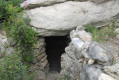
(1) Then turn left and walk up the entire valley. There is a 45-metre climb before the stone bridge at the end of the valley, which is not yet visible, hidden by the terrain, but whose approach wall can be seen. Take a tiny path on the right to reach, 10 metres to the right of the main path, a large rock shelter under a large slab of white rock. This is Shelter No. 2 in the Vallon des Bonnes Herbes.
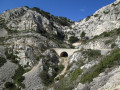
(2) Take the same path and pass under the bridge dated 1878. Climb up the scree on the right (3) to reach the edge of the cliff. There is another large rock shelter here. This is Shelter No. 1 in the Vallon des Bonnes Herbes.
(3) Take the path on the left marked in dark green. Pass through the metal gate that once blocked the way. The ravine is called Vallon de la Rouvière Plane or Vallon de la Grille, but is better known as Vallon des Bagnards.
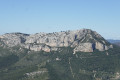
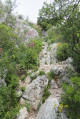
The trail is carved entirely out of rock, especially in its first section. It features stone steps or steps carved directly into the rock. This trail climbs quite steeply until it reaches the old military cistern of La Rouvière Plane. On the left is the Massif du Croupatier and on the right the Massif du Baou de Quatre Ouro (rock of the four winds in Provençal).
(4) Take the path on the right, marked in blue.
(5) Pass a crossroads at an elevation of 535 metres and continue north-east to reach the summit of Baou, known as Cap Gros, which rises to 576 metres.
(6) Descend via the same path to an elevation of 535 metres.
(5) Take a small path on the left that leads to the southern ridge of Baou, where the boundary between the municipalities of Toulon and Evenos is marked by two cairns over a metre high.
Stay on the 520 contour line heading north-east and look for a few cairns marking a goat path leading to the Brèche de Madema.
(7) Descend the breach, sometimes scrambling over rocky outcrops or following an ancient goat path, until you reach the path at the foot of the Baou cliff.
(8) Take this path on the right, which leads to the top of Hautes Pavègnes, then to a small car park (on the D2262 track) leading to Baou, via a path marked with light blue dots.
(9) South of the car park, find the fairly wide dirt path that descends towards the bottom of Hautes-Pavègnes, crosses a large pine forest and joins the old Bonnes Herbes quarry. Do not leave this path, which joins the fork at the start.
The trail climbs steeply from elevation 142 (on the IGN map) to elevation 175.
Return to the crossroads and take the original path back to the starting point (S/E).

 – I couldn’t find it.
 Visorando Member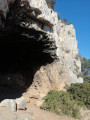
 Average
 Easy
Easy  Association / Club / Walk leader