Country:

 City:
City:



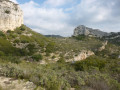
Reach Niolon via the D48 and park in the car park on the right-hand side before the village entrance.
(S/E) Follow the road, pass the station and reach the tunnel under the railway line. Do not go through the tunnel but turn opposite to reach the residents’ car park at the end of the cul-de-sac.
Blue signposts
Head towards the far end of the car park and go through a small barrier to take the path running alongside the railway line. Pass a building on your left to reach a scree slope and a junction that is not very obvious on the ground.
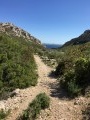
(1) Turn left onto a small stony path to descend into the valley towards the railway bridge overlooking the Calanque du Jonquier. Climb up the other side, pass at the foot of one of the bridge piers (unfortunately heavily tagged!) and continue on level ground, enjoying the view of Marseille and the Frioul Islands.
Further on, ignore a path branching off to the right towards a tunnel in the rock (not shown on the map) and keep to the left, following the blue markings on the ground. After about 200 metres, take the path on the right (marked by a cairn) which takes you round the pretty Calanque du Riflard.
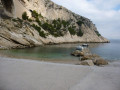
(2) Cross a narrow crevice, then climb up a scree slope, following the path which then veers left to run alongside one of the railway’s engineering structures. Continue towards the Moulon headland, which closes off the calanque on the western side. Pass this headland, keeping it on your left, and come within sight of the Éverine calanque, facing the island of the same name.
After crossing a rocky, overhanging section secured by two webbing straps, pass under the railway bridge and climb up to the junction at the entrance to the Éverine valley.
No signposting
(3) Leave the blue markings and turn right onto the track that enters the valley and winds its way along its contours.
(4) About forty metres before the ruins of a stone building, leave the track and take a narrow path on the right marked by a cairn. After a steep climb, this path leads to a junction where you should turn left to quickly reach the track leading to Fort de Niolon Haut.
(5) Cross this track and continue straight ahead. When you reach a large junction, head straight on along the wide path until it bends right, descending towards a small olive grove. Leave the path here and take a much narrower track opposite.
(6) Keep to the left at the junction marked by a stone on the ground bearing a very old green arrow. After crossing a small pass, the path begins a fairly technical descent (watch out for the numerous stones that give way underfoot) before emerging onto the D48.
Cross with care, then turn right to follow the road until you reach the small car park on the left at the entrance to the La Vesse service road. Walk past the skips, turn left immediately to go through a white metal barrier and cross a large dirt area. At the far end, find a path and follow it uphill, heading towards a pair of wooden electricity poles.
(7) Take the path on the right which, after a short climb, runs almost level before rising again to reach a junction (cairn). Turn left, keep to the right at the next junction (not shown on the map) and begin the climb leading to the tarmac road heading towards Fort de Figuerolles. Turn left and walk for about twenty metres.
(8) Cross the road to take the path that starts on the right and climbs steeply. A few metres further on, turn right, following green markings on the ground which you won’t see again. Keep to the right at the next fork, then carry on straight ahead, crossing tiny patches of cultivated land and skirting an aviary before reaching a wide track.
(9) Turn right. Walk for about 50 metres, then head down to the left to the lovely rural spot at the Puits de l’Œuvre, ideal for a break. Then return to the track and continue to the left until you reach the Fork in the road (elevation 195) situated beyond a large rock, at the base of which is a yellow sign bearing the inscription ‘La Basse de l’Œuvre’.
Head straight ahead and slightly to the right to reach another junction offering a stunning view of Marseille. Turn right to rejoin the tarmac road, follow it whilst veering to the right, then take the first path on the left (fluorescent pink markings on the ground). You will then enter the Fontêtes valley through a beautiful pine forest.
(10) Continue to the left. After a left-hand bend and a short climb, keep to the left to follow a narrower path which avoids a steep and slippery descent. Carry on to a three-way junction.
(11) Take the narrowest path (the right-hand branch). Continue on almost level ground until you reach a large crossroads at the foot of the large rock bearing the cross overlooking the Port de La Vesse.
(12) Turn right, then quickly veer left to begin a steep descent where you may need to hold on to the pine trees at the edge of the path to keep your balance. Reach the dirt car park at the foot of the railway viaduct and turn left towards the harbour.
Go past the first barrier, then take the path on the right to go round the second one. You’ll arrive at a car park after passing several dilapidated buildings covered in graffiti, which unfortunately take away all the charm of the place.
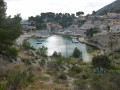
Cross the car park and continue along a path that soon gives way to a concrete staircase winding its way through the aloe plants. Then begin the descent down a concrete lane. When you reach a green postbox, don’t forget to take a short detour of a few metres to the left to reach a magnificent viewpoint over Niolon harbour and the calanque.
Continue down the slope, veer left to reach the harbour. Walk along the harbour to the concrete jetty, then retrace your steps. Take the steps below the restaurant La Pergola, turn left at the corner of its terrace to join the Chemin de la Pergola.
Turn right, then left onto the Chemin du Port, before turning right to pass under the railway line. Continue along the road to reach the car park (start/end).


 Visorando Member

 Easy
Easy 
 Difficult