Circular route from La Ville-aux-Nonains to Senonches

Don't be fooled by the name of this route: the "town" in question is just a small village attached to Senonches. The nuns and monks left it long ago! This circular route, starting from Ville-aux-Nonains, follows quiet paths and roads and leads to Senonches, a "Petite Cité de Caractère" (Small Town of Character) that is well worth a detailed visit. On the way back, it follows the edge of the national forest. This route also serves as a reminder, through its place names, of the activities that once took place in this other part of the Senonches area, better known for its forest, and evokes activities that have now disappeared: marl pits, tile works, lime kilns, forges and mechanical workshops, which played a major role in the economic development of the commune. These have now been replaced by intensive farming in vast fields reorganised after the consolidation of the old bocage. The hedges have disappeared, with only a few small woods remaining as refuges for game.

Details

89287311
Creation:
Last update:
Last review:
  • Walking
    Activity: Walking
  • ↔
    Distance: 15.48 km
  • ◔
    Average duration: 4h 30 
  • ▲
    Difficulty: Moderate

  • ⚐
    Back to start: Yes
  • ↗
    Ascent: + 26 m
  • ↘
    Descent: - 26 m

  • ▲
    Highest point: 233 m
  • ▼
    Lowest point: 197 m

Photos

Description of the walk

Parking is available near the church.

No signposts

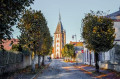
(S/E) With your back to the church, follow Rue du Pressoir opposite. Walk past the old workshops of "Étains du Manoir". After the last buildings, the road becomes a path. You will reach a fork.

(1) Keep to the right and continue straight ahead until you reach the D140.

(2) Cross carefully and continue straight ahead on the tarmac path. Walk alongside the Bois du Rouvray. Shortly before the end of the woods, turn left onto the path that crosses it. Ignore a path on the left and continue straight ahead. At the end of the woods, follow the path opposite towards the Boulangeries farm.

(3) At the crossroads, continue straight ahead until you reach the small road near Les Thesseries. Turn right onto this road, cross the hamlet, noting a pond on your right, and continue to the entrance to Le Buisson. Turn right onto the road and continue for about 300 metres.

(4) Turn left onto the first path:views of the Saint-Cyr valley. This path passes behind the houses and rejoins the road at the entrance to Senonches. Follow the road to the right.

(5) Cross Rue Jean Grandon carefully at the pedestrian crossing on the left, then follow Rue des Laitiers opposite. It runs alongside the former Étang de l'Isle, now dry:a remarkable protected site, currently being developed. Arrive at Rue de Launay.

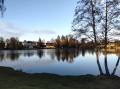
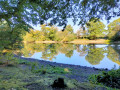
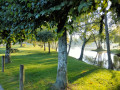
(6) Cross carefully at the pedestrian crossing, turn left and then immediately right onto Rue de Pontgouin. Go up to the bend, then turn right onto the path that crosses the Ruisseau de Saint-Cyr via a footbridge. When you reach the edge of the Étang Rémy, follow the bank to the right. Cross the sluice gate and arrive at the wash house on Avenue des Evés.

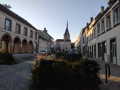
(7) Turn right and continue to the small roundabout. Cross the street carefully and turn left onto Rue du Château. You will arrive at the entrance to the château:a visit is recommended. Take the alley on the right or cross under the market halls to reach Place des Halles. Turn left and you will arrive in front of Notre-Dame Church. Turn left down Avenue Poucin. Take a detour to the right to walk through the Petit Bossard square:children's playground - picnic tables. Leave via the central path which leads to Rond de Battenberg.

Yellow and red markings for the GRP® "Vallées de la Blaise et de l'Avre"

(8) Continue along the water's edge. Go around the Butte des Sarrasins on the left, pass in front of the statue of the fisherman and follow the fitness trail, which leads to Allée de la Tourbière. Follow it to the left, along the edge of a second pond. Pass in front of the international motorhome reception area and arrive at the fence of the horse paddock.

No signposts

(9) Continue along the fence, passing behind the tennis courts and then the gymnasium. Join Avenue de Badouleau near the transformer. Follow it to the left until you reach the entrance to the Huttopia Holiday Village, then continue straight ahead: access is permitted during the season to the bar-restaurant on the banks of the Étang de Badouleau.

(10) Then return to the entrance. When leaving the holiday village, turn left and follow the fence. Pass the stadium and rejoin the GRP®.

Yellow and red GRP® markings

(11) Continue straight ahead, enter the forest and continue to a large forest crossroads. Cross the stream on the metal footbridge, called Le Pont Noir, and continue along the large path opposite. After 200 metres, turn left, following the fence of the holiday village. Cross a stream on a small footbridge and continue up to the pumping station. Walk along the fence, cross the forest lane andtake the path along the edge of the forest opposite, which is also a bridle path. It crosses the Tuilerie line at its end:view on the left of the buildings on the site of the former tile factory. Thenwalk between a wood on the left and the forest and continue to a confluence of streams.

No markings

(12) Shortly before this, take a path on the left, which crosses the embankment and leaves the forest. Follow the wide path to the D155, which passes close to the houses of La Maladrerie. Head left and follow the road for about 100 metres to the next right-angle bend. Then turn right onto the path across the plain. Continue straight on to La Marnière.

(13) Follow the D140.12 to the left for about 200 metres, then take the small road on the right. Pass in front of "Les marchés" (la Gratte on the IGN map) and continue to the D24 at the entrance to Ville-aux-Nonains.

(14) Cross very carefully and follow Rue de la Mare des Marchés opposite. At the end of the pond, follow a path on the left. Go through the gate on the right, arrive in front of the church's caquetoir, and continue to the car park (S/E).

Waypoints

  1. S/E : km 0 - alt. 223 m - Church of La Ville-aux-Nonains
  2. 1 : km 0.4 - alt. 217 m - Fork, on the right
  3. 2 : km 2.15 - alt. 200 m - D140
  4. 3 : km 3.94 - alt. 211 m - Crossroads
  5. 4 : km 6.43 - alt. 214 m - Path on the left
  6. 5 : km 7.84 - alt. 210 m - Rue Jean Grandon
  7. 6 : km 8.3 - alt. 213 m - Rue de Launay
  8. 7 : km 8.75 - alt. 210 m - Lavoir des Evés
  9. 8 : km 9.55 - alt. 211 m - Rond de Battenberg
  10. 9 : km 9.89 - alt. 215 m - Fence around the meadow
  11. 10 : km 10.46 - alt. 218 m - Badouleau pond, bar-restaurant
  12. 11 : km 10.83 - alt. 222 m - Corner of the stadium, return to GRP®
  13. 12 : km 12.42 - alt. 229 m - Confluence of streams
  14. 13 : km 14.45 - alt. 226 m - La Marnière
  15. 14 : km 15.24 - alt. 224 m - Crossing the D24
  16. S/E : km 15.48 - alt. 223 m - Church of La-Ville-aux-Nonains

Notes

Wear good waterproof shoes.

Suggestion: set off late in the morning, have lunch in Senonches, visit the town and castle, then return to Ville-aux-Nonains at the end of the day.

(4) Follow the road straight ahead for 900 metres to reach the Boussard site.

Worth a visit

Along the way:

La Ville-aux-Nonains:

This former small commune of barely 200 inhabitants has been associated with Senonches since 1972. The village was built from the 13th century onwards around a former convent of nuns belonging to the nearby abbey of Belhomert. Abandoned during the Revolution, all that remains of this religious establishment is its memory, perpetuated by the names given to the village and two of its streets.

Former Rémy factory, then Etains du Manoir:

Rue du Pressoir recalls the ancient wine-growing activities of the abbey's heyday.

But it was here, in the agricultural machinery workshop founded in 1912 by Albert Rémy, that the famous "soleils" hay rakes were manufactured, which were used throughout France in the 1960s for hay swathing. After this small company moved to Senonches, it was taken over by the American firm John Deere, which bought the factory and expanded it to employ more than 400 people. The reputation of this hay rake has endured, and it can still be found in working order on small farms.

The former Rémy factory - Les Étains du Manoir:

An artistic pewter foundry then moved into these premises, producing magnificent decorative objects for the table: jugs, vases, wine tasters... They are still appreciated by enthusiasts in France and abroad.

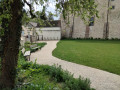
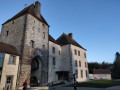
The parish church of Saint-Pierre: Nearby was the small convent founded in the 13th century by the nuns of the Belhomert priory. Although it became a parish church, it continued to depend on Bellhomert Abbey until the Revolution. The building, which was already restored at the end of the 19th century, is once again in need of major repairs. The work is planned but is still awaiting full funding. An appeal for donations has been launched.

For more details, see the detailed study of the municipality's buildings:
https://patrimoine.centre-valdeloire.fr/gertrude-diffusion/dossier/IA28001109

Les Thesseries
According to local historian Paul Alexandre, the name probably comes from "tessier" - weaver.

The Saint-Cyr valley
The path behind the hamlet of Le Buisson offers views of the valley:
You can see the cemetery with the Chapel of Saint-Cyr, the patron saint of Senonches, in the middle. It was once a place of annual pilgrimage on 16 June. Around this date, a very popular fair has been held since the early 16th century and continues to this day.

The Saint-Cyr stream and its leat powered several proto-industrial sites: mills, forge furnaces and lime kilns.

The Boussard mill site has recently been redeveloped and transformed by the "La forge des Arts" association into a magnificent venue for cultural activities. (900 m from the route via the D 320.2 - take the D 320 on the right then the path on the left. - Visits possible for groups by appointment)
https://www.laforgedesarts.org/pages/contact.html

Senonches: Castle museum on the theme of the forest and its exploitation. Sensory discovery trail at the edge of the woods - Hotel - Restaurants - Lodges - Shops.

http://www.lesforetsduperche.fr/culture-et-tourisme/office-de-tourisme/

Le Square du Petit Bossard: Formerly marshland overgrown with scrub, it was transformed into a public garden by the municipality in the 1970s during the time of Senator-Mayor Jean Grandon.
A plan to build a spa using water from its many springs was drawn up but had to be abandoned with the approach of the Second World War.

Lake Arthur Rémy:
Dug on the site of the former Launay pond and marshes in the 1960s by Albert Rémy, Arthur's son, who had taken over his father's factory and was then mayor of Senonches.

La Hutte Equestrian Centre. Located on the former farm, it uses part of the surrounding land to graze horses. The rest of the farm was used to build a large sports and leisure complex.
https://www.parc-naturel-perche.fr/voir-faire/nature-et-loisirs/centre-equestre-de-senonches-768635 holiday village.

The Huttopia Holiday Village: Set around the Badouleau Pond, it welcomes many tourists from mainly northern countries from April to October. Accommodation is in wooden and canvas cabins in a preserved environment, close to the forest and nature.

La Tuilerie: from the edge of the forest, you can see the buildings of a former tile factory on the other side of the Pontgouin road, which operated from the second half of the 18th century until after the end of the First World War. The clay was extracted from "earth holes" located on the north side of the D 24. The wood needed to fuel the kilns was brought from the forest via the path that we cut through and that can still be seen leading up to the buildings, but which has disappeared into the fields. On the right, it crosses the entire lower forest from the edge to the Rond du Grand Veneur in the south.

La Marnière: the name has an obvious explanation. It is a place where large quantities of marl were extracted. There were many marl pits north of Senonches and many lime kilns producing high-quality hydraulic lime until the 1950s.

La Gratte: this strange name may come from the existence of land that was difficult to cultivate or thorny, or from the fact that it referred to a barrier (a grate).
(according to Paul Alexandre, "Balades en toponymie senonchoise" [Walks through Senonches place names]).

Nearby:

La Saint-Fraise , 3 km away .
Horse riding: Les écuries du Grand Chemin.
https://www.parc-naturel-perche.fr/voir-faire/nature-et-loisirs/les-ecuries-du-grand-chemin-769287 (Nolimit Adventure).

Nolimit Aventure tree climbinghttps://nolimit-aventure.com/digny/

Fontaine-Simon , 9 km away : Perche Water Park - campsite - swimming pool - water skiing - hotel-restaurant - shops.
https://www.terresdeperche.fr/pages/parc-aquatique-du-perche (Perche Nature Centre).

Manou, 11 kmaway : the Froux peat bog, a site developed by the Conservatoire des Espaces Naturels (Conservatory of Natural Areas) for the discovery of rare and protected plant and animal species.

La Loupe , 12 km away , SNCF railway station.
The cellars of history https://www.lechateaulaloupe.fr/
Commemoration of the 1944 bombings.

La Ferté-Vidame, 16 km away . Espace Saint-Simon - Park and ruins of the Marquis de Laborde's castle.https://www.maisonsaintsimon.com/
Chapelle de Réveillon - frescoes -

Other walks in the area

For more walks, use our search engine .

The GPS track and description are the property of this route's author. Please do not copy them without permission.