Along the way
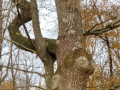
Approximately 400 m away, off the route: The big oak tree of Maucé
Shortly after setting off, after turning right into Rue du Gros Chêne, continue straight ahead, passing under the railway bridge and following the footpath to the big oak tree of Meaucé. This remarkable tree is several hundred years old. It has been the object of devotion and there is a legend about its origin. You can walk around it and information panels provide all the relevant details. You then need to turn back and rejoin the route on the right after passing under the bridge.
Vaupillon. You will also pass a few hundred metres from the church of Vaupillon, which was part of the former parish of Trinité des Bois. To get there from (1), carefully follow the D25 to the right. Then return to point (1). You can also continue to the crossroads near the town hall to see the communal pond and wash house.
In Saint-Éliph
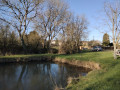
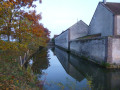
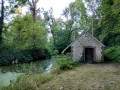
The wash house: located at the entrance to the village, it has a large rectangular basin fed by a spring. Its distinctive feature is its old mechanism, which has been completely restored.
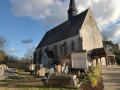
The church, still surrounded by its cemetery, contains a monumental 17th-century painted stone altarpiece. This ensemble is one of the most beautiful in the Perche region. Saint-Éliph, decapitated and holding his head in his hands, is depicted twice, in a niche to the left of the tabernacle and on the tabernacle itself.
The altarpiece is crowned by a sculpture of the Holy Trinity, recalling that the former parish comprising Saint-Éliph, Vaupillon and La Loupe was called "La Trinité des Bois" (The Trinity of the Woods). No one knows why, around the 11th century, it took the name of the martyr Saint-Eliph.
In La Loupe:
Vauban Castle: "The cellars of history". Evocation of the bombing of 17 June 1944, which destroyed the town centre, killing 72 people, as the population could not be warned. Among the victims were the members of the municipal council and the mayor, who had gathered at the Town Hall to bring aid to Senonches. It was thought that this neighbouring town was under threat because of the ammunition depot that the Germans had set up in the forest. In fact, it was the rail and road communication routes very close to the town that were targeted in order to prevent the movement of German troops after the Normandy landings.
Les Caves de l'Histoire - https://www.lechateaulaloupe.fr/ (11)
Notre-Dame des-Fleurs Church: commercial activity developed around a chapel, initially called Notre-Dame des-Fleurs, and the monks of the priory founded another chapel known as the Rosary Chapel, which quickly became a parish church. It drew its income from local markets and, according to rumour, also unduly collected income from the churches of Vaupillon and Saint-Éliph, which explains why, for a time, these three churches were grouped together under the name La Trinité-des-Bois following this usurpation of titles.
It was rebuilt in 1929 following a fire.
Off the route
Meaucé: 400 m away. The legendary "Gros chêne" (big oak tree) also plays a part in the town's history. According to tradition, this venerable tree (said to be over seven hundred years old) was home to a statuette of the Virgin Mary (a mariette en percheron) which was the object of particular devotion and pilgrimages. It is said that the statue was removed during the Revolution and that a large mushroom in the shape of a cross grew in its place! In this revolutionary context, where the aim was to combat obscurantism and superstition, it was decided to cut down the oak tree, but the woodcutters gave up because their axes broke on contact with the wood... It is also said, and this is more credible, that the population protected the tree from the fury of these axe-wielding fanatics. Legend has it that this oak tree was planted in the 14th century by the Knight of Montireau and the daughter of the Lord of Meaucé who, although engaged to be married, separated when the Lord of Montireau had to leave on a crusade. This tree was, in a way, a token of fidelity. We do not know how the story ends, but the oak tree has survived to this day.
Maucé: Saint-Léonard Church, 2 km away. This 13th-century church, with its porch, is generously furnished. Following the annexation of Saint-Jean-de-Pile-of-Stone-gathered-from-fields to the commune of Meaucé and the decommissioning of its church (now a village hall), the furnishings were transferred to Saint-Léonard Church in Meaucé, which now boasts a considerable collection of statues and four altarpieces, including one from the 17th century.
The folding doors of the portal reveal Renaissance ornamentation that has been preserved in the building.
The door of the dead (south side wall), now walled up, gave access to the surrounding cemetery. The door of the "living" (north side wall) was intended for the baptised. (Ask for the key at the town hall).
La Grand'Maison: 3 kmaway : Built in the 13th century, this former fortified house, with its moat and drawbridge, expressed the power of the lords of Meaucé. It had four beautiful towers, one of which has been preserved. The house was remodelled in the 19th century and the drawbridge replaced by a stone bridge.
Beautiful farm surrounded by moats that are still filled with water. Place to stay - Small menagerie visible from the road.
Vaupillon 300 maway : church in the cemetery about 300 m from the route via the D25 from the point (1)
Notre-Dame Church: no bell tower – the result of a dispute... over bell towers in the 19th century; the church in Vaupillon was originally a chapel belonging to the former Vaupillon castle (demolished in 1852). The high altar that was there has been preserved. Two chapels were added at the beginning of the 18th century.
One is dedicated to the Virgin Mary, the other to Saint Hubert, invoked to ward off attacks by wolves. This succession of events is reflected in the distinctive appearance of the building, which is still surrounded by its cemetery.
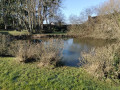
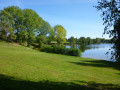
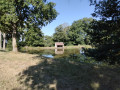
Wash house and pond at the crossroads near the town hall.
Fontaine-Simon: 4 km. Sainte-Anne Church and oratory. The original Romanesque church was remodelled during the 19th century. The building is extended by a semicircular apse. The chapel, which opens widely onto the choir, mitigates the effect of the length of the main nave.
The rich and abundant furnishings include three Baroque altarpieces and a remarkable polychrome wooden counter altar.
Oratory of Sainte-Anne: this oratory, built around 1872 in Alençon granite above the fountain dedicated to Sainte-Anne, is still a place of pilgrimage (in July).
It is believed to have been a place of worship even in pre-Christian times.
A procession from the church of Fontaine-Simon to the Chapel of Saint-Symphorien in La Ferrière takes place every year at the end of August.
Perche Water Park - Swimming pool - Campsite - Cable ski.
Saint-Maurice-Saint-Germain 4 km away
Château des Vaux.
Manou, 5 km away
Tourbière des Froux - découverte route -
Bel'Eure communal lake: fishing, fitness trail - picnic tables.
Senonches, 12 kmaway Castle museum - Holiday village - Fishing at Arthur Rémy pond



 Country:

 City:
City:


 Visorando Member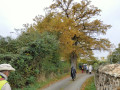
 Easy
Easy