In the footsteps of Saint-Laumer around Belhomert-Guéhouville

In the 6th century, Saint Laumer, or Lhomer, was a shepherd before becoming a canon and then bursar of Chartres Cathedral; he retired to the forests of the Perche where he founded two hermitages: he first settled in 558 in these places, later named Beatus Launomarus, then, 12 years later, moved to the banks of the Corbionne near Moutiers-au-Perche.
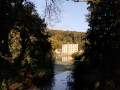
This circular walk takes you around the Belhomert area in the footsteps of the holy man. Passing first by the entrance to the abbey that succeeded the original priory, the route follows the banks of the Eure. It reaches the edge of the Forest of Senonches, where trees were until recently the subject of strange rituals.
After overlooking the valley at the edge of the forest, the route passes by the charming Étang de Fontaine-Aubert, a place name which, like Fontaine-Simon or Les Ressuintes, reminds us that many pagan places of worship were established near springs before being Christianised by devout hermits.

Details

93324944
Creation:
Last update:
Last review:
  • Walking
    Activity: Walking
  • ↔
    Distance: 8.08 km
  • ◔
    Average duration: 3h 25 
  • ▲
    Difficulty: Moderate

  • ⚐
    Back to start: Yes
  • ↗
    Ascent: + 390 m
  • ↘
    Descent: - 424 m

  • ▲
    Highest point: 311 m
  • ▼
    Lowest point: 190 m

Photos

Description of the walk

Belhomert via the D941. Parking is available in the car park near the motorhome stopover on Rue de l'Abbaye, not far from the church.

No signposting

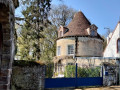
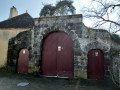
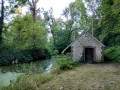
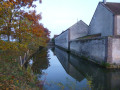
(S/E) Walk past the war memorial as you leave the car park. Turn right onto Rue du Général de Gaulle, following the path alongside the cemetery and then the sports ground. Turn right into Rue de l'Abbaye. Walk past the monumental gate and the dovecote dating from 1657. After the town hall, turn left past the village hall and the boules courts to head down to the riverbank. Follow the river to the right as far as the wash house.

(1) Head back up to the right, following the fence, and return to Rue du Général de Gaulle. (There’s a lovely mural on the transformer). Follow the street for a few dozen metres to the left and immediately turn left into Rue Jean Moulin. Continue to the start of the Chemin de Promenade.

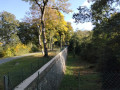
(2) Turn left onto Chemin de Promenade, which leads back to the banks of the Eure. Follow it to the right until it ends. The path climbs steeply for a few metres, then the gradient eases. The path leads back to Rue Jean Moulin; follow it to the left until you reach the wayside shrine. Continue left along Rue Hélène Boucher until you reach the junction with Rue Marceau D2.

(3) Cross it carefully at the pedestrian crossing on the right and turn left to take the path that climbs gently across the fields towards the forest. Enter the forest, cross a ditch and continue for about a hundred metres until you reach the bridle path.

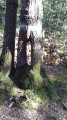
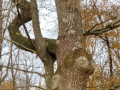
(4) Follow the bridle path to the left, then the wide avenue that continues from it. You will reach the corner of a path between plots 233 and 234. (Ritual oak – a remarkable tree). You will join the GRP® Vallée de l’Eure.

Yellow and Red + Yellow markings

(5) Turn right and continue straight on until you reach the D941. Cross it carefully and continue opposite along a path that joins the Route forestière de la Mare Ronde. Temporarily leave the GRP® markings.

No markings

Take the track on the right to reach the picnic area.

(6) Turn left, near the road, onto the bridle path at the edge of the forest. It passes close to a magnificent cluster of four oak trees before rejoining the GRP® Vallée de l’Eure.

Yellow and Red + Yellow markings

(7) Continue straight ahead on the winding bridle path. Cut across the Ligne de la Rachée near its end. After a right-left bend, climb quite steeply up to a junction at the edge of the forest.

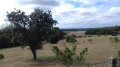
(8) Take the path furthest to the right, which soon leaves the woods and joins Rue de la Forêt. Lovely view over the Eure Valley. Reach a small transformer at the corner of a path leading down to the pond visible on the right. Leave the GRP®.

Yellow markings

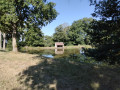
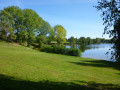
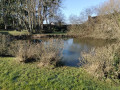
(9) Head down the path on the right to the Étang de Fontaine-Aubert, a hamlet in the commune of Belhomert (wash house – picnic table). You can walk around it.

(10) Follow the access road. Cross the D928 very carefully at the wayside shrine and continue straight ahead on the D140.14 along the wider right-hand verge.

(11) At the end of the hedge on the left, cross the D140.14 with care and follow a path to the left which climbs a few metres to join the old tramway line that once linked Saint-Sauveur-Marville to La Loupe. Descend gently to the right along this wide path to a T-junction.

(12) Turn right. When you reach the entrance to Belhomert, follow Rue Charles Péguy (D140.14) to the left, using the designated pedestrian crossing. Caution: heavy lorry traffic during the week. At the junction with Rue du Général de Gaulle, cross to the left using the pedestrian crossings. Walk past the war memorial to reach the car park (S/E).

Waypoints

  1. S/E : km 0 - alt. 242 m - Car park on Rue de l'Abbaye - Église Saint-Jean (Belhomert)
  2. 1 : km 0.81 - alt. 235 m - Washing place
  3. 2 : km 1.38 - alt. 210 m - Start: Chemin de la Promenade - Eure (rivière)
  4. 3 : km 2.11 - alt. 207 m - Junction with Rue Marceau – D2.
  5. 4 : km 2.6 - alt. 231 m - Horse riding track
  6. 5 : km 2.96 - alt. 225 m - Ritual oak
  7. 6 : km 3.76 - alt. 267 m - Picnic area at the entrance to the forest
  8. 7 : km 4.44 - alt. 221 m - GRP Eure Valley
  9. 8 : km 5.38 - alt. 268 m - Crossroads at the edge of the forest
  10. 9 : km 5.97 - alt. 248 m - Path to the pond
  11. 10 : km 6.27 - alt. 231 m - Access road to the pond
  12. 11 : km 6.71 - alt. 217 m - Path at the end of the hedge on the left
  13. 12 : km 7.31 - alt. 206 m - T-junction
  14. S/E : km 8.08 - alt. 199 m - Car park on Rue de l'Abbaye - Église Saint-Jean (Belhomert)

Notes

Make sure you wear good waterproof shoes, as the paths can be damp.

During the hunting season, check the hunting calendar for state-owned forests on the Forêts du Perche Tourist Office website. http://www.lesforetsduperche.fr/culture-et-tourisme/office-de-tourisme/

No hunting on Sundays in the state-owned forest.
In the lowlands, follow the instructions given by the hunters.

N.B. The footpath along the River Eure climbs quite steeply. You can continue along Rue Jean Moulin from the point (2) to avoid this slightly tricky section.

Worth a visit

The former abbey

The hermitage founded by Saint Laumer was converted into a priory, which came under the authority of Fontevrault Abbey at the end of the 11th century. It became home to a convent of nuns following the Rule of Saint Benedict. Mathilde, daughter of HughI, Lord of Châteauneuf-en-Thymerais, was the first prioress of Belhomert. Among the nuns, who came from noble families, were relatives of the Counts of Perche.
Its activities ceased during the Revolution. The land and buildings were sold as national property.
In 1948, the buildings were converted to house a holiday camp run by the Association of Former Prisoners of War of Seine-et-Oise. They are now privately owned.

Saint-Jean Church

Built in 1132, not far from the river, the church is surrounded by the buildings of the former hermitage. The bell tower and façade feature buttresses made of stone and brick. The bell tower houses three bells dating from 1783 and 1878. The interior is a single nave with a panelled vault; the walls are adorned with old varnished wood panelling (according to the text on the local information panel).

(4) the ritual oak. A testament to the persistence of the region’s oldest beliefs, this tree—now classified as a ‘Remarkable Tree’—was, not so long ago, the site of a Christian religious ceremony during which a newborn deemed frail was passed through an opening cut into the trunk of a young oak. It was hoped that the tree’s vigour would be passed on to the child. If the oak survived its injury, the child was saved.

Other walks in the area

For more walks, use our search engine .

The GPS track and description are the property of this route's author. Please do not copy them without permission.