Country:

 City:
City:


Easy parking near the church.
(S/E) Walk down about fifty metres northwards to the three-way junction marked by two large trees. Turn sharp right (east) onto the Chemin des Vignes de Doye (tarmac). Pass a signposted path on your right and continue to the next fork, where there is a picnic table.
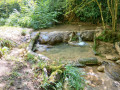
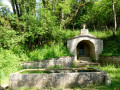
(1) Turn right (north-east) onto the unpaved track (yellow markings) which climbs through the meadows and then the vineyards. There is a lovely view to the left over the Bresse plain, the foothills of the Jura and the village of Beaufort. Walk past a secluded vineyard hut near a fountain and continue along the same path, which winds through vineyards, pastures and woodland until you reach a junction marked by the signpost for ‘La Carroz’.
(2) Head down to the left (north-north-east) along the stony path (still marked in yellow), which winds twice before reaching a tarmac road; follow this down to the left (west-south-west) for a few metres.
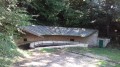
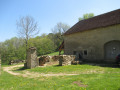
Turn right (north) onto a small path that descends through the woodland (still marked in yellow). It widens and winds more or less along the hillside to a clearing shaded by tall trees, equipped with picnic tables and enclosed to the north by a fence and a few sections of stone wall (remnants of Beaufort Castle, private property).
(3) Cross the clearing, leaving the picnic tables on your left, and head diagonally uphill (north-north-east) to the signpost marked ‘Les Tilleuls de Beaufort’. Then follow the ‘Belvédère’ arrow to the right (south) up the wide stony path, which soon turns left (east).
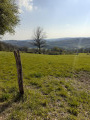
Shortly after the bend, leave the yellow markings: a few rocky steps to the right of the path and a grassy track between trimmed bushes lead you uphill towards the east-southeast to the viewpoint, which is situated at the edge of the tarmac road (bench), just below the clearly visible statue of the Virgin Mary. A beautiful panoramic view over the Bresse plain, the Revermont and the village of Beaufort. You can even make out, far to the south-west, the bell tower of Maynal.
(4) Turn your back on the view and turn left (north, then east) onto the tarmac road until you reach the sign for “Site de la Madone”. Then turn left (north-east) onto a path that leads down to a large, gravel-surfaced picnic area. Walk straight across this, passing a concrete table on your left, then a pigeon shooting range (small slabs on the ground and an underground concrete shelter).
(5) Just to the right of the clay pigeon shooting range, take a grassy path that descends towards the north-east, then veers northwards to the crossroads marked by the signpost ‘La Croisée’. Turn right onto the yellow-marked path which climbs through the woodland towards the east-southeast, then towards the north-northeast, to the “Côte Molard” junction (signpost), where you reach the pastures.
Head straight up (north), towards Crève-Coeur, along the stony path which joins the road near a water reservoir. Leave this to your left and continue uphill along the tarmac road to the village green in the hamlet of Crève-Coeur, which features two fountains, one on the left (west) and the other on the right (east).
(6) At the signpost just before the fountain on the left, turn left (north) towards Sainte-Agnès, taking the stony path which descends to a vineyard, which it follows on the left. At the Fork in the road at the bottom of the vineyard, follow the yellow markings to the right (north-north-east) until you reach the tarmac road.
Take this road to the right until you reach the first crossroads, marked by a walnut tree.
(7) Take the tarmac road to the right (north-east), and at the first Fork in the road, leave the yellow markings and take the right-hand branch (towards “Rotalier”, mountain bike route no. 26). The tarmac road climbs then descends, gradually veering east-southeast, until you reach a farm shed set back slightly to the left of the road, from where you can see the houses of the hamlet of En Fromencé.
(8) A few dozen metres past the shed, take the fairly steep tarmac track on the right, which approaches diagonally from behind. It soon turns left, becomes stony and continues to climb between the vineyards towards the south-west, until it reaches a track marked by a signpost for “Haut de la Chanée”. Here you join theGR®® 59 (red and white markings are quite sparse and sometimes somewhat illogical).
(9) Take theGR®® to the right (south-south-east).
(10) At the signpost marked ‘Curenne’, follow the hairpin bend to the right (west). At the next hairpin bend, follow theGR®® markings, ignoring the forest track coming from the opposite direction (not shown on the map), and continue climbing to the left (east-north-east). At the following junctions, stay on theGR®® – which is the main path – and follow it to the tarmac road, where you turn right (south) and continue for 400 metres to the Chailles hunting lodge (picnic table and canopy that can serve as makeshift shelter for a few people).
(11) Almost directly opposite the hut, on the other side of the road, take the path that heads into the woods towards the south-west. At the next Fork in the road, turn left (west-south-west) and join the tarmac road, turning right (west-south-west). You are now back on theGR®®59.
At the next junction (signpost for “Le Boutot”), turn left (south-south-west) onto the wide, stony path leading uphill (towards Grand Rambey). TheGR®® markings appear to be missing at the junction, but there is an orange arrow on a tree to the left of the path. At the next fork (signpost ‘La Scie’), turn right, still heading towards Grand Rambey.
(12) At the signpost marked “Chênes Clairs”, leave theGR®® and head down the path to the right (west-south-west, towards Grand Rambey). At the crossroads at the bottom of the slope, before reaching the meadows, continue straight on until you reach the tarmac road at the entrance to the hamlet of Grand Rambey.
Follow it to the left (west) for 80 metres, then, near a wrought-iron cross, take the stony path marked in yellow which climbs to the right (north) to the Baccailla crossroads (signpost).
(13) Take the path leading uphill to the left (west-north-west, towards “Stèle de Lanézia”). The path turns to the left (south-west), continues to climb, then descends. At the bottom of the descent, at the unmarked Fork in the road, carry on straight ahead (yellow markings a little further on), ignoring the path leading down to the right. The path begins to descend again, becomes narrower and meets a wider cross-path; take this to the left (south), still going downhill. It begins to climb gently from a sharp bend to the left.
(14) Shortly after this bend and just before the path widens (timber yard) followed by a right-hand bend, turn right onto a barely visible, unmarked track which heads south through the undergrowth, then veers right (south-west) as it climbs. Varying in width, it winds its way up and down whilst broadly maintaining a south-westerly direction, leading to the Lanézia memorial, a monument erected in memory of Resistance fighters who died in action.
After the monument, the path becomes very wide and grassy, and continues to descend in the same south-westerly direction. When it meets another path coming from the right, turn left until you reach the tarmac road.
(15) Follow this road to the right (west) as far as the fountain. Immediately after the fountain, take the road on the right (north-north-east), towards Maynal. Follow this road downhill for 600 metres, until it enters the forest, then takes a sharp right-hand bend.
(16) In this wide bend, a few metres before a metal drain grate on the right-hand verge, turn left onto a barely visible track that heads into the woods towards the west, then winds to the right (east-north-east). It descends the side of a small valley, then turns left (west) and descends the valley floor.
On reaching the pastures, it comes to a cross-path; take this to the right (North-North-West) on a slight incline. This path joins the tarmac road; follow it down to the left (North) to reach the church at Maynal (S/E) after 500 m.



 Visorando Member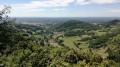

 Easy
Easy 
 Association / Club / Walk leader