Country:

 City:
City:


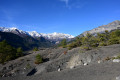
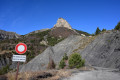
At Guillaumes, take the D2202 towards the Col de la Cayolle. After about 5 km, a small space on the right allows two or three cars to park safely at marker 17.
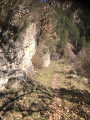
(S/E) Head east along a fairly stony path that climbs steeply in hairpin bends. The yellow markings are old but the route is clearly visible. Thefirst kilometre is quite challenging due to the gradient, which levels off considerably as you approach marker 17b, which is missing from all maps. This first section is wooded.
(1) Continue straight on, leaving the path leading to the Crête de Coni on your right. The path follows a pasture area where there may be sheep with guard dogs. This is the hamlet of Valliera Dou Rei.
(2) As you approach the village, there is a junction with no signposting. You must pass to the left of the hut and follow the path to Châteauneuf-d’Entraunes, which you reach via marker 17a, marked 17 on the map.
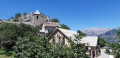
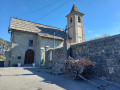
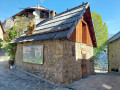
(3) To the left, a car park and the tarmac road lead directly to the Chapel of Saint-Antoine, but the village on its promontory is well worth a detour. As you wander through the narrow streets, you can see the very old dates on the doors of the houses—some are over 350 years old—the old bread oven, the fountain, and, at the very top, the 17th-century Saint-Nicolas Church surrounded by the cemetery. Return to the bread oven and head left to reach the Saint-Antoine Chapel.
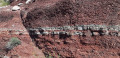
(4) On the left, the direction to Bante is signposted. Follow the unpaved track made of black marl, which can be slippery in wet weather, to marker 188.
(5) Turn left onto the very steep path for 20 metres, which levels out just after the hairpin bend, and continue to Bante. Marker 187 is located near a farm with sheep fencing.
(6) The walk continues further on to the left, but turn right instead to join the tarmac road leading to the hamlet; at the very top, beyond the chapel, there is a drinking trough next to a shelter.
(7) Return along the road to marker 187.
(6) Take the track on the right towards the D2202 as far as the Plan de Bante solar panel farm.
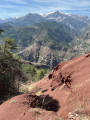
(8) Go round the fence on the right. The path is well marked. From here to the road, this area of black marl resembles a mini canyon; it can be used by downhill cyclists, who generally prefer the winding bottom section, whilst walkers enjoy descending via wide, raised sections to marker 189.
(9) At lunchtime or for a dip at the end of the walk, cross the road and head down to the stony bed of the Var for a refreshing break, then return to marker 189. Follow the road in the same direction as the river for 600 m. This road is very busy in summer; take care as there is a blind bend – keep to the right-hand side and return to the starting point (S/E).

 Visorando Member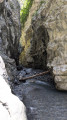

 Difficult
 Very difficult