Country:

 City:
City:


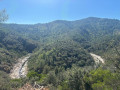
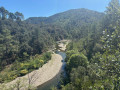
Park in the large car park at Col de Portes via the D906.
(S/E) Head towards the foot of the ruined castle.
(1) Take the path indicated on the left, which goes around the castle to the north. Then follow the wide path, GR®44B marked in white and red, which continues the trail. Continue straight on this path until you reach a junction with the RD453 (Route des Bouzigues).
(2) Turn right, pass in front of the entrance to a farmhouse with two red brick columns and cypress trees, and take the path on the right. Immediately afterwards, keep left and follow the markings. Continue along this wide DFCI path to the Col des Quatre Chemins.
(3) Take the path that descends to the left towards the north, in the direction of Peyremale. Walk for about 900 m until you reach the "Bladier" signpost.
(4) Continue straight ahead, following the direction of Peyremale. You will arrive at an old tarmac road, another signpost "Les Fourches".
(5) Cross it slightly to the left and continue towards Peyremale, taking the path opposite. At the bottom of this path, after passing a house on your right, you will reach a crossroads with the signpost "Carignan".
(6) Take the road that climbs opposite and leads to the hamlet of Le Puech, marked in yellow. You will arrive at a left-hand bend at the entrance to the hamlet. See Practical Information.
(7) Turn right and follow the path that passes under several stone arches and between houses until it runs alongside the stone wall of a garden on the right and begins to descend towards Peyremale. A little over 300 m after these stone houses, cross a small tarmac road to join the path directly opposite and continue. Ignore the two paths you come across and continue until you reach the Route de Clamoux at a hairpin bend.
(8) Follow it to the right for a few metres, then leave it for a path on the right. Immediately turn left onto the yellow-marked path and rejoin Route de Clamoux near the Peyremale roundabout. Head towards it, go around it on the left (pedestrian crossing) and arrive at the D17 at a place called Le Claux.
(9) Follow Route de Mas Herm (D17) towards Génolhac. Cross the bridge over the Luech, head north towards the hamlet of Le Mas Hern and cross it. You will reach a crossroads marked with a sign for "Mas Herm".
(10) Take the small road that climbs to the left (Chemin de la Combe du Chat), towards Le Chambon or La Combe aux Chats: marked GRP® Yellow and Red. At the first bend, the path branches off to the right between two houses, as indicated on a sign, and joins the D17 further up after passing a large stone house, signposted "Château d'eau du Serre".
(11) Carefully follow the D17 on the left for about 500 m, then, after a slight right-hand bend, take the path that branches off to the left with steps, marked in yellow and red. Return to the D17, follow it to the left for a few dozen metres, then, at the bend, take the path that branches off to the left. You will arrive at the signpost marked "Renoir".
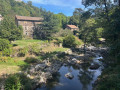
(12) Take the hairpin bend to the right, towards Chambon above the road. This is where you will find some beautiful views overlooking the Luech. Continue westwards, ignoringa path that branches off to the left towards the river, and after a left-hand bend, continue to a hairpin bend.
(13) Leave the path and go straight ahead to take the path opposite. Follow a beautiful little winding climb that leads to a wider path. At the top, turn left, following the yellow and red markings. You will reach another crossroads, where you will see the "Mas du Pellet" sign after a hairpin bend to the left.
(14) Leave the path heading west towards Saut des Chiens and head towards Chareneuve and Chambon in the south-east. Descend towards the river , enjoying beautiful views, and after the right-hand bend, cross the hamlet of Chareneuve, following the road and the yellow and red markings. About 300 m after the hamlet, a path branches off to the right.
(15) Leave the road and take this path, continuing along the Luech to Chambon. Ignore the metal footbridge on the left and continue to the village hall after the village square, signposted "Pont sur le Luech".
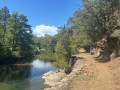
(16) Just before reaching the bridge, turn right towards Dieusses, taking the path that runs alongside the Luech. At the end, continue along the path that runs alongside the river. Follow it until you reach the road at Martinet Neuf. Do not take the bridge on the left; instead, follow the road until you reach the signpost marked "Le Martinet Neuf". See Practical Information.
(17) Follow the yellow markings and take the path that climbs to the right between the houses until you reach the trail almost in front of a house gate. Then just follow this trail, which climbs steeply to the hamlet of Dieusses. Turn left, cross the hamlet and follow the road to the left for about 50 metres.
(18) At the Dieusses signpost, take the path that descends to the left, then turns right towards Viaduc de Luech and Chamborigaud. After a left-hand bend and then a right-hand bend, it reaches a fork in the road.
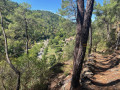
(19) Take the path that descends to the left. Be careful, the descent is not easy: rolling stones, pine needles (depending on the season), fatigue from the climb, stability is precarious. Stay alert.
At Le Rigal, ignore the path that branches off to the right and continue to follow the yellow markings to reach the tarmac road after passing a large house.
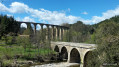
(20) At the "Le Rigal" signpost, turn left and descend towards the viaduct and Chamborigaud. After a large bend, you will have beautiful views of the viaduct. Join another road, signposted "Chemin de Rigal".
(21) Follow it to the right towards the viaduct, which is approaching. Follow the road, which is very quiet, and pass under the viaduct. The markings are still yellow and the Luech is still close by on the left. Continue straight ahead and reach the "Landiol" signpost.
(22) Turn left towards Chamborigaud, return to the banks of the Luech and arrive at a stop sign on the D906.
(23) Cross the bridge on the left (IGN map is incorrect at this point) and continue under the plane trees to reach a crossroads before a left-hand bend in the road.
(24) Take thefirst road on the left (D452), which follows the GR®700, marked in white and red, known as the Chemin de la Regordane, a thousand-year-old trade and exchange route. The trail is well marked until Col de Portes. Pass the post office. Then, as you continue along this quiet little road, the houses will become increasingly scarce. You will eventually come out onto Route de Crouzas.
(25) Ignore the access to the D906 on the left and continue straight on along the Chemin de la Clap à l'Arbous. Pass under the railway line and continue until the road gives way to a path at a place called l'Arbous.
(26) Continue on the GR® which, after a long left-hand bend, joins the Route d'Alès (D906).
(27) Turn right and carefullyfollow the road for about 100 metres, then take the path on the right which heads south and leads to a tarmac road. Continue straight ahead until you reach the Tavernoles crossroads.
(28) Cross the road using the pedestrian crossing on the left, walk a few metres to the right and take the Voie Régordane, which climbs to the left, marked in white and red. Continue along the path that joins the road you crossed earlier.
(29) Carefully cross the D906 and take the uphill path (dead end) a few metres further on, which veers to the right and rejoins the D906 at the end.
(30) Cross (pedestrian crossing) and take the tarmac road opposite, which quickly becomes a footpath. Follow the white and red markings, which are very dense and easy to follow, as there will be a few paths crossing the GR® on which you are walking. You will arrive at Chemin de Salze, a tarmac road that passes above the water treatment plant and leads to the D906.
(31) Finish this hike with the least pleasant part by continuing straight ahead along the road to the Col de Portes and its car park (S/E).
 Visorando Member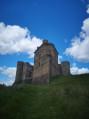
 Easy
Easy 
 Moderate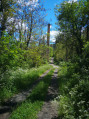
 Very difficult