Country:
 City:
City:


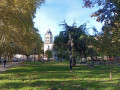
(S/E) From the "Quinconces" tram stop, head towards Place des Quinconces, the largest square in Europe.
There you will find the Monument des Girondins, Bordeaux's famous horse fountain. From the fountain, head towards the river, passing between the two rostral columns. At the bottom of the stairs, turn left. Continue towards the Bourse Maritime.
(1) At the crossroads with Rue Ferrere, turn left and walk a few metres. You will see the former colonial goods warehouses, now home to the CAPC, a modern art museum and conference centre.
Continue along the quays. You will pass the corner of Rue Ferrere in front of the Maritime Exchange and then the Hôtel Fenwick, with its distinctive two small towers on the roof. In the 18th century, this bourgeois house was the first United States consulate in France.
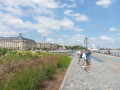
Cross the tramway towards the pedestrian path that runs along the river. You will stroll through renovated spaces and refurbished warehouses. At La Voile Blanche (after hangar 14), the first establishment on the Quai des Marques, look towards the right bank. You will see two bridge piers with no other construction. These are the supports for the metal framework of Bordeaux's unfinished transporter bridge. Continue to the Bacalan-Bastide bridge.
(2) Cross the river using the pedestrian path on the bridge. From here, you will have a beautiful view of the Bordeaux quays. On the other bank, take the cycle path immediately to the right as you exit the bridge. The rural area offers a privileged view of the bridge and its architecture.
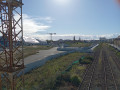
Continue along this cycle path. You will enter an industrial area. On your left, you will see two large masonry blocks. These are the anchor points for the Transporter Bridge mentioned above.
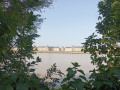
(3) As you leave the industrial area, you will find a series of paths and green spaces offering remarkable views of the river and the left bank. You can admire the view of the Place des Quinconces and, a little further on, the Place de la Bourse, the jewel of Old Bordeaux.
(4) The walk takes you past the old Gare d'Orléans railway station, which used to connect Bordeaux to the north of France. Today, this space has been converted into a cinema. Continue on to the Pont de Pierre bridge.
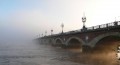
(5) To return to the left bank, cross the Pont de Pierre. Until 1967, this bridge was the only crossing point over the Garonne. From the bridge, you can admire the Porte de Bourgogne and the arc of the circle that surrounds it.
On the left-hand side is Rue de la Tour du Pin. Although its name refers to an old tower that no longer exists, this narrow street gives an insight into how the quayside façade was built to replace the old ramparts.
In line with the Pont de Pierre, the Porte de Bourgogne is located at the corner of Bordeaux's 12th-century ramparts. The old moats of Bordeaux were located along the route of the Cours Victor Hugo.
 From the Porte de Bourgogne, head towards the Place des Quinconces. You will soon come across the Porte Cailhau on your right, a remnant of the 14th-century fortifications. This gate is open to visitors; ask at the Tourist Office for more information.
Continue on your way. You will come to the most remarkable architectural ensemble on the quays of Bordeaux: the Place de la Bourse.
(7) It represents the best of 18th-century architecture. Opposite this façade, on the right, is the Hôtel des Douanes (its museum is open to visitors). In the centre of the square, in place of a former equestrian statue of Louis XIV, now stands the Fontaine des Trois Grâces.
Continue along the quays until you reach your starting point, Place des Quinconces (S/E).


 Visorando Member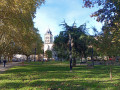

 Moderate