Country:
 City:
City:



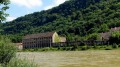
Parking: Chemin de Mazagran, after the small bridge before the nightclub, along the wooden fence. The nightclub car park is usually available, but is closed at this time.
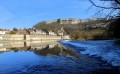
(S/E) Head towards the nightclub via Chemin de Mazagran, which runs alongside the Doubs. View of the citadel ramparts, the prefecture and the Parc de la Gare d'Eau.
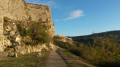
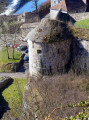
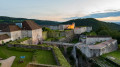
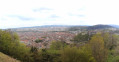
(1) Take the iron staircase on your left and climb the hill to Fort de Chaudanne, following the yellow markings. This is a pretty winding path clinging to the hillside. Ignore any perpendicular paths you may come across. The path runs alongside a tarmac road, which you should ignore. Continue climbing along the path on your left. At the fork, at the next bend and at the signpost, take the path on the right, heading towards Fort de Chaudanne. You will arrive at the fortifications and turn left for the first viewpoint over the citadel and the rooftops of old Besançon nestled in the hills surrounding the circular.
(2) Leave the viewpoint behind you and climb the stairs to reach the second viewpoint overlooking the citadel and the Buis mountains. Head towards the gate, where a signpost invites you to continue along the walls on the left towards the Velotte viewpoint. Leave the rampart moat via a log staircase and continue on the right. You cross limestone lawns, typical of the Monts Bisontins. A third viewpoint overlooks La Circulaire and the more modern Besançon.
(3) You will reach the Chemin du Fort de Chaudanne at a stop sign and turn right towards Velotte via the Chemin des 2 Lys. Leave this street at a new signpost in a bend for a dead-end road, still in the same direction as the Chemin des 2 Lys. Soon you will come to another fork. This time, leave the Chemin des 2 Lys for the uphill road on the right towards Petit Chaudanne. It ends in a cul-de-sac with a beautiful view of the Doubs valley.
(4) Just before the last house, turn right onto the grassy path, which quickly becomes a stony trail. Be careful, as the local council has been stingy with signposts. In an open area, the path seems to fork, so take the right-hand fork. The other path ends in the undergrowth. When the stone path gives way to earth, ignore the first path that comes in perpendicularly from the left, then a little further on at a fork, take the left-hand fork (marked with yellow paint). A half-faded yellow cross indicates that you should not go right. The path ends when it joins another path at right angles. Continue a few metres to the left to find the yellow markings on a stone and a staircase leading down to Rue du Petit Chaudanne, which you take to the left towards Rosemont. Note the Grette drinking water reservoir dating from 1881 on the left as you descend.
(5) You will reach the busy Rue de Velotte. Cross it carefully and turn left onto Chemin des Vignes de Rognon, which you will follow until it ends in a cul-de-sac. At the first intersection with Rue des Oeillets, turn right, and at the second intersection with Chemin du Fort de Rosemont, turn right again. At the barrier, turn left onto a path that climbs the hillside (yellow markings). The path soon forks. Keep following the uphill path, which is more clearly marked.
(6) When you reach a wider gravel path at a signpost, continue climbing to the right towards Fort de Rosemont. A little further on, ignore the steps on the right leading down to La Malcombe.
(7) You will soon arrive at the viewpoint overlooking the new town of Planoise. Leave the gravel path and, to the left of the bench, a new signpost will indicate a small path that winds its way through the box trees. There are beautiful views of the valley. You will soon come to a wider stone path at a hairpin bend. Follow it up to the left towards the fort.
(8) There is a signpost at the corner of a fork in the path: take the right-hand path towards Point de vue — Retour par Fort de Rosemont. This will lead you to a magnificent 180° viewpoint over the valley and the new town. You will reach the fort via steps. Walk along a wire fence on your right to go around it, and a path will take you back to the previous signpost. Go back down to the hairpin bend and continue for about 100 metres, ignoring the path through the box trees that you took on the way up. A signpost invites you to descend the stairs on the right to Velotte via the charming little Combe de l'Oeillet. I was lucky enough to meet what is probably the only shepherd in the region with his goats. A view of Montfaucon and Chaudanne. You cross it in a straight line, opening two gates.
(9) To the left of a small pond, there is a signpost. Head towards Velotte for about ten steps and then turn right onto the path indicated by the sign for Roche d'Or via Cras Rougeot. The path is difficult and stony, but it runs along a picturesque ridge with beautiful views. Take care on the steps leading downhill.
(10) You will reach Rue de Cras Rougeot, which you will follow to the right towards Saint-Ferjeux. Ignore the next signpost, which is very close by, but at the first right-hand bend ( Les Vallières electrical transformer), leave the street and take the gravel path on the left that runs alongside houses Nos. 35 and 37. The path becomes grassy and crosses orchards. You will discover a small piece of market gardening countryside a stone's throw from Planoise, still preserved from urbanisation. At the last house, turn left onto Chemin du Champ Melin.
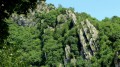
(11) 200 metres further on, at the signs for Rue des Champs Melin and Chemin du Muenot, you will see a new signpost. Turn left onto the grassy path that runs alongside the house. Twenty steps from the house, on the right, a small path climbs up to La Roche d'Or. At the top, near a large rock, there is an open area with a view of the Doubs valley and the village of Beure. You can also climb very carefully to the left to an unsecured viewpoint overlooking Planoise and Rosemont. Then descend the other side to reach Chemin d'Avanne in Velotte, where you turn left.
(12) Return to the car park by following the cycle and pedestrian path, continuing along the riverbank (S/E).
 The route includes cliff paths and unsecured viewpoints. Good shoes and walking sticks are recommended. Some paths are stony and difficult or slippery. Despite being described as urban, this hike is not suitable for young children.




 Visorando Member
 Easy
Easy