Country:

 City:
City:


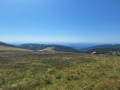
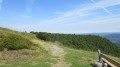
To get to the Ballon d'Alsace via the RD 465 - On the Vosges side, 1 km from the summit, park your vehicle in the large car park located 100 metres above the Jumenterie.
(S/E) Descend to the Jumenterie.
‘(Breeding farm established by Henri II, Duke of Lorraine, in 1618 to improve the horse breed. The experiment ended in 1621).’
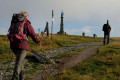
To the right of the building, take the path (marked with a red disc - summit of the ballon) which passes behind the gas tank enclosure and climbs gently through the ski slopes to emerge below the equestrian statue of Joan of Arc.
(1). This is where the boundaries of three municipalities, three departments and three regions meet. (Lepuix-Gy–Territoire de Belfort for Franche-Comté, St Maurice-sur Moselle Vosges for Lorraine and Sewen-Haut-Rhin for Alsace).
Take the ridge path on the left (marked with red and whiteGR®59 signs), which also marks the watershed. On the left is the Moselle, which flows into the North Sea, and on the right is the Savoureuse, which flows into the Mediterranean Sea.
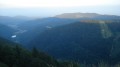
Turn left again onto the discovery trail, which circles the summit and features information panels. Enjoy beautiful views of the Moselle valley.
At the eastern end of the summit, leave theGR®5trail and turn right to go to the orientation table (360° viewpoint) and then to the Vierge du Ballon.
(2) Descend to the RN 465 towards the farmhouse inn. Turn right and follow the road, passing in front of the hotel at the summit and crossing to find yourself in front of the monument to the mine clearance experts.
(3) (Picnic room and toilets available in the tourist office building).
In the autumn of 1944, the Allied advance slowed and the front remained stable for over a month on the first foothills of the Vosges. The Germans took advantage of this to lay numerous minefields. From 1945 to 1947, 3,200 volunteers and 30,000 prisoners neutralised or destroyed more than 12,000 objects. This operation cost the lives of 600 men, including 116 from the Vosges department. This monument is a testament to their sacrifice. There is a small museum to visit.
Behind the car park, follow the main signposted path (red and white rectangle ofthe GR®59 trail, doubled with a red triangle) for 1 km.
(4) Take the path on the left (marked with a red triangle) towards La Planche des Belles Filles. After 300 metres, turn left again onto the path (marked with a blue signpost). The trail crosses the Fagne du Faisan, a wide basin forming a marsh of stagnant water on a peat bed estimated to be 3 metres thick, which considerably hinders vegetation growth.
This area is truly one of the most unspoilt in the Ballon. We are also in a protected natural area (please note that dogs are not allowed). For a brief moment, we can imagine a bear or an aurochs and go back centuries in time.
After a difficult descent on uneven ground, we arrive at the Étang Madrier. Take a look at the broken dyke and its charming footbridge, then take the path (Triangle and Chevalet Bleu) to reach the Petit-Haut pond.
(These two water reserves were used to regulate the flow of water needed to operate the factories in the valley.)
(5) Facing the spillway, take the path on the right (marked with a blue triangle). Following the banks of the stream, you will see the pretty Rummel waterfall. You will arrive at the viewpoint.
(6) Turn around.
(5) At the Petit-Haut pond, follow the dyke to the right. At the end of the dyke, turn left (blue disc sign). The climb is on the moraine front of the Savoureuse glacier. In the tangle of rocks, you will see an isolated boulder that looks as if it was placed there by Obelix. The climb continues to the road and the Chaumière restaurant.
(7) Cross with caution and follow the path that plunges into the glacial cirque of Lac d'Alfeld (Blue Ring signpost - Tour du Ballon).
you are now at the bottom of the old glacial valley of the Doller with piles of rocks broken by the force of the ice
Enjoy the beautiful views of the valley. At the junction with the path leading up from Lac d'Alfeld, take theGR® 5 (red rectangle - direction Ballon d'Alsace) on the left until you reach the Col de Ronde Tête.
(8) This was the junction of the Doller glacier and the Moselle.
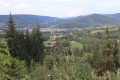
Then turn right onto the Birkel trail (marked with a blue ring). After a grassy start, the path becomes difficult and enters a tangle of jagged rocks resembling the colossal ruins of a great lost city: these are the Roches de Mortevilles, carved out by the Moselle glacier. This is the Belvédère Birkel viewpoint with its panoramic view of the Moselle valley.
(9) Continue along the path, which remains difficult, and return to the car park above La Jumenterie (S/E).


 Visorando Member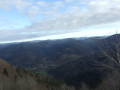

 Difficult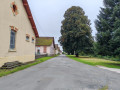
 Easy
Easy 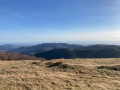
 Tourism professional