Around the Egray and the Rochers de la Chaise

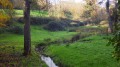
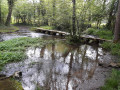
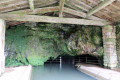
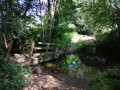
A pleasant hike in hilly terrain around the Egray River and its tributaries. It offers beautiful landscapes and allows you to discover a rich heritage of ancient buildings (Château de la Pimpelière, houses, farm buildings, etc.). The natural heritage is not to be outdone, with the Planche de Rochard and the Rochers de la Chaise, for example.

Details

1866345
Creation:
Last update:
Last review:
  • Walking
    Activity: Walking
  • ↔
    Distance: 11.29 km
  • ◔
    Average duration: 3h 45 
  • ▲
    Difficulty: Moderate

  • ⚐
    Back to start: Yes
  • ↗
    Ascent: + 191 m
  • ↘
    Descent: - 194 m

  • ▲
    Highest point: 124 m
  • ▼
    Lowest point: 47 m

Photos

Description of the walk

(S/E) Leave the car park at Place de Saint-Médard by taking the path behind the church and join the Route de l'Egray. Turn right and go to the nearby crossroads.

(1) Turn right onto Chemin de Bourneau. Further on, walk alongside the cemetery and, at the corner, continue straight ahead onto Chemin de Fontbouc. Further on, the road gives way to a path. Continue straight ahead.

Further on, the path crosses an intermittent stream, then further on, next to some farm buildings, it arrives at a T-junction with a small road on the right and a path on the left. Turn left to cross a small wood.

(2) At the edge of the woods, before Les Ritraisses, turn right onto a path at the edge of the woods. Follow it to a footbridge called Planche de Rochard.

(3) Turn right, cross the footbridge and continue along the Chemin des Rochards. Further on, at a large building on the right and a pond on the left, the path gives way to a road. Continue straight ahead on this road until you reach the D12.

Turn left and follow it with great caution until you reach the next crossroads with a small road on the right.

(4) Turn right and follow the small road that leads to the Pleige quarries. When you reach the entrance to the site, take the farm track on the right. Follow it until you reach the road leading to Le Bouchet. Continue along the road towards the north-east (with your back to Le Bouchet) until you reach the first crossroads.

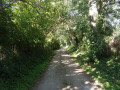
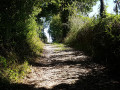
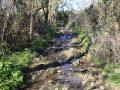
(5) Turn left onto the shaded path. Further on, cross the Fontaines stream and continue straight ahead until you reach the road leading to Le Petit Bouché. Please note that the section of the path between the Fontaines stream and Le Petit Bouché also serves as a stream in the event of heavy rain.
When you get there, turn left and follow the road heading west. It passes north of La Chambinière and leads to a road called La Chambinière.

(6) Turn left and follow the road carefully. Pass the hamlet of La Petite Grue and continue to the entrance to the hamlet of Bourdigal at a Y-junction.

(7) Follow the road on the left towards La Chaise, where you can see a calvary on top of the Rochers de la Chaise. At the end of the road, continue south to take a path that descends the cliff, staying parallel to the stream at the bottom of the valley, the Fontaines stream you crossed earlier.

Continue down this "wild" path, which is poorly maintained but passable with the right footwear. Continue until you reach a path just above the D12 road.

When you get there, turn right and go up the path to a place called Les Frichères. The path leads to a small road. Turn left and go to the nearby crossroads with a street on the right.

(8) Turn right into this street, which quickly turns into a path. Follow this path until you reach a junction with a path on the left at the edge of the woods. Turn left onto the path that descends towards the Vergne stream.

Cross the stream and climb up the other side of the valley. Turn right onto the first path heading west towards the plateau. Towards the top of the climb, turn left onto a path that soon joins the road leading to the hamlet of Rault.

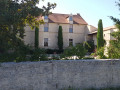
When you reach the road at a bend, continue straight ahead towards the south, passing the localities of Les Mothes and Pimpeau to arrive at a crossroads with four roads. Just before reaching the crossroads, at No. 15 Chemin de Rault, you will see the magnificent 16th-century Moussière property on your right (behind a large surrounding wall).

(9) Turn left onto the D168 road. Follow it carefully. On the spur to the right of the road, you will see the Château de la Pimpelière. Descend to the crossroads with the D12 road. Cross it with great care and continue straight ahead. Cross the bridge over the Egray.

(10) Immediately after the bridge, turn left onto a path that runs alongside the Egray river some distance away at the bottom of the valley. Shortly after the ponds on the right, the path turns right and climbs towards the hamlet of Racle-Bourse. Cross the hamlet and continue on the road that follows the path. Follow it to the junction with the Egray road in Germond.

(11) Turn left onto the Route de l'Egray and follow it to the next crossroads.

(1) Continue straight ahead for about 100 metres and take the path on the left behind the church to reach Place de Saint-Médard (S/E).


Waypoints

  1. S/E : km 0 - alt. 101 m - Place de Saint Médard
  2. 1 : km 0.13 - alt. 98 m - Crossroads between Route de l'Egray and Chemin de Bourneau
  3. 2 : km 2.14 - alt. 99 m - Crossroads (on the right) before Les Ritraisses
  4. 3 : km 2.5 - alt. 60 m - Crossroads at the footbridge
  5. 4 : km 3.14 - alt. 91 m - Crossroads D12 - Pleige quarry road
  6. 5 : km 3.95 - alt. 123 m - Road-path junction on the left after Le Bouchet
  7. 6 : km 4.96 - alt. 115 m - Crossroads at La Châmbinière
  8. 7 : km 5.6 - alt. 114 m - Y-shaped crossroads in Bourdigal
  9. 8 : km 7.03 - alt. 82 m - Crossroads at Les Fichères
  10. 9 : km 8.33 - alt. 89 m - Crossroads at La Moussière
  11. 10 : km 8.97 - alt. 49 m - Road junction - farm track on the left
  12. 11 : km 10.97 - alt. 105 m - Chemin de Racle Bourse crossroads - Route de l'Egray
  13. S/E : km 11.29 - alt. 101 m - Place de Saint Médard

Notes

The parking area is located in a large car park on the left after the town hall when coming from the south.

This hike takes place on varied terrain and may be slippery in places during rainy periods, so suitable footwear is required.

The route is not fully signposted. At the start, it follows the GR®36 to the point (5), then a short section of the GR® de Pays Sud Gâtine just before the point (8). It is therefore advisable to follow the directions in the description and on the map, while also paying close attention to the landscape. The waypoints (with their GPS coordinates and distance from the starting point) are helpful for hikers discovering the route.
This route is loosely based on a hike developed by the Deux-Sèvres Departmental Committee
for the "La Vallée de l'Egray" walking route

Alternative route: to avoid the "nature" path after the point (7), you can continue the route by staying on the small road and turning right (instead of left). Continue straight on to Les Frichères and you will find the point (8) after crossing it.

Hike completed by the author on 22 August 2019

Warning: in November 2025, hikers were attacked by two dogs that were apparently running loose between the point (7) and the point (8). There is a sign simply saying "Beware of dogs", even though the path is public according to the land registry! Be careful and, above all, keep your dog on a leash to minimise the risk.

Worth a visit

Germond-Rouvre
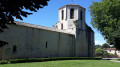
The Saint-Médard church dates back to the 12th century. It has been listed as a historic monument since 1986.
The Germond site has been occupied since ancient times: in 1874, a Gallo-Roman villa with a hypocaust (underfloor heating) was found there. In 1003, the Count of Poitou gave the land of Germond to the Abbey of Saint-Cyprien in Poitiers to build a town that would be free and exempt from taxes. The church that would be built there would be dedicated to Saint Médard, the bishop of Noyon who consecrated Radegonde as a deaconess and died around 560. More
than 70 towns in France bear the name of Médard, including Saint-Mard-la-Lande in the Deux-Sèvres department. Twelve other churches in the diocese of Poitiers have Saint Médard as their patron saint.
Three stages of construction:
- From the Romanesque church, a very simple semicircular apse remains, as well as a large part of the five bays of
the nave
- At the beginning of the 13th century, a powerful bell tower porch was erected on the western bay, which was covered with an 8-rib Gothic vault. The bell tower is square at its base and octagonal at the top. The bell tower has no spire.
- In the 15th century, a two-bay funeral chapel with Gothic vaults was built on the south side of the church, destroying part of the Romanesque wall.
For more information
Source: parvis.poitierscatholique.fr

According to the inventory of remarkable trees in Poitou-Charentes, there are four in the commune:
the common walnut tree (Les Moussandières)
the common yew (town hall square)
an oak tree (La Touche)
another oak tree (La Pleige)
Source: official website of the Town Hall

The Château de la Pimpelière
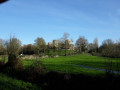
The Château de la Pimpelière is perched on a hillside overlooking the Egray valley. It takes its name from the Pimpeau family, who once owned the estate and a nearby mill that still bears the same name. At the end of the 15th century, La Pimpelière was owned by Antoine Chabot, Lord of Thélouze. The estate passed to his son Jehan, peer of Niort in 1535, then to François, Lord of La Pimpelière, Chaillé and La Mothe St Denis de Mairé, and Mayor of Niort in 1548, 1564 and 1569. Jean Baptisle, squire, was special lieutenant of the Niort election from 1576 to 1580. His daughter Marie brought it as a dowry to René Rousseau, Lord of La Parisière. At the end of the 17th century, the seigneury of La Pimpelière belonged to the Decemme family.
The building is simple and elegant. The main building is rectangular, flanked by a round tower at each end on its rear façade. It appears to date back to the 16th century, but alterations were made in the 18th century.
Private property, not open to visitors.
Source: Châteaux de France website

La Moussière
The owners of the estate have been known since the 16th century. Set in a courtyard that appears to be enclosed by buildings on the 19th-century cadastral map, the main building is a long rectangular structure. The dwelling is built of rubble stone; the tables and openings are made of cut stone. The dormer windows have triangular pediments decorated with acroteria. The more sober rear elevation is connected to the north by a large round tower (remnants of the defensive elements). The interior layout follows a very simple plan: a hallway and rooms at the rear. Two fireplaces are decorated with painted scenes, one of which appears to depict Saint Peter denying Christ, and the other a romantic scene. The quality of the architecture of this dwelling, combined with the simplicity of the details, is characteristic of the residences of the rural gentry.
Source: "Châteaux de France" website

Always be cautious and plan ahead when you're outdoors. Visorando and the author of this route cannot be held responsible for any accidents occurring on this route.

The GR® and PR® markings are the intellectual property of the Fédération Française de Randonnée Pédestre.

Reviews and comments

4.5 / 5
Based on 5 reviews

Reliability of the description
4.6 / 5
Ease of following the route
4.6 / 5
Route interest
4.4 / 5
philouis
philouis

Overall rating : 4 / 5

Date of your route : Nov 14, 2025
Reliability of the description : ★★★★☆ Good
Ease of following the route : ★★★★☆ Good
Route interest : ★★★★☆ Good
Very busy route : No

I confirm that the section after the Chaise rock is impassable due to brambles blocking the path and is even dangerous.

Machine-translated

GILMIC79
GILMIC79

Overall rating : 5 / 5

Date of your route : Jul 23, 2025
Reliability of the description : ★★★★★ Very good
Ease of following the route : ★★★★★ Very good
Route interest : ★★★★★ Very good
Very busy route : No

A very beautiful hike that actually follows a route set out by the departmental federation, with a detour between 7 and 8 to avoid the road. This detour is a good idea and starts off well until you reach the buildings at the end of the paved section and the start of a path, which quickly disappears into a thicket of brambles. It is impossible to continue without tools to clear the way.
And that's assuming you can find the rest of the path!

Machine-translated

christophantoine
christophantoine

Overall rating : 4.7 / 5

Date of your route : Feb 12, 2023
Reliability of the description : ★★★★★ Very good
Ease of following the route : ★★★★☆ Good
Route interest : ★★★★★ Very good
Very busy route : No

A very beautiful parish-specific to Brittany hike (under bright sunshine, with no wind and mild temperatures), alternating between wide views, panoramas, woodland and stream crossings. Rarely flat, but the climbs are never long: just enough to keep you in shape!
And how peaceful and gentle it is! I can't wait for the colours of spring (and the end of the hunting season...) to come back here.

Machine-translated

pgetrochon
pgetrochon

Thank you for your message. The maintenance of certain paths is uncertain following the lockdown this spring.
Enjoy your walks!

Machine-translated

jlfaure
jlfaure

Overall rating : 4.3 / 5

Date of your route : Jul 07, 2020
Reliability of the description : ★★★★☆ Good
Ease of following the route : ★★★★★ Very good
Route interest : ★★★★☆ Good
Very busy route : No

I confirm that after "La Chaise", the path is not easy to find. We didn't want to venture into the tall grass, not knowing what we would find afterwards, so we turned back to return to the point (7) and resume our journey.
On the other hand, opposite the remarkable "La Moussière" lodge, we took the marked trail that descends, passes in front of a spring and a wash house, then continues along the old Moulin de Pimpeau path nestled in the valley and joins the D12.
Finally, we followed the marked CG.Les Farfadets route. In any case, these paths are very pleasant at this time of year, especially in the morning...
I will return to the Rochers de la Chaise and the historic site of Les Mothes, which we were unable to see.
I discovered that there is another route to the south: the Saint-James valley between the villages of Germond and Rouvre. Worth doing.

Machine-translated

Cmarsil
Cmarsil

Overall rating : 4.7 / 5

Date of your route : May 27, 2020
Reliability of the description : ★★★★★ Very good
Ease of following the route : ★★★★★ Very good
Route interest : ★★★★☆ Good
Very busy route : No

The path from point 7 is not easy to find. It should be marked "behind the small isolated barn with a gabled roof on the right as you arrive."
The path is not very well maintained and the end before reaching the D 12 road is not obvious.

Machine-translated

Other walks in the area

For more walks, use our search engine .

The GPS track and description are the property of this route's author. Please do not copy them without permission.