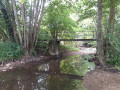
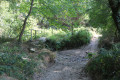
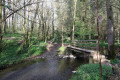
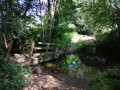
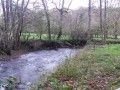
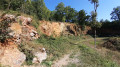
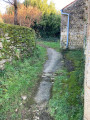
The Autize Valley starting from Béceleuf

A pleasant walk starting from Béceleuf, with its Romanesque church, exploring the Autize Valley with its dovecotes, castles and manor houses, not to mention the numerous wash houses and mills in this area rich in heritage and nature, such as the Chêne de Pouzay. As you walk, be sure to look out for the Gâtine barriers, reminders of the past.

Details

21307749
Creation:
Last update:
Last review:
  • Walking
    Activity: Walking
  • ↔
    Distance: 7.22 mi
  • ◔
    Average duration: 3h 40 
  • ▲
    Difficulty: Moderate

  • ⚐
    Back to start: Yes
  • ↗
    Ascent: + 433 ft
  • ↘
    Descent: - 427 ft

  • ▲
    Highest point: 351 ft
  • ▼
    Lowest point: 131 ft

Photos

Description of the walk

(S/E) Leave Place René Casin via Rue de l'Autize heading north-east (to the right, towards the town hall). Follow it carefully to the junction with Rue de Mortagne on the left, where the War Memorial stands. Turn left onto Rue de Mortagne. Walk past the school and continue to Route de Fenioux (T-junction). Turn left and follow Route de Fenioux carefully.
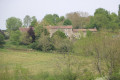
As you cross the Guillet, look out for the Petit Château on the hillside to your right, with a watermill and a windmill, as well as a pond at the foot of the hill.

(1) Shortly afterwards, turn right onto Rue du Petit Château, which climbs steeply up the hillside and then runs across a sort of plateau towards Rue du Liseron on the left and Place Pintet opposite. At the square, turn left onto Rue du Bois. Follow it carefully until you reach a path on the left, about fifty metres after a right-angle bend in Rue du Bois.

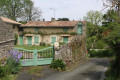
(2) Turn left onto the gently ascending path. From here, the route follows theGR® de Pays Sud Gâtine. The path runs along the side of the valley, passes the wash house at Fontaine des Loges and heads towards La Chancelée at the foot of the hamlet known as La Bénette (Benêtre – well-being?), a large farm with typical buildings constructed from limestone rubble. Cross the ford at La Chancelée to climb up towards the hamlet of La Bénette.
Pass to the west of La Bénette and follow the path downhill, which offers a fine view of the Autize Valley further north. Descend a sort of spur towards the D126 road. Just before reaching it, cross the Chancelée stream once more.

(3) Turn left and carefully follow the D126 road for about a hundred metres before turning right onto a path that descends to the bottom of the valley and then crosses the Autize via a footbridge.
Note, on the right, a service tree, a species that has become very rare.
The path runs alongside the River Autize on your left. At the end of a small road on the left where two paths meet, look for the path leading to Roc Cervelle on the right (hidden by the trees). (See the ‘During the walk’ section).

(4) Take the path on the right and turn left about twenty metres further on onto a path heading west, which soon crosses the Saumort. Immediately afterwards, at the next crossroads, turn left and follow the course of the River Autize on your left.
A little further on, the path passes beneath the hamlet of La Maillette before reaching a crossroads.

(5) Continue straight ahead along the path which climbs towards a sort of small plateau before descending gently towards the hamlet of Mortay.

(6) At the junction with the Chemin des Touchettes on the left, before the hamlet, continue straight on towards the houses of Mortay. The route is now on a variant ofthe GR® de Pays Sud de Gâtine.
At a right-hand bend, you will see a fountain on your left.
At the T-junction with the Route d’Ardin, turn left and follow this road carefully as it descends towards the south-west. At the bottom of the descent, the route passes under a high-voltage power line and crosses the intermittent Longecou stream. From there, the road follows the course of the River Autize, slightly above it.

(7) At the next four-way junction, take the left-hand road downhill, which joins the River Autize and follows it as far as the Moulin de Pouzay. The Moulin de Pouzay is private property: only pedestrians, cyclists and horse riders are permitted to cross the property, provided they stay on the path; dogs must be kept on a lead (the owners’ dogs may be off lead – personally, I did not see any).

Cross the Autize and continue along the farm track which follows on from the road and climbs the hillside towards the hamlet of Pouzay. Upon reaching the edge of the plateau, before the hamlet, look out for the Chêne de Pouzay, a remarkable tree growing in a dovecote (see the ‘During the walk’ section).

On reaching the hamlet of Pouzay, see the castle (see section “During the walk”). The main building, set in the middle of its grounds, has retained its two fortified gates which open onto a vast courtyard: to see them, continue straight on at the crossroads for about 50 metres, then return to the junction with the road to Rochard.

Turn left coming from the dovecote (or right coming from the castle’s fortified gates) just before the hamlet. Carefully follow the road down towards Rochard, with a lovely view of the valley and the Moulin de Rochard on the banks of the Autize, on the left-hand side. In Rochard, a beautiful house serving as a bat roost (see information panel).

(8) At the T-junction at the entrance to the hamlet of Rochard, a return trip to the Moulin de Rochard, on the left, is well worth it for those up to the challenge (an extra 300 m return).
Otherwise, continue to the right along the path that climbs the valley towards a plateau where the Noues area is located. After the climb, the path runs across the plateau towards the south-east.

(9) At a path joining from the left, continue straight on along the path towards a road known as Rue de Beauregard.

(10) Turn right and carefully follow Rue de Beauregard, which leads to Château Beauregard on your left. Go round the grounds of Château de Beauregard until you reach Rue de la Règle. When you get there, turn right onto this road, which runs alongside Béceleuf cemetery. Continue to the junction with the D745 and D126 roads, where there is a wayside shrine (between the two roads).

Turn left to follow the D745 on a protected path running alongside the road, which serves as a pavement. When you reach the outbuildings of Château de la Marzelle, on the right-hand side of the road, you will see an old blue signpost. Just after this is the entrance to Château de la Marzelle.

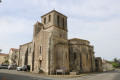
Continue towards the centre of Béceleuf. Just before reaching Place René Cassin, you will see Béceleuf Church on the left-hand side of the street (see the ‘During the walk’ section).
Return to the nearby car park (S/E).


Waypoints

  1. S/E : mi 0 - alt. 318 ft - Car park: Place René Cassin
  2. 1 : mi 0.41 - alt. 259 ft - Crossroads: Route de Fenioux – Rue du Petit Château
  3. 2 : mi 0.95 - alt. 318 ft - Junction of Rue du Bois and the path on the left
  4. 3 : mi 2.32 - alt. 171 ft - Crossroads: path – D126 road - Autise (rivière)
  5. 4 : mi 3.04 - alt. 161 ft - Crossroads – road near Roc Cervelle - Saumort (rivière) - Affluent de l'Autise
  6. 5 : mi 3.55 - alt. 164 ft - Crossroads of four paths after La Maillette
  7. 6 : mi 3.83 - alt. 194 ft - X Chemin de Mortray - Chemin des Touchettes
  8. 7 : mi 4.41 - alt. 167 ft - Crossroads: Route de Fenioux – Route du Moulin de Pouzay
  9. 8 : mi 5.47 - alt. 174 ft - T-junction on the Pouzay – Moulin de Rochard road
  10. 9 : mi 6.35 - alt. 331 ft - Junction with the Cherveux path on the left
  11. 10 : mi 6.53 - alt. 351 ft - X paths – road near Beauregard Castle
  12. S/E : mi 7.22 - alt. 318 ft - Car park: Place René Cassin

Notes

The car park at the start is located on Place René Cassin, next to the Town Hall.

This hike across varied terrain requires sturdy footwear.

This walk is marked in yellow along almost the entire route. It follows almost entirely the route entitled "La Vallée de l'Autize", a guide produced by the Deux-Sèvres Departmental Hiking Committee and published by the Deux-Sèvres General Council. In addition, it is advisable to follow the directions in the description and on the map, whilst paying close attention to the landscape. The waypoints, with their GPS coordinates and the distance from the starting point, are helpful for hikers exploring the route for the first time.

Hike completed by the author on 28 April 2022. A very quiet route, except for slightly more traffic around the dovecote and at the end of the trail.

Worth a visit

Béceleuf
The origin of the word ‘Béceleuf’ is thought to be ‘a place planted with birches’. When we say ‘planted’, it is a figure of speech; it is a place where birches are plentiful. Birch comes from the Gaulish word ‘bettu’, which gave rise to ‘besse’, a name found quite frequently (Besse en Chandesse, etc.). The syllable ‘leuf’ or ‘leu’ indicates the location. Indeed, the local pronunciation of Béceleuf is ‘Besse leu’…
The commune of Béceleuf is home to the Autize valley, which cuts the commune in two and forms the boundary with the communes of Xaintray and Ardin.
Our area is crossed by various streams that flow into the Autize. In the far north-west, we have the Fenioux stream, which forms the boundary with the commune of Fenioux and joins the Saumort at La Vergnée, a hamlet of Fenioux. The Saumort then joins the Autize at Roc Cervelle.
To the north-east, we have the Miochette stream, which flows into the Autize in the commune of Xaintray on the border with Béceleuf.
We also have two other streams crossing our territory: one is the Chancelée, which forms the boundary with Xaintray and flows into the Autize at the Plet bridge.
Finally, the Guillet stream, which rises in the wash houses of Grande Fontaine and Fondmorand, follows the Fenioux road until it joins the Autize, also at the Plet bridge.
Our area is rich in water sources, which gives it a distinctive landscape and magnificent scenery.

Heritage
Saint-Maurice Church
Listed as a Historic Monument, the oldest parts of the church date from the 11th and 12th centuries. It is renowned for its chevet modillions, typical of Poitevin Romanesque art, but also for its paintings inside the bell tower (16th–17th centuries), which are unique in Poitou-Charentes (tulips, woodcocks, etc.). A close look at the modillions reveals monsters, a mermaid, a horseman and his horse, and mischievous figures (for example, the modillion of the woman ‘sprinkling’ passers-by).

Pouzay
A large castle once stood here, as the north wall of the buttresses still bears witness. A beautiful entrance remains , along with a former stud farm and the dovecote, which contains 2,700 nesting boxes and is famous (and listed) for the oak tree that rises in its centre.
It is for this reason that the entire site of Pouzay (buildings, field walls and pond) is listed as a historic monument.
The Pouzay Oak is a curiosity located in the commune of Béceleuf. A fusion of plant and stone, the main feature of the Pouzay Oak is that it has grown right in the middle of a dovecote. Listed among France’s 250 ‘remarkable trees’, it is certainly worth a visit. What’s more, the hiking trails that run alongside it allow walkers to explore this region with its authentic rural charm.

Beauregard
The Beauregard house has been mentioned since the 15th century. Renovated in the 18th and 19th centuries, the building features two round towers and a gatehouse at the entrance to a short driveway.

La Roche
The ancestral home of the Brochard de La Roche (De La Rochebrochard) families, only dilapidated buildings and a ruined dovecote in the adjoining field remain.

Le Petit Château
So named in deference to the castle of the castellany which stood opposite, the current dwelling replaced an earlier building; the retaining wall and two watchtowers are clearly visible; a large dovecote is also situated within the property’s grounds.

La Marzelle
This elegant late 19th-century residence replaced a more modest dwelling; it is surrounded by pleasant grounds; a private property currently undergoing renovation.

La Règle
This old farmhouse, part of the Beauregard seigneury, features a pretty entrance porch

Rochard
Near Pouzay, the Rochard watermill belonged to this seigneury. It is worth noting that during heavy rain, the river flows over the footbridge, demonstrating the torrential nature the Autize can take on.
Near the mill, a renovated old farmhouse serves as a refuge and outdoor base for the Deux-Sèvres Camping Club. It is a site equipped to provide shelter for bats.

Roc Cervelle
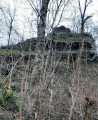
This block of schist overlooks the Autize (accessible summit) and the Saumort. Legend has it that the fairy Melusine placed it here.

Fountains and Wash Houses
The village, situated at the junction of the plain and the Gâtine, has several springs and wash houses.
The Gaudine fountain near the village and the hamlet of Livernière.
The fountain and wash house at Fontmorand.
The fountain and wash house at Fougères (the Grande Fontaine).
The fountain and wash house at Les Loges (on the outskirts of Fougères towards Benête).
The fountain and wash house at La Vergne.
The fountain and wash house at Le Plet.
The fountain at La Règle.

The grave of Napoleon’s soldier
The gravestone of a ‘grognard’, that is to say a soldier of the Imperial Guard, stands at the edge of an aisle in the Béceleuf parish cemetery; a plaque makes it easier to read the epitaph.
Louis Bridonneau began a long military career in 1793 (during the mass conscription), first with the armies of the Revolution and then following Bonaparte to Italy. In 1800 he joined the Imperial Guard and thus followed the Emperor through his campaigns across Europe (Austerlitz, Eylau, Moscow…), having no doubt even spent some time as a prisoner in Russia. A total of seventeen military campaigns up to Waterloo.
It was in Béceleuf, where his parents lived, that our veteran continued his civilian life, marrying in 1821 and working first as a coal merchant and then as a cart driver. He died in 1850, ‘faithful to his God as he was faithful to his flag’, as his epitaph states, and was buried in the cemetery at Béceleuf, where the local council maintains his grave. His career is outlined on one side of the gravestone, though very incompletely due to lack of space.
Source: the municipality’s official website

Always be cautious and plan ahead when you're outdoors. Visorando and the author of this route cannot be held responsible for any accidents occurring on this route.

The GR® and PR® markings are the intellectual property of the Fédération Française de Randonnée Pédestre.

Reviews and comments

4.8 / 5
Based on 5 reviews

Reliability of the description
4.8 / 5
Ease of following the route
4.8 / 5
Route interest
4.8 / 5
Marcel-Le-Cycliste
Marcel-Le-Cycliste

Overall rating : 5 / 5

Date of your route : Mar 21, 2026
Reliability of the description : ★★★★★ Very good
Ease of following the route : ★★★★★ Very good
Route interest : ★★★★★ Very good
Very busy route : No

A wonderful walk, full of interesting sights.
There’s just one problem: crossing a ‘private’ farmyard, whose owner isn’t very friendly!

Machine-translated

isabellebl
isabellebl

Overall rating : 5 / 5

Date of your route : Sep 28, 2025
Reliability of the description : Not used / Not applicable
Ease of following the route : ★★★★★ Very good
Route interest : ★★★★★ Very good
Very busy route : No

A very beautiful hike with varied landscapes. It is essential to wear suitable footwear.

Machine-translated

MARTDomi
MARTDomi

Overall rating : 4 / 5

Date of your route : Sep 01, 2024
Reliability of the description : ★★★★☆ Good
Ease of following the route : ★★★★☆ Good
Route interest : ★★★★☆ Good
Very busy route : No

A lovely walk along well-marked paths. The architectural highlights are a bonus

Machine-translated

hp79
hp79

Overall rating : 5 / 5

Date of your route : Jul 27, 2023
Reliability of the description : ★★★★★ Very good
Ease of following the route : ★★★★★ Very good
Route interest : ★★★★★ Very good
Very busy route : No

A superb walk, with little road walking and well-maintained paths.
Next to the remarkable oak tree growing in a dovecote, there is a picnic table for anyone who might be interested.

Machine-translated

philouis
philouis
• Edited:

Overall rating : 5 / 5

Date of your route : Jun 23, 2022
Reliability of the description : ★★★★★ Very good
Ease of following the route : ★★★★★ Very good
Route interest : ★★★★★ Very good
Very busy route : No

A lovely walk, mostly in the shade, which is a real bonus in summer.
It’s always a pleasure to see the Pouzay dovecote again.
We came across the dogs from the Moulin de Pouzay, as well as their owner, which is reassuring for anyone who might be afraid of them.
On the way back to Béceleuf, we treated ourselves to a little detour via the Gaudine fountain.

Machine-translated

Other walks in the area

For more walks, use our search engine .

The GPS track and description are the property of this route's author. Please do not copy them without permission.