Route des lavoirs de Saint-Christophe-sur-Roc

A pleasant walk exploring the restored wash houses, between the Roche and Musson valleys. This route takes you past the Romanesque church, the Tree of Liberty and the Hosanna cross in the village, then on to the wash house at Boisne, the wash house at La Perdillière, the wash house at Chazais and the wash house at La Roche, as well as the underground river. The route offers varied scenery and a chance to experience the natural beauty of this lovely corner of the Gâtine region.

Details

3258750
Creation:
Last update:
Last review:
  • Walking
    Activity: Walking
  • ↔
    Distance: 10.77 km
  • ◔
    Average duration: 3h 20 
  • ▲
    Difficulty: Moderate

  • ⚐
    Back to start: Yes
  • ↗
    Ascent: + 84 m
  • ↘
    Descent: - 87 m

  • ▲
    Highest point: 116 m
  • ▼
    Lowest point: 78 m

Photos

Description of the walk

(S/E) As you leave the car park, note the Hosannière cross. Head towards Rue de la Croix and turn right onto Chemin de la Gelousière. At the Y-junction, follow Chemin de la Gelousière to the right. After the farmhouse on the left-hand side, there is a spring on this left-hand side, near an old farm shed.

Follow Chemin de la Gelousière, uphill and then along the flat plateau, until you reach the junction with Rue du Plan d’Eau (the D122). There is a wayside cross on the left-hand side, just across the junction. Cross the junction carefully and continue straight ahead until you reach the next road nearby.

(1) Turn left and carefully follow the road heading west until you reach a fork. Turn left onto the road leading to the hamlet of La Genête. The road, running along the edge of the plateau, overlooks the hamlet of Boisne further west, on the other side of a small valley through which flows an intermittent stream, the Musson, which feeds the Cherveux–Saint Christophe reservoir. Just as the road takes a sharp left-hand bend near the hamlet, continue straight ahead onto a path heading south which, further on, descends from the plateau to the bottom of the valley.

(2) Cross the Musson via a footbridge and begin climbing the western slope of the valley. Soon, take a path on the right that runs along the slope, the Chemin du Musson. See the Boisne wash house. Pass a small dip in the terrain and follow the path climbing the western slope of the main valley to reach Boisne on the plateau.

Cross the hamlet by heading straight along the edge of the plateau via the Route de la Carte, then the Route du Patrouillet. Towards the end of the hamlet, the road turns sharply left.

(3) Immediately after the bend, take the road on the right known as Chemin du Paradis, which continues northwards. Continue to a T-junction.

Turn onto the left-hand path going uphill, which soon joins a road known as Rue du Puits au Breuil. Turn right onto this and follow it through the hamlet to the T-junction with Rue du Breuil.
Make sure you keep the Impasse de la Burgalière on your right as you enter the village. Turn left onto Rue du Breuil and head to the nearby junction with the road known as Chemin du Taulis.

(4) Turn right onto Chemin du Taulis and, at the next junction, take the left-hand track towards the hamlet known as La Bâtonnière. Walk along the left-hand side of the hamlet and, a little further on, turn left onto a track and immediately right onto a track heading north.

At the junction with Chemin du Frêne, continue straight ahead along the path which is circular and heads towards the hamlet known as La Péchellerie, where it joins a small road. Take this road carefully to the right. At the T-junction, take the road on the right for a few metres to find, on the left, the path leading to the Lavoir de la Perdillière on the banks of the Musson.

(5) Return to the nearby crossroads and continue straight ahead towards the hamlet of La Quairie. Just before reaching it, as the road turns to the right, take the path opposite heading south-east, which leads straight to the hamlet of Le Plantis. You will come out onto the road serving this hamlet; follow it to the right for about forty metres.

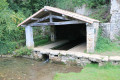
(6) Turn left downhill towards a small valley, then climb up and pass near the hamlet of La Bernière on your right before reaching the D122 road at Chazais. Turn left and follow the road for about thirty metres before taking the Chemin du Lavoir on the right. Continue straight on to the covered wash house at Chazais, taking the path that follows the road.

(7) Head back towards Chazais and turn left onto the Chemin de la Selle. Before reaching the road known as the Chemin de la Galinière, take the farm track on the left which heads south-east, marked by two low stone walls at the start. The track descends into a valley before climbing partway up the other side of the valley

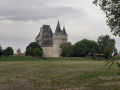
(8) Just before reaching the road leading to the hamlet of La Selle to the east and the hamlet of Le Peu to the south. Look out for the fortified farm of Maillé in the distance on the plain. Take the path on the right downhill, which joins the Route de la Grue. When you reach the road, take it carefully to the left to climb up the side of the valley. Further on, the road takes a sharp left-hand bend and heads towards the hamlet of Le Peu. At this point, continue straight on along a path that curves gently to form a semicircle to the right.

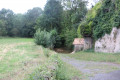
After this wide circular route to the right, the path descends towards the valley east of Saint-Christophe-sur-Roc, where the Ruisseau de la Roche flows. Beautiful views of the village and the church. After passing through the bottom of the valley, the path joins the road known as the Chemin de la Roche. Follow it, turning to the right. The road climbs. At the bottom of a steep slope, take the path on the left which leads, after a few dozen metres, to the source of the Ruisseau de la Roche and its underground stream (see the ‘During the hike’ section).

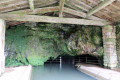
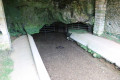
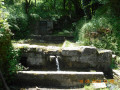
Return to the road and take the steep slope on the left, then turn left and take the Chemin de la Fontaine on the left, which seems to pass through the storage area of a metalworks factory. Go to the end of it to see the covered wash house and the source of the Ruisseau de la Roche.

(9) Head back up towards the village. At the top of the Chemin de la Fontaine, you’ll find the car park on the left (S/E).

Waypoints

  1. S/E : km 0 - alt. 104 m - Car park opposite the - Église Saint-Christophe (Saint-Christophe-sur-Roc)
  2. 1 : km 0.66 - alt. 98 m - Crossroads north of the D122.
  3. 2 : km 2.26 - alt. 78 m - Footbridge over the Musson
  4. 3 : km 3.11 - alt. 101 m - Junction of Rue du Patrouillet and Chemin du Paradis
  5. 4 : km 4.29 - alt. 107 m - Junction of Rue du Breuil and Chemin du Taulis
  6. 5 : km 6.04 - alt. 101 m - La Perdillière wash house
  7. 6 : km 6.98 - alt. 115 m - Road-path junction at Le Plantis
  8. 7 : km 8.13 - alt. 105 m - Chazais wash house
  9. 8 : km 8.93 - alt. 102 m - Crossroads near the La Selle road
  10. 9 : km 10.57 - alt. 89 m - La Roche wash house
  11. S/E : km 10.77 - alt. 104 m - Car park opposite the - Église Saint-Christophe (Saint-Christophe-sur-Roc)

Notes

The car park is located opposite the church on Rue de la Croix, near the Hosanna Cross. Alternatively, you can park at Place de l’Église.

This hike across varied terrain requires sturdy footwear.

This route is signposted as it follows the “Le circuit des Lavoirs” route published by the Deux-Sèvres Departmental Hiking Committee. It is marked in yellow. Nevertheless, it is advisable to follow the directions in this description and on the map, whilst also paying attention to the surrounding landscape. Distance markers from the starting point, and even the GPS coordinates of waypoints (including the start), can also help hikers find their way.

Hike completed by the author on 21/08/2020

Worth a visit

Saint-Christophe-sur-Roc
Saint-Christophe-sur-Roc is situated 17 km north of the town of Niort and 23 km south-west of Parthenay. The village is set within a distinctive landscape: the Gâtine (a region of poor soil), which is also found in other regions (notably Touraine). The impermeable soil encourages the presence of numerous springs, ponds and rivers, which irrigate a landscape of green, rolling hedgerows. The village centres on a market town surrounded by a dozen hamlets, which in 1376 fell under the jurisdiction of the seigneury of La Faye. A former priory-parish which held feudal rights, subject to the election of the archpriest of Saint-Maixent. A large majority of the inhabitants converted to Protestantism and a church was built in the 16th century.

Places and monuments
The Hosanna Cross
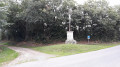
The Hosanna Cross, dating from the 12th century, features a 9-metre cylindrical shaft decorated with a circle of diamond-shaped points. It stands on a cubic pedestal approximately 2 metres high. In the 17th century, the lower part of the cross was fitted with a corbel and a niche, which has long been empty of its statue. Listed as a Historic Monument on 22 March 1889.

The Church of Saint Christopher
The church, of Romanesque origin and renovated in the 17th century, has a semicircular apse and a fragment of a carved funerary plaque, probably dating from the 13th century.
The church of Saint-Christophe-sur-Roc overlooks a small valley and is built into the hillside. A hosanna cross stands nearby. Immediately after passing through the door, one must descend eleven steps. The worshipper is thus invited to leave behind the concerns of daily life to find contemplation in the presence of the Lord. Due to the slope, there are a further three steps before the straight chevet.
The parish is first mentioned in records in the 13th century. The village has been known as ‘sur-Roc’ since the 17th century. The church has always been under the direct authority of the Bishop of Poitiers.
The church suffered greatly during the Wars of Religion. The parish converted en masse to Protestantism.
Following the revocation of the Edict of Nantes in 1685 and fearing the ‘dragonnades’ (the imposition of lodging for dragoons on Protestants), the parish priest received the abjuration of 999 Protestants from his parish in 1686. In a pitiful state, the church was restored in the 17th century.
After the Revolution, the nave vault had to be rebuilt. In 1846, Abbé Vallon had a brick vault constructed, which collapsed in the 1870s, necessitating a further restoration in the Roman-Byzantine style (domed vaults) for the three bays of the nave, which required the side walls to be raised. The original straight bay of the chancel, with its broken barrel vault, remains.
The massive rectangular front section, which serves as the entrance and features a low-set storey housing the bell from 1851–1852 (cast by Gallois of Paris), is striking due to its very low-pitched roof.
The construction of two chapels within the side walls of the nave, likely during the 19th-century restoration, could not be achieved solely within the thickness of the wall and resulted in an extension of the wall.
To find out more:

The wash house, built below an old industrial dairy (dating from 1894 and listed as a heritage site since 2002), provides access to the underground river.
The Priest’s Fountain: opposite the former dairy stands the stone dome of a fountain said to have been built in the Middle Ages by monks.

The underground river
The Roche stream originates from an underground river, of which approximately
4,300 metres of galleries have been explored by speleologists. It is the longest underground network discovered to date in the Deux-Sèvres. This river, situated in the triangle formed by Saint-Christophe, La Chapelle-Bâton, Saint Projet, is fed partly by rainwater seeping into the limestone layers, and partly by surface runoff flowing into the sinkholes. In summer, most of these sinkholes look like dry dolines. In winter, however, significant silting often transforms them into pools or bodies of water.

The Tree of Liberty
Located near the old post office, this lime tree was named the “Tree of Liberty” by those who planted it on 5 May 1889 to celebrate the centenary of the opening of the Estates General, which marked the prelude to the French Revolution. To mark the bicentenary of the Revolution, another lime tree was planted on 14 July 1989 in the presence of the local community.
Sources: Wikipedia (excerpts), the “Circuit des lavoirs” walking route guide produced by the Deux-Sèvres Departmental Committee for Hiking, and the Parvis du Centre Théologique de Poitiers guide for the church (excerpts)

Reviews and comments

4.5 / 5
Based on 5 reviews

Reliability of the description
4.8 / 5
Ease of following the route
4.6 / 5
Route interest
4 / 5
chantal david
chantal david

Overall rating : 3.7 / 5

Date of your route : Sep 30, 2021
Reliability of the description : ★★★★☆ Good
Ease of following the route : ★★★★☆ Good
Route interest : ★★★☆☆ Average
Very busy route : Yes

THERE'S TOO MUCH PAVED ROAD FOR THE FIRST 5 OR 6 KM – it's a shame.

Machine-translated

Samy79
Samy79

Overall rating : 4.3 / 5

Date of your route : May 23, 2021
Reliability of the description : ★★★★★ Very good
Ease of following the route : ★★★★★ Very good
Route interest : ★★★☆☆ Average
Very busy route : No

Hikes that take you along a small road which is actually quite dangerous. Fortunately, there was no traffic. There are three wash houses to see: two are absolutely beautiful, one where you can visit a cave, and the other where you can see grey shrimp.
There are two book boxes along the route; we were able to make use of them as we had a child with us.
We saw a lovely Poitou donkey; he had two other friends – a pony and another donkey. It was nice, but there are better hikes out there.

Machine-translated

ElDoFrem
ElDoFrem

Overall rating : 5 / 5

Date of your route : Apr 18, 2021
Reliability of the description : ★★★★★ Very good
Ease of following the route : ★★★★★ Very good
Route interest : ★★★★★ Very good
Very busy route : No

A lovely walk with plenty of well-maintained and clearly signposted paths. We came across some beautifully preserved wash houses and walked along a few ‘genuine’ sunken paths. Absolutely brilliant!

Machine-translated

philouis
philouis

Overall rating : 5 / 5

Date of your route : Jan 02, 2021
Reliability of the description : ★★★★★ Very good
Ease of following the route : ★★★★★ Very good
Route interest : ★★★★★ Very good
Very busy route : No

A STUNNING HIKE LOCATED ABOUT TEN KM FROM OUR HOME, FEATURING UNTRODDEN PATHS, MAGNIFICENT WASHHOUSES AND VILLAGES RICH IN HERITAGE. THE HEDGEROW LANDSCAPE IS WELL WORTH THE TRIP. THE SEASON IN WHICH WE DID IT MEANS SOME WET PATHS, SO WATERPROOF FOOTWEAR IS ESSENTIAL.
A great trip for all seasons.

Machine-translated

pgetrochon
pgetrochon

Thank you for your message.
The heavy, repeated rainfall this autumn is turning many paths into little streams or making them so soggy that you really do need proper walking boots.
Enjoy your walks.

Machine-translated

RASSELET
RASSELET

Overall rating : 4.3 / 5

Date of your route : Dec 17, 2020
Reliability of the description : ★★★★★ Very good
Ease of following the route : ★★★★☆ Good
Route interest : ★★★★☆ Good
Very busy route : No

A lovely walk, though you’ll need sturdy footwear, especially on the final stretch between Chazais and St. Christophe, where the path is very narrow and steep; when we were there, it looked more like a stream than a path. Otherwise, a pleasant walk,

Machine-translated

Other walks in the area

For more walks, use our search engine .

The GPS track and description are the property of this route's author. Please do not copy them without permission.