Country:

 City:
City:


On leaving Prades, heading towards Andorra, take the first road on the right over the road bridge across the Têt towards Ria and Conat via the D26.
Park inthe first visitors’ car park on the left, at the entrance to the village, Place du 8 Mai 1945, next to the town hall.
If this car park is full, continue on and park at the next residents’ car park on the right without crossing El Callau. (Ask the locals for permission as this car park is reserved for residents).
(S/E) From the visitors’ car park, head uphill towards Saint-Jean-Baptiste Church and Conat Cemetery on your right. Do not head towards the green gate, which leads to a private garden. At the end of the tarmac road, you will find a path on the right, consisting of beautiful steps leading down to the Route de Conat; turn left carefully towards the village centre, then cross el Callau to the right via the road bridge.
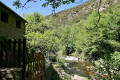
Head up Rue du Château, then take the second street on the right and then Rue des Giroflées. Continue uphill through the village along Rue de la Tour de Guet. Then head down towards the stream. Pass a footbridge with a gate on your right. Continue along the right bank.
(1) At a fork in the path, continue to the right, crossing a very pretty Roman bridge over the Rivière d’Urbanya to reach a junction very quickly. Continue to the left. An old yellow marker will help guide your way. Pass the sign for Santa Margarita and the Còrrec de l’el Riberot on your right.
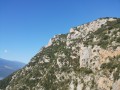
The very pretty path carved into the rock climbs steeply, heading due north-west.
You will need to follow this ridge path heading due north-west. Pass the point with an altitude of 723 metres and continue for about 200 metres.
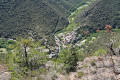
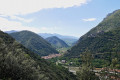
Don’t hesitate to take a break and look back to admire the scenery and Conat at the bottom of the valley.
(2) Note: at around 735 m, at the fork in the path, look for a cairn and a yellow marker on your right. Leave the path that heads westwards on level ground.
The path climbs to the right and very quickly turns left again, heading due north-west as it rejoins the ridge.
At around 800 m, the path turns right and moves away from the ridge to go round the Clarelles (altitude 918 m). The ruins of an old sheepfold come into view.
(3) At La Falguerosa (865 m), it is hard to imagine that there was ever any human activity here, in the middle of nowhere, with no flat grazing land and surrounded by ravines.
Note: look out for the old yellow markings, continue left, due west, climbing up the pasture for about fifty metres, then turn due north, north-west.
Very soon, the ruins of another old sheepfold come into view. The path continues along the hillside, climbing gently, and passes a first gully. Then, just after fording the second gully, El Riberot, you must climb steeply to the left towards the ruins, heading due north.
(4) At Arletes (950m), the site was larger than the previous ruins. There is a spring, a large ruined building, stone enclosures and terraces, but still no flat pasture.
Continue by passing over these ruins on the right-hand side. Find a path that now heads due east after a large tree. The path continues along the mountainside, rising slightly, passes a hunting post on the right-hand side (990 m), and goes past a fence. It then climbs to around 1050 m, passing the Còrrec de Cattlorenç. Shortly afterwards, there is a very overgrown spring on the right-hand side.
You arrive in an open, still grazed, and flat area.
(5) At Cattlorenç (1040 m), the farmhouse, still standing, must have been in use until recently. Pass through an iron gate and join a small track suitable for vehicles, which is beginning to be overgrown with various rockroses and broom.
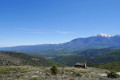
The view opens up and a beautiful panorama unfolds before us.
Continue along this track, taking the first turn to the left, then the next turn to the right. Walk for another 150m or so and look out for a cairn on the right-hand side of the track.
Head right, off the track for about a hundred metres, for a return trip to a cairn by the fence.
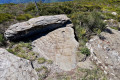
(6) At Les Cupules (1065 m), note the presence of a large flat stone, a sort of sundial into which several cupules (¹) have been carved.
Return to the track and continue to the right. You will come to a large crossroads of tracks (altitude 1086).
(7) At the gate made of an iron bar, turn left onto a wide, motorable dirt track. Head up this track due north-west. At an altitude of 1169 metres, continue right due north along the same track, which climbs less steeply. You will reach a very large open area.
(8) At Gare d'Estarder (1220 m) (²), continue to the left. Note the ruins of the old station on your left. Pass through an open gate and turn left onto a track suitable for vehicles that climbs.
After 300 m (distance recorded during reconnaissance), at around 1245 m, turn left, climbing into an open area, then quickly turn right, following a wide, open track maintained by forestry machinery.
This grassy track runs parallel to the track below on the right.
(9) At Serrat de Miralles, enjoy the beautiful spot and note the presence of a survey marker that I cleared, with a 360° unobstructed view.
You might want to take a break after this climb.
Turn back and descend via the same route you took on the way up to Gare d'Estarder.
(8) Turn left onto a small track heading north-east. You’ll reach a bend to the right of the track.
Note: if you encounter any problems at this bend, you can turn right onto this track and rejoin the (14).
Continue straight ahead due east from this bend along a track cleared by forestry machinery but not suitable for vehicles.
Caution: the 33% gradient is very steep. You will arrive 150 m further down at a track junction (altitude 1040).
(10) Turn right at a right angle onto the track, which climbs slightly and then descends.
(11) At the junction of four tracks, continue straight ahead on the widest track, which turns due south.
(12) At La Caseta, head straight ahead into the bend in the track. Ford the Còrrec de les Escomes. The track then heads due east to join a bend in a wide track.
(13) At this junction, continue to the right, heading due south up the track. Leave the forest and continue for about 500 m. Take care.
(14) Leave the track. Look for cairns on the left along the fence, which you should follow, keeping it on your left. Descend due south. The animals keep the path clear, though it is a bit overgrown in places.
(15) At Roc de l'Home Mort (altitude 952 m), head right through the low vegetation to find a ‘footpath’ in the fence. Just beyond this gap, which you must close behind you, turn left onto a good path marked on the ground. The view opens up.
Opposite, high up on the other slope, you can make out an enclosure. This is your target.
You must therefore descend towards the còrrec and climb up the opposite side via a wide path clearly marked by the passage of livestock.
Note: under no circumstances should you head towards the private residence; keep it well to your left.
Pass to the right of the enclosure, keeping well clear of the herds. There is a good path clearly marked on the ground. You will come to a track suitable for vehicles. Very soon, the chapel comes into view.
At an altitude of around 870m, turn right towards the summit above the chapel.
(16) At the 886 m triangulation point, enjoy the 360° view once again. A stunning landscape stretching as far as the eye can see. Continue south-east towards the Santa Margarita de Nabilles Chapel.
This chapel is, unfortunately, left to its sad fate.
Indeed, it is open and serves as a sheepfold and cowshed. A magnificent vaulted roof still stands inside, but outside the tiles (³) have almost all fallen off. Rain and wind are contributing to the erosion of the roof.
Continue the descent along the well-marked path heading due south; south-east.
At the confusing fork encountered at around 825m, turn right, still heading due south.
(17) At Les Esquerdes (³), from this promontory there is a stunning view down over Conat.
Caution: the area is unstable as it consists of flat, slippery stones; do not approach the edge.
Retrace your steps for a few metres uphill and look for cairns and old blue markings on the right indicating the path to follow, which heads due east and descends steeply. It then turns south-east into the Teixoneres to reach a junction.
(18) Continue to the right, heading due west. The path is magnificent and descends gently. It is easy to imagine the difficulty and danger involved in creating these vital paths on the mountainside. The contour lines are close together on the IGN map; the gradient is very steep. Cross a footbridge over the El Callau.
Join Rue du Moulin, which descends towards the road. Cross the road with care and head up the small street below the church, towards the town hall and the visitor car park (S/E).




 Visorando Member
 Average
  Association / Club / Walk leader
 Extremely difficult