Argelès - Collioure via the Sentier du Littoral coastal path and inland

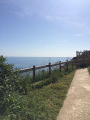
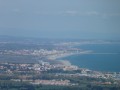
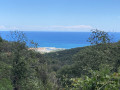
A hike that allows you to follow the Sentier du Littoral (Coastal Path) on the way there, while enjoying steep passages overlooking the sea and the beauty of certain landscapes. Visit the heart of Collioure through its picturesque narrow streets to the church and the pier, then stroll along the seafront around the Royal Castle before climbing up to Fort Saint-Elme. Return to Collioure via the windmill before heading inland to Port-Argelès via Le Racou.

⚠️Check whether the coastal path linking Argelès-sur-Mer to Cerbère is open or closed here before starting this hike.

Details

13983535
Creation:
Last update:
Last review:
  • Walking
    Activity: Walking
  • ↔
    Distance: 14.14 km
  • ◔
    Average duration: 5h 00 
  • ▲
    Difficulty: Moderate

  • ⚐
    Back to start: Yes
  • ↗
    Ascent: + 330 m
  • ↘
    Descent: - 331 m

  • ▲
    Highest point: 163 m
  • ▼
    Lowest point: -1 m

Description of the walk

The walk starts from the roundabout at the Fondation de la Maison de la Gendarmerie holiday village for residents, but can also be started from the public car park at the Argelès-sur-Mer marina.

(S/E) From the car park, turn right along the road leading to the port (keep left). After 200 metres, keep right on a gravel path until you reach the D81. Cross it carefully using the pedestrian crossing. Opposite, slightly to the left, is a public car park (another possible starting point).

(1) Turn right towards Servi Plaisance, following the fence (guide on the left). Turn left onto the marked coastal path towards Le Racou. Walk along the careening area (guide on the left). Continue straight ahead towards the trees along the tarmac path. Immediately after turning left, turn right to cut diagonally across the Racou public car park. Exit via the gate visible in the distance. Use the pedestrian crossing to cross the road carefully. Follow the footpath. Walk along Avenue de la Torre d'en Sorra (the main road serving Le Racou) or along the beach.

At the end of the road (from the beach), you will arrive at a roundabout. Go up the steep tarmac road that leads to a property. At the end, take the steps on the right. At the end of the path, turn left (the path on the right leads to a damaged orientation table and an old viewpoint obstructed by tall trees, which is of no interest). Go down the steep path and turn onto the first marked trail on the left.

(2) The marked coastal path branches off to the left, overlooking the sea, towards the coves of Portell. Pass a small cove. Continue and then descend into Ansa dels Portells via a staircase with a metal handrail. Cross the pebble beach from one side to the other and climb up to the left of the small house. At the top, keep to the left.

(3) Further on, go around the campsite on the left via the coastal path (beautiful views). If the gate is closed, retrace your steps a few metres to go around the campsite on the right, inland. In both cases, the paths converge at Ouille Beach (Platja de l'Olla).

(4) Cross the pebble beach from one side to the other, then cross the Ru du Ravaner stream to reach a concrete dyke. Continue along the Sentier du Littoral coastal path up a steep slope before arriving at an old asphalt platform. There are a series of steep ascents and descents until you reach the wall of an old fort. Follow it to the right. Opposite, in your line of sight, is Fort Miradoux (National Commando Training Centre). Turn right and follow the marked path. Leave it shortly afterwards, turning onto the first path on the right.

(5) Follow a narrow path to the main entrance of Fort Carré (Carrat), an old redoubt. Turn right to reach a casemate located further on.

(6) Take in the 360° view from this strategic location, then retrace your steps.

(5) Walk around the fort and take a path heading south to a pay car park. Cross it to reach the Route du Pla de Las Fourques, which descends towards the centre of Collioure.

(7) When you reach the Rond-Point des Écoles roundabout, turn left to go up Avenue du Mirador. At the start of a right-hand bend, turn right to follow Ruelle Saint-Sébastien. Take in the typical sights of the El Morer neighbourhood. Continue along the path, keeping to the left until you reach the end, respecting the peace and quiet of the area. To the right are terraced houses, and to the left is the perimeter of the National Commando Training Centre.

Retrace your steps to the previous crossroads. Turn left up a few steps and join Rue Bellevue, with its rampart wall on your left, until you descend and find yourself directly opposite the church.

(8) Entry to the church is free. You can go for a swim, visit the adjacent shopping streets, or stroll along the pier to the chapel and the lighthouse.
Retrace your steps back to the church. Continue straight ahead along the seafront via Boulevard du Boramar (cafés and restaurants). At the end, take the footbridge towards the Royal Castle. Turn left to go around it on the sea side and reach the central beach. Walk along the seafront, overlooking the beach.

(9) Continue along the seafront, turning left at the end of the beach after the footbridge. Beautiful view of old Collioure, the National Commando Training Centre, the castle, the port and the church. Go around the jetty. Just before a pebble beach, climb the stairs on the right.

(10) From Anse de la Baleta, take the long, steep marked path. At the end, carefully cross the D914 (Route de Port Vendres). Turn left and then immediately right towards Fort Saint-Elme. At the first sharp left-hand bend, keep to the right in an open passage.

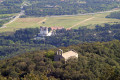
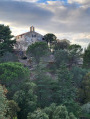
(11) Follow this path to an old chapel, La Glorieta. Superb view over the whole of Collioure. Retrace your steps to the left-hand bend. Climb up Chemin du Fort Saint-Elme to the fort. Enter the property via the main path to the edge of the fortifications. Superb view over the Côte Vermeille and inland.

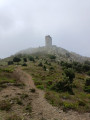
(12) Turn around and head down towards the centre of Collioure. Just before entering the village outskirts, turn left onto a path that leads directly to the Moulin à Vent, visible from afar.

(13) Descend towards Collioure via the steps through the olive grove. Pass in front of the Museum of Modern Art. Carefully cross the D914 and take the pavement on the right towards the centre. Shortly afterwards, keep to the right to take the footbridge and return to the outward route overlooking the beach. Go around the castle again before crossing the footbridge over the harbour.

(9) Turn left onto Avenue Camille Pelletan, then take the third right onto Rue Berthelot. At the end of the street, turn left onto Rue Jules Ferry, then immediately right to reach the Rond-Point des Écoles roundabout.

(7) Walk up Route du Pla de Las Fourques until it meets the D914 at the roundabout.
Turn right and follow the D914 on the right-hand pavement.

(14) Just after the town exit sign, turn right down a road (Chemin de l'Ouille) leading to a campsite, then bear left onto Ancienne Route de Perpignan shortly afterwards (flood zone barrier). Cross over the railway line (Narbonne to Port-Bou). At the bottom of the tarmac road, after crossing the ford, turn right under the bridge and then immediately left at the 5-star Les Criques de Portells campsite.

(15) Go up the car park, following the railway line to the left. At the end, continue straight ahead along a dead-end path. After passing the Moulin d'En Sourd barrier, there is a descent and an ascent to reach the crossroads of tracks leading to the coves of Portells.

(2) Return to the starting point via the same route you took on the way there, via Le Racou and the careening area (S/E).


Waypoints

  1. S/E : km 0 - alt. 5 m - Roundabout in front of the VVMG
  2. 1 : km 0.47 - alt. 4 m - D81. Public car park at the port
  3. 2 : km 1.9 - alt. 12 m - Coastal path. Portell coves
  4. 3 : km 2.58 - alt. 15 m - Portal
  5. 4 : km 3.43 - alt. 0 m - End of Ouille Beach
  6. 5 : km 4.37 - alt. 65 m - Fort Carré / Fort Rond (Collioure)
  7. 6 : km 4.45 - alt. 64 m - 360° viewpoint
  8. 7 : km 5.25 - alt. 14 m - Rond-point des Écoles
  9. 8 : km 5.78 - alt. 3 m - Church, beach and pier - Plage Saint-Vincent
  10. 9 : km 6.02 - alt. 2 m - Footbridge - château Royal Collioure
  11. 10 : km 6.77 - alt. 2 m - Anse de la Baleta climb the stairs towards RN
  12. 11 : km 6.82 - alt. 21 m - Old chapel of La Glorieta
  13. 12 : km 7.96 - alt. 163 m - Fort Saint-Elme
  14. 13 : km 8.91 - alt. 52 m - Collioure windmill
  15. 14 : km 10.72 - alt. 53 m - Leave the D14. Road on the right.
  16. 15 : km 11.63 - alt. 6 m - Camping: Les Criques de Portells
  17. S/E : km 14.14 - alt. 5 m - Roundabout in front of the VVMG

Notes

Hiking boots are recommended, as there are steep sections in some places.

Walking sticks are useful on some ascents and descents.

Remember to bring a hat and enough water to stay hydrated, depending on the season.

Binoculars are necessary to fully enjoy the beautiful views and panoramas offered here and there.

Worth a visit

- Port Argelès: equipped with 790 moorings. All services available: supplies, handling, fittings, sailmaker, boat repairs. A real little village with its squares, shops, restaurants and entertainment.

- Le Racou (El Raco): a remarkable coastal area. Means "the corner" in Catalan. Located at the junction between the sandy coast to the north, the rocky coast to the south and the Pyrenees reaching the sea via the Albères massif. First mentioned in the 16th century. Urbanisation of the beach began in 1910 with the construction of wooden and reed huts. Permanent houses were built from 1930 onwards. An exceptional living environment.

- Les Criques du Porteil or dels Portells: a 200-metre-long pebble beach. Site classified by the Conservatoire du Littoral. The sea cliffs plunging into the Mediterranean offer remarkable underwater ecosystems. Beautiful diving spot.

- Plage de l'Ouille: a secluded beach with small pebbles. It stretches for about 100 metres below the cliffs of the Côte Vermeille.

- Fort Carré: a historic monument listed since 1991. In the Middle Ages, the area was the site of public executions of those condemned to death. In the 18th century, a defensive complex was built to improve and consolidate the defence of Fort Miradou. It overlooks the west coast and the Ravanel valley. A powerful redoubt built on a steep slope and surrounded by deep moats.

Fort Miradou: Built by Vauban in the 18th century. In the Middle Ages, it was a simple watchtower to guard the north coast. Reinforced in 1554 by Charles V with an enclosure, it became Fort Sainte-Thérèse. In 1679, Vauban ordered its destruction to build the current fort. Since 1964, it has housed the National Commando Training Centre (CNEC).

- The Church of Our Lady of the Angels in Collioure: Built between 1684 and 1691, reusing the old lighthouse tower as a bell tower. Surrounded by the sea on three sides. The dome of the bell tower is of the Tuscan type. The admirable altarpiece of the high altar was created by Joseph Sunyer in 1698. It is a large triptych with three sections. In the centre is the Virgin of the Assumption, and at the top is the Eternal Father between Justice and Charity. It was gilded in 1901 (coins are needed to light it).

- Saint Vincent Chapel: at the end of Collioure Cove. Built in 1701 on a schist rock. According to legend, it was on this rock that Saint Vincent was martyred. A small, simple chapel. Rectangular room with a semi-circular archway. A large wooden cross bearing a martyred Christ stands behind it, facing the sea.

- The Royal Castle: listed as a historic monument since 1922. Built on the site of an ancient Roman castrum. Constructed between 1276 and 1344 to house the court of the Kings of Majorca. It protected the village of Collioure and its natural harbour. The fortress was remodelled many times and witnessed Franco-Spanish border conflicts and the dark episodes of the 20th century, when its barracks were used as a prison.

- Fort Saint-Elme: originally a watchtower built in the 9th century, Torre de la Guardia protected the population from invasions by the Normans and Barbary pirates. It was part of a larger defensive system that included the Madeloc and Massane towers. The tower was occupied in 1344 by the King of Aragon, who built fortifications. A century later, it was occupied by the French, and Louis XI built ramparts to house a larger garrison. The final structure was built by Charles V in 1538 in the form of a six-pointed fortress with walls over 8 metres thick. Vauban intervened in 1680, digging moats and installing defences. It was heavily damaged in 1793 by more than 11,000 cannonballs fired by the French. It was used as a military store after the Revolution. It was demilitarised in 1903.

- The Moulin à Vent or Moulin de La Cortina: built in the 14th century. In 1337, Jacques Ermengald de Collioure was granted permission to use the building to grind grain and other personal crops. Resembled a field of ruins at the dawn of the 20th century. Restoration completed in 2001. Today, it is used to produce olive oil.

Reviews and comments

4.5 / 5
Based on 9 reviews

Reliability of the description
4.4 / 5
Ease of following the route
4.4 / 5
Route interest
4.6 / 5
bernard coulomb
bernard coulomb

Overall rating : 5 / 5

Date of your route : Jun 10, 2025
Reliability of the description : Not used / Not applicable
Ease of following the route : ★★★★★ Very good
Route interest : ★★★★★ Very good
Very busy route : No

An excellent route for exploring the port of Argelès, the coastal path running alongside wild coves and the beautiful village of Collioure.
No problems following the route with GPX.

Machine-translated

TISSOTY
TISSOTY

Overall rating : 5 / 5

Date of your route : Oct 24, 2024
Reliability of the description : ★★★★★ Very good
Ease of following the route : ★★★★★ Very good
Route interest : ★★★★★ Very good
Very busy route : Yes

A beautiful hike accessible to all walkers, allowing you to explore the coastline and coves, with the added bonus of beautiful views of Argelès beach. I preferred to take the same route on the way back to enjoy the coastline again.

Machine-translated

sebillot
sebillot

Overall rating : 4.7 / 5

Date of your route : Dec 28, 2023
Reliability of the description : ★★★★★ Very good
Ease of following the route : ★★★★★ Very good
Route interest : ★★★★☆ Good
Very busy route : No

A very interesting hike with varied views. The only downside is the uninteresting section between the starting point and point 2. Starting from Racou is also interesting.

Machine-translated

Christian DUVIC
Christian DUVIC
• Edited:

Overall rating : 4.7 / 5

Date of your route : Dec 03, 2023
Reliability of the description : ★★★★★ Very good
Ease of following the route : ★★★★★ Very good
Route interest : ★★★★☆ Good
Very busy route : Yes

An accessible and very pleasant hike along the coastline with views of Fort St Elme, but it is best to start at Racou to avoid the steep climb and possibly return along the coastline, as the inland route is not particularly interesting unless you want to vary the route.

Machine-translated

bpi13
bpi13

Overall rating : 3.7 / 5

Date of your route : Jun 13, 2023
Reliability of the description : ★★★★☆ Good
Ease of following the route : ★★★☆☆ Average
Route interest : ★★★★☆ Good
Very busy route : No

The coastal path is partially closed:
"Following the fire that broke out between the towns of Cerbère and Banyuls-sur-Mer on Sunday 15 April 2023, many sections of the coastal path have been damaged or destroyed. For everyone's safety, a diversion has been put in place from Cap Rédéris to Peyrefite beach with immediate effect and until further notice. The path is inaccessible between the village of Aloès and Cap Canadell."
After Cerbère (before point 10), to follow the trail, you have to step into the sea twice!

Machine-translated

Sandrine L2.
Sandrine L2.

Overall rating : 4.7 / 5

Date of your route : Apr 11, 2023
Reliability of the description : ★★★★☆ Good
Ease of following the route : ★★★★★ Very good
Route interest : ★★★★★ Very good
Very busy route : Yes

This is a very beautiful hike, best done in the direction of Argelès/Collioure. After Ouille beach, there is a very steep and rocky climb. The arrival in Collioure is magnificent.

Machine-translated

Evi30
Evi30

Overall rating : 4.3 / 5

Date of your route : Apr 08, 2023
Reliability of the description : ★★★★☆ Good
Ease of following the route : ★★★★☆ Good
Route interest : ★★★★★ Very good
Very busy route : Yes

Very pretty hike, beautiful views, a bit physically demanding on the knees due to numerous steps. Superb sea views. Magical Collioure...

Machine-translated

philphil9
philphil9

Overall rating : 4 / 5

Date of your route : Apr 03, 2023
Reliability of the description : ★★★★☆ Good
Ease of following the route : ★★★★☆ Good
Route interest : ★★★★☆ Good
Very busy route : Yes

Very pleasant, but best avoided in summer as it must be very crowded. Still, definitely worth a visit.

Machine-translated

Bobl'infatigable
Bobl'infatigable

Overall rating : 4.3 / 5

Date of your route : Feb 18, 2023
Reliability of the description : ★★★★☆ Good
Ease of following the route : ★★★★☆ Good
Route interest : ★★★★★ Very good
Very busy route : Yes

We parked at the harbour car park. Departure at 7:30 am. Walked along the coastal path; arrived in Collioure around 9 am. Returned along the coastal path as well. Lots of people on the way back. Pleasant path, very pretty and well signposted.

Machine-translated

Other walks in the area

For more walks, use our search engine .

The GPS track and description are the property of this route's author. Please do not copy them without permission.