Crossing Les Follys and Pointe de Chavannais in a circular loop

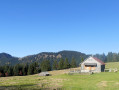
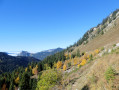
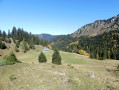
I suggest a lovely circular route starting from La Chèvrerie (Bellevaux) with numerous viewpoints along the way. After reaching the Diomaz waterfall, you will climb three peaks in succession (Pointe des Follys, Tête des Follys and Pointe de Chavannais) before returning via the Pététoz area. The main difficulties are the distance, the elevation gain and the steepness of some of the slopes.

Details

86342958
Creation:
Last update:
Last review:
  • Walking
    Activity: Walking
  • ↔
    Distance: 16.24 km
  • ◔
    Average duration: 8h 15 
  • ▲
    Difficulty: Very difficult

  • ⚐
    Back to start: Yes
  • ↗
    Ascent: + 1,252 m
  • ↘
    Descent: - 1,253 m

  • ▲
    Highest point: 1,826 m
  • ▼
    Lowest point: 1,084 m

Photos

Description of the walk

Departure from the Pont de Lajoux car park at La Chèvrerie (approximately 9 km from Bellevaux).

(S/E) Cross the Pont de Lajoux bridge, then immediately afterwards follow a road on the right that runs alongside the riverbed.

(1) Continue straight ahead until you reach a path coming from La Chèvrerie (towards Lac de Vallon). Shortly afterwards, follow a path on the left at an intersection uphill (no sign). You will soon reach the Saint Bruno Chapel.

(2) Continue straight ahead, following a path that branches off slightly from a house. Further on, join another path on the right at a Y-junction: continue straight ahead along the stream bed, then shortly afterwards cross it twice at two closely spaced fords.

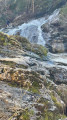
(3) At an intersection, follow the path ascending to the left: the route overlooks the surrounding area for a while and then follows the stream bed. You will reach the foot of the pretty Diomaz Waterfall , where you can see the Croix des Chartreux engraved on a stone.

(4) From this point, there are a few difficulties to be encountered in a rather rugged area (a chain helps with the first few metres). Along the way, it is possible on several occasions to access the waterfall marked by a few potholes.

(5) After fording the stream bed, you will reach a junction: continue to the left (no signposting in this direction), keeping the stream on your left. Another junction is reached further on (if you miss it, you can also follow the next one).

(6) Continue to the right on a path with some steep slopes. Further up, you will reach the end of a forest track.

(7) Continue left on a path with some steep slopes. You will reach a forest hut.

(8) Continue straight ahead on the forest track, then, not far away, follow another track to the left.

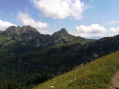
(9) Shortly after passing a small pass (elevation 1542), follow a discreet path to the left: after a steep climb, you will reach a small viewpoint on the right with views of the western sector. Continue along the ridge, then after an intersection, continue straight ahead on a path with steep ascending slopes. Reach the ridge and head for the summit of Pointe des Follys, located a few metres to the left (marked by a cross); there are some views of the eastern sector (notably Pointe de Chalune and Roc d'Enfer).

(10) Continue the route almost due south in the direction of the descent.

(11) At Col des Bétets, continue straight ahead uphill towards Tête des Follys. At the intersection (no sign), turn left and continue uphill.

(12) After reaching the ridge line, you can access the summit a few metres away on the left (beautiful views of the western sector). Continue south along the Arête des Follys ridge (more beautiful views of the eastern sector). You will reach an intersection at Col des Follys.

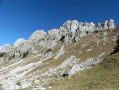
(13) Continue straight ahead on the path, then walk along the foot of the imposing Chavannais cliff (area potentially exposed to rock falls). You will reach another intersection at Col des Charmettes.

(14) Continue to the left and follow the path that joins a ridge line higher up (be careful, you will be passing very close to steep grassy slopes that themselves overlook cliffs).

(15) You will reach the Col des Chavannais: follow a path on the left to reach the summit of Pointe de Chavannais, which is not far away (be careful as the path is directly above cliffs).

(16) Turn back to the Col des Chavannais.

(15) Continue the route to the left on the other side (towards Chalet de Chalan): fairly quickly, follow another less marked path to the left and continue downhill in a rather rocky environment with some steep slopes. Further down, there is a short climb before you reach an alpine pasture: go straight ahead at the intersection (Chavan) and continue downhill.

(17) Just before the Chalet de Chavan (refuge), continue to the right towards the Pâturage de Pététoz: head towards the Pointe de Chavasse, which you then follow at its foot along some steep ascending slopes in a rocky environment (be careful, as this entire area is potentially exposed to rockfalls).

(18) You will come to two steep passages (thefirst is equipped with chains) that require a little caution, then climb up a wide grassy valley.

(19) Continue straight ahead to a Y-junction (known as Pâturage de Pététoz): the route takes you through alpine pastures at the foot of Pointe de Chalune and joins the Col de Jorat, then on to the Chalet de Pététoz.

(20) Near thefirst chalet, turn left towards Pont de Lajoux: the route passes close to a second chalet, then follows a track entering the forest for a descent. Join another track coming from the right.

(21) Continue left on a path where you will encounter a difficult section on steep slopes. Further down, you will come to another path: continue straight ahead.

(22) At the end of the path, follow the carriage road to the left. Shortly afterwards, continue to the right at a place called Lajoux to return to the car park (S/E).

Waypoints

  1. S/E : km 0 - alt. 1,123 m - La Chèvrerie - Pont de la Joux (car park)
  2. 1 : km 0.82 - alt. 1,091 m - La Chèvrerie
  3. 2 : km 1.29 - alt. 1,095 m - Saint Bruno Chapel
  4. 3 : km 1.87 - alt. 1,131 m - La Chèvre
  5. 4 : km 2.31 - alt. 1,196 m - La Croix des Chartreux - Diomaz Waterfall
  6. 5 : km 2.51 - alt. 1,269 m - Croix des Chatreux - Upstream
  7. 6 : km 2.81 - alt. 1,323 m - Intersection
  8. 7 : km 3.09 - alt. 1,400 m - Intersection at elevation 1398
  9. 8 : km 3.62 - alt. 1,484 m - Forest hut
  10. 9 : km 4.45 - alt. 1,541 m - Colet
  11. 10 : km 5.2 - alt. 1,695 m - Pointe des Follys (1713 m)
  12. 11 : km 5.76 - alt. 1,602 m - Col des Bétets (1602m)
  13. 12 : km 6.52 - alt. 1,763 m - Tête des Follys
  14. 13 : km 7.53 - alt. 1,664 m - Col des Follys
  15. 14 : km 8.38 - alt. 1,652 m - Col des Charmettes
  16. 15 : km 8.93 - alt. 1,812 m - Col de Chavannais (1851m)
  17. 16 : km 9.06 - alt. 1,826 m - Pointe de Chavannais
  18. 17 : km 10.48 - alt. 1,590 m - Refuge de Chavan
  19. 18 : km 11.37 - alt. 1,680 m - Cable crossing
  20. 19 : km 11.95 - alt. 1,773 m - Pététoz pasture
  21. 20 : km 14.06 - alt. 1,531 m - Pététoz chalets
  22. 21 : km 14.86 - alt. 1,398 m - Under Pététoz
  23. 22 : km 15.81 - alt. 1,164 m - La Joux Dessus
  24. S/E : km 16.24 - alt. 1,122 m - La Chèvrerie - Pont de la Joux (car park)

Notes

The starting point can be viewed on Google Maps.
Good walking shoes and walking sticks are recommended.
Take your rubbish with you, nature will thank you. I hesitated a little over which route to take

I hesitated a little over which route to choose: initially, I planned to return directly after the Chavan Refuge, but I decided against it because this route involves steep slopes that are not very pleasant going downhill, followed by a relatively long road.
I also hesitated to follow a route via Lac de Pététoz, which is certainly a beautiful place, but it added to the difficulty given the steep slopes and the extra distance to cover.
In the end, I chose this route as it seemed the most balanced to me, despite the additional elevation gain (around 200 metres) and distance (around 2 km) compared to thefirst option with a direct return.

In light of these considerations, I propose the following variations:

  • At the Col de Chavannais, shortly after the point (16), the route can be taken via the Col de Chavan: shortly afterwards, continue straight ahead until you reach a short steep section with a handrail. Continue along a less distinct path before reaching the pass, then turn left onto a trail to rejoin the route of this itinerary further down and then reach the Chavan refuge (point (17).
  • At the Chavan refuge, you can shorten the route by heading straight towards the Pont de Lajoux bridge: the route follows a steep section, then continues for about 2 km on a carriage road to the starting point.
  • At the Pététoz pasture at point (19) or even a little before, cutting across the meadow, you can take a short detour to the Col de Vésinaz for more beautiful views of the eastern side.
  • At the Petetoz chalets at point (20), you can take a detour (about 1.5 km more) to reach the very pretty Lake Petetoz: continue to the right across the meadow on a poorly marked route, then follow the marked trail. Care is required on two steep sections with roots (thefirst before reaching the lake and thesecond after). The return journey is then straightforward, following the forest path.

Below is a detailed breakdown of the difficulty of each section (the route is not uniform):
- green: fairly easy route with no significant elevation gain or difficulty.
- blue: steeper slopes and/or elevation changes on a well-marked trail.
- orange: route presenting some technical difficulties and/or poor route viability (markings or visibility of the path).
- red: difficult route due to significant elevation changes that may require some climbing, in an environment with some hazards.
- black: route on a fairly difficult trail and/or with adjacent hazards.
- white: route in very difficult technical environments requiring certain equipment.

From (S/E) to (2). Green difficulty
An easily accessible road is followed.
Markings: Yellow arrows + signposts.

From (2) to (4). Blue difficulty
A path running alongside the Diomaz stream is easy to follow in "normal" conditions. Access is not recommended in case of rain and high water (warning sign) and especially at fords. At point (3), you can also follow the direction to the right: this route is less difficult, but it avoids the Diomaz Waterfall area (note that you will have to ford the stream).
Markings: Yellow arrows + signposts.

From (4) to (5). Orange difficulty
From this point, the route becomes quite rugged: after a short section aided by a chain, the path continues via a series of more or less natural steps amid numerous roots. The stream is forded again before reaching an intersection.
Markings: Yellow arrows + signposts.

From (5) to (6). Blue difficulty
A path is then followed with few difficulties to encounter.
Unmarked section.

From (6) to (7). Blue difficulty
The route follows a trail with a few steep slopes but no technical difficulties before continuing on a forest track.
Unmarked area.

From (7) to (8). Blue difficulty
The trail follows moderate slopes, then becomes more steep.
Unmarked area.

From (8) to (9): Green difficulty
The route is easier to follow along forest paths.
Unmarked area.

From (9) to (10). Orange difficulty
Follow a discreet path at the start, then tackle a few steep slopes up to the 1,625 metre contour line. The route then continues without any significant elevation gain along the ridge line, then after an intersection it climbs up slopes that gradually become steeper.
Marked with red dots.

From (10) to (11). Green difficulty
The route is easy to follow along a footpath.
Unmarked section.

From (11) to (12). Blue difficulty
The trail follows moderate slopes uphill, which become steeper shortly after the intersection.
Unmarked area (only one signpost at the pass).

From (12) to (13). Green difficulty
The route is easy to follow along a trail that follows the ridge line (Arête des Follys)
Unmarked section.

From (13) to (14). Blue difficulty
This section runs along the foot of the long Chavannais cliff (area potentially exposed to rockfalls) in an increasingly rocky environment.
Signposts + old GR® country markings in yellow and red

From (14) to (16). Blue difficulty
Follow a path in an alpine environment without encountering any significant difficulties; on the ridge line, take care at the edge of steep grassy slopes overlooking cliffs. Shortly afterwards, access to Pointe de Chavannais is directly at the edge of the cliffs and requires a minimum of vigilance (caution).
Markings: Yellow arrows + signposts.

From (16) to (17). Difficulty: Orange
Shortly after the Col de Chavannais, you turn onto another path (no sign at the start): this path winds through a rocky environment with some steep slopes that can be slippery underfoot. At the bottom of the route, the path winds through alpine pastures where it is less visible. After the Chavan intersection, follow a well-marked path.
Yellow markings until the Chavan junction, then old GR® yellow-red markings and signposts.

From (17) to (18). Blue difficulty
The route is fairly easy at first, then changes to a rocky environment at the foot of some cliffs, with a few steep slopes (area potentially exposed to rockfalls).
Markings: Yellow arrows + old GR® country markings in yellow and red + signposts.

From (18) to (19): Blue difficulty
There are two steep sections close together: the first is equipped with chains, the second is less critical and is not equipped; both require a minimum of attention. The route then becomes easier as it climbs up a grassy valley.
Markings: Yellow arrows + old yellow-red GR® country markings + signposts.

From (19) to (20). Blue difficulty
Follow a downhill path with no excessive difficulties. The route then continues for a short while along the mountainside with slight elevation changes, then descends more steeply before reaching the Chalets de Pététoz.
Signposting: Yellow arrows + old GR® country signposting in yellow and red + signposts.

From (20) to (21): Blue difficulty
A carriageway with no excessive gradients is followed downhill.
Markings: Yellow arrows + signposts.

From (21) to (22). Blue difficulty
At the start of the section, you continue on a rough path with steep slopes. The rest of the route is then easier.
Markings: Yellow arrows + signposts.

From (22) to (S/E). Green difficulty
An easily passable road leads to the initial starting point.
Markings: Yellow arrows + signposts.

Worth a visit

  • Diomaz Waterfall: read the Wikipedia article
  • Pointe de Chavannais
  • Pointe de Chalune: read the Wikipedia article
  • Lac de Pététoz: read the Wikipedia article

 Always be cautious and plan ahead when you're outdoors. Visorando and the author of this route cannot be held responsible for any accidents occurring on this route.

The GR® and PR® markings are the intellectual property of the Fédération Française de Randonnée Pédestre.

Other walks in the area

For more walks, use our search engine .

The GPS track and description are the property of this route's author. Please do not copy them without permission.