Tour of the Bienne hills from Morez

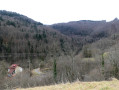
From Morez, I suggest a lovely route overlooking the Bienne Valley, mainly through woodland, with a few scenic viewpoints. The length of the route and a few steep slopes are the main challenges (see the Practical Information section).

Details

68896415
Creation:
Last update:
Last review:
  • Walking
    Activity: Walking
  • ↔
    Distance: 13.30 mi
  • ◔
    Average duration: 8h 25 
  • ▲
    Difficulty: Difficult

  • ⚐
    Back to start: Yes
  • ↗
    Ascent: + 2,671 ft
  • ↘
    Descent: - 2,667 ft

  • ▲
    Highest point: 3,615 ft
  • ▼
    Lowest point: 2,024 ft

Photos

Description of the walk

Update by the author on 17/02/2025:

- minor corrections to the route,

- correction to the "Practical information" section: following changes to the location of Waypoints, the comments between (2) and (6) had become incorrect.

Park at the start of Chemin des Pêcheurs in Morez, near Route de Saint-Claude, where parking spaces are available.

(S/E) Head towards the Route de Saint-Claude D126 and follow it to the left towards Le Trou Bleu. Pass under the Saillard Viaduct, which is a lovely spot, and further on you’ll reach a large open area at a place called Doye Gabet.

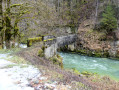
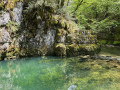
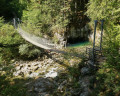
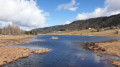
(1) Head left, then keep left along the path to reach the Himalayan footbridge; cross the Bienne via the bridge. Take a moment here to view the Trou Bleu resurgence. Turn left and follow the left bank of the Bienne until you reach a junction of paths.

(2) Take the path on the right, leaving the signposted section. You will soon come to the GRP® Tour de la Haute Bienne, marked in yellow and red. Follow it to the right, then keep right as you follow the D69 for a few metres. Then turn left, still on the GRP®, and head towards the Maison Lamartine junction.

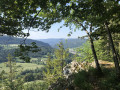
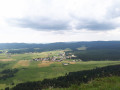
(3) Continue along the GRP® to reach the Belvédère de la Roche au Dade junction, turn left, and head to this viewpoint to enjoy a lovely vista.

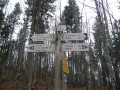
(4) Retrace your steps, then continue left towards the Belvédère du Béchet. After a short climb, begin a long descent followed by another, always following the yellow-red markings. You’ll reach a four-way junction at a place called Les Mouguettes, where there’s a large signpost.

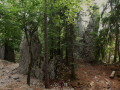
(5) Continue straight ahead to reach the viewpoint after Les Mouguettes. From there, go straight on to a signposted junction: about 200 metres further on, turn left onto a path towards La Roche Fendue.

(6) Continue along the path, but be careful: when I was there, the signposting was patchy in places in this area due to tree felling. Continue down the slope to the final viewpoint, the Rocher du Béchet.

(7) Continue on the GRP® to the right downhill, then start the climb to reach the hamlet of Sur le Bévet. Junction with the GR® 559.

(8) Take a small road on the right, arriving at the crossroads at the hamlet of Sous le Bévet.

(9) Turn right towards La Mouille, following another path: after about 200 metres, turn left onto a footpath (marked with red and white signs). You will reach another junction.

(10) Continue left towards La Mouille, following the red-and-white markings; follow this route until you reach the Bévet crossroads.

(11) Carry on straight ahead, following the small road downhill. You will reach the village of La Mouille.

(12) Cross the D69 with care, then first turn left then right, following the Chemin de la Bienne. You will soon come to a T-junction.

(13) Turn right into the large meadow towards the buildings. The path then leads through the undergrowth to reach the bed of the River Bienne further down.

(14) Cross the footbridge, then take the path opposite, heading uphill on a concrete surface. At the top of the hill, pass a house and follow the road to the left for about ten metres. Turn sharply right. Cross the level crossing with care. Then follow a path at a bend to reach a small road. Leave the GRP® and GR® trails.

(15) Cross the road and take the path on the right. Walk uphill and, via a double hairpin bend, reach a junction above Les Cuisiniers.

(16) Continue by following the yellow markings, pass under a power line and complete the climb. You will then begin a new descent. Take care on this section, which is in a fairly open area where the markings are not very clear; stay on the main path, ignoring the branches to the right and left. Further down, you will reach the village of Les Buclets d’Aval.

(17) Follow the small road to the right for a few metres, then turn left onto a path running parallel to the D26 until you reach the entrance to Morbier.

(18) Follow Route des Roches to the right, then continue along Route leat to reach the junction with the N5, which is also known as the Route Blanche.

(19) Turn right onto it for about a hundred metres, then turn right onto a path with a few steps. Follow the GRP® signposts to reach the junction with the Route de Saint-Claude.

(20) Turn right onto it to quickly reach the car park on Rue des Pêcheurs (S/E).

Waypoints

  1. S/E : mi 0 - alt. 2,280 ft - Les Pêcheurs - Morez
  2. 1 : mi 0.84 - alt. 2,320 ft - Doye Gabet
  3. 2 : mi 1.16 - alt. 2,267 ft - Junction
  4. 3 : mi 1.93 - alt. 2,680 ft - Maison Lamartine crossroads
  5. 4 : mi 2.35 - alt. 2,992 ft - Roche au Dade
  6. 5 : mi 3.07 - alt. 3,156 ft - Les Mouguettes
  7. 6 : mi 3.46 - alt. 3,212 ft - Roche fendue
  8. 7 : mi 3.98 - alt. 3,028 ft - Rocher du Béchet
  9. 8 : mi 4.54 - alt. 3,028 ft - On the Béchet
  10. 9 : mi 4.73 - alt. 3,097 ft - Under the Bévet
  11. 10 : mi 5.09 - alt. 3,422 ft - The three markers
  12. 11 : mi 6.6 - alt. 3,215 ft - Le Bévet
  13. 12 : mi 7.14 - alt. 2,999 ft - La Mouille
  14. 13 : mi 7.4 - alt. 2,927 ft - Towards Chez Beaud
  15. 14 : mi 8.74 - alt. 2,024 ft - Footbridge
  16. 15 : mi 9.26 - alt. 2,461 ft - Le Cautard
  17. 16 : mi 10.34 - alt. 2,730 ft - Les Cuisiniers
  18. 17 : mi 11.18 - alt. 2,779 ft - Les Buclets d'Aval
  19. 18 : mi 11.88 - alt. 2,710 ft - Route des Roches - Morbier
  20. 19 : mi 12.75 - alt. 2,651 ft - Route Blanche - RN5 - Morbier
  21. 20 : mi 13.15 - alt. 2,287 ft - Les Essarts - Morez
  22. S/E : mi 13.3 - alt. 2,280 ft - Les Pêcheurs - Morez

Notes

The starting point can be viewed on Google Maps (satellite view): click here.

We recommend wearing good walking boots and using walking poles.

Take your rubbish home with you; nature cannot digest it.

Below is a difficulty rating for each section (the route is not uniform):
- green: fairly easy terrain with no significant elevation changes or difficulties.
- Blue: slopes and/or elevation changes are more pronounced on a well-marked route.
- Orange: routes presenting some technical difficulties and/or poor route conditions (markings or visibility of the path).

From (S/E) to (1): Green difficulty
This section is a fairly comfortable ride along a small road.
Yellow markings

From (1) to (2): Blue difficulty
The slight difficulty lies in the descent towards the footbridge over steep slopes. Alternatively, you can follow the discovery route (partly or even entirely), starting a little way past the main route (see the description of the Bienne Discovery Route for more details)
Yellow markings

From (2) to (3): Blue difficulty
Sections of paths and roads are followed without major difficulty (at most, caution is required along the RD69 road)
Unmarked until the junction, then Yellow-Red markings (GR® de Pays).

From (3) to (4): Green difficulty
Continue along a small road, then follow a path up a few steep slopes leading to the viewpoint.
Yellow-red markings (GR® de Pays).

From (4) to (6): Green difficulty
From here, follow a path over a few steep slopes. Further up, you can choose between two routes that converge relatively quickly: either straight ahead, following this route, or to the left, following the IGN route (the latter being more gradual). The rest of the route is relatively straightforward.
Yellow-red markings (GR® de Pays).

From (5) to (6): Green difficulty
The route to follow is not very complicated: it follows a forest track to the large sign marking the junction, then continues left onto a path.
Yellow-Red markings (GR® de Pays).

From (6) to (8): Blue difficulty
The route follows a path with no significant elevation gain. At most, I noticed on my last visit that the waymarking was patchy at times due to tree felling (markings missing).
Yellow-Red markings (GR® de Pays).

From (8) to (9): Green difficulty
The route follows a very easy, vehicle-accessible track.
White-red markings (GR® 559).

From (9) to (10): Blue difficulty
After the junction, the route continues along an easy track. After the fork, the route suddenly becomes a path with a steep uphill gradient.
White-red markings (GR® 559).

From (10) to (11): Blue difficulty
After the fork, continue along an uphill path until you reach the second junction. From there, follow an easy downhill path for a good distance.
White-red markings (GR® 559).

From (11) to (12): Green difficulty
It’s a fairly easy walk along a small road leading to La Mouille
White-red markings (GR® 559).

From (12) to (14): Blue difficulty
The route is straightforward, with generally gentle gradients. At most, just before reaching the River Bienne, the gradients are a little steeper.
White-red markings (GR® 559).

From (14) to (18): Blue difficulty
The route follows a sustained incline (almost steep at times) along a concrete path.
White-red markings (GR® 559). The route follows a small road, then a path with steeper gradients.
White-red markings (GR® 559). For a long stretch, you follow an easy path that is initially mostly uphill. After the point (16), you must pay close attention to the direction at the junctions you encounter, where the markings are rather inconspicuous.
Yellow markings

From (18) to (19): Green difficulty
This section follows a small road (much of which is closed to traffic) and is very easy to walk.
Yellow markings

From (19) to (20): Green difficulty
Follow a very well-maintained path with a few steps.
Yellow-red markings

From (19) to (20): Green difficulty
Return via urban routes to the starting point.
Yellow markings

This route passes through a protected area, which may be subject to special regulations:

Worth a visit

Morez: this is the town particularly associated with the eyewear industry. To find out more, read the Wikipedia article.

Ligne des Hirondelles: this is a railway line between Andelot and Saint-Claude and is one of the most beautiful in France. In Morez, the engineering structures are truly remarkable. To find out more, read the Wikipedia article.

Maison Lamartine: for more information, see the link. The building was unfortunately destroyed by fire on 9 December 2024: for more information, read the France 3 article.

Always be cautious and plan ahead when you're outdoors. Visorando and the author of this route cannot be held responsible for any accidents occurring on this route.

The GR® and PR® markings are the intellectual property of the Fédération Française de Randonnée Pédestre.

Other walks in the area

For more walks, use our search engine .

The GPS track and description are the property of this route's author. Please do not copy them without permission.