Stanley Spencer's Cookham

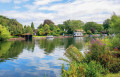
Sir Stanley Spencer was one of the most important painters of the 20th century. This walk will take you round his home village, a place he regarded as ‘heaven on earth’. It also ventures out into the surrounding countryside and alongside the Thames.

The locations of several of his paintings are highlighted in the description with more details in the "to do or see" section.

Details

51309559
Creation:
Last update:
Last review:
  • Walking
    Activity: Walking
  • ↔
    Distance: 6.06 km
  • ◔
    Average duration: 1h 45 
  • ▲
    Difficulty: Easy

  • ⚐
    Back to start: Yes
  • ↗
    Ascent: + 17 m
  • ↘
    Descent: - 17 m

  • ▲
    Highest point: 46 m
  • ▼
    Lowest point: 24 m

Photos

Description of the walk

Start: Stanley Spencer Gallery, High St, Cookham (SL6 9SJ). Grid ref: SU 897 853.

(S/E) From the (C) Stanley Spencer Gallery, walk along the High Street past the Kings Arms to a house called (D) Fernlea. Continue along the High Street as far as the (E) War Memorial. Continue in the same direction and cross School Lane to join the surfaced path that runs parallel to the road. This path is known as (F) The Causeway.

(1) At the end of The Causeway continue straight ahead, walk past the mini roundabout and take the pedestrian crossing over the road.  Turn left along the pavement to Belle Vue Cottages in (G) The Pound. Walk along for a few metres and turn right into Poundfield Lane.

(2) The rough track climbs gently uphill and, just past a field gate, arrives at a large house on the right, (H) Englefield. Continue up Poundfield Lane to road junction. Turn left and immediately right on a rough track through a car park. Go through a barrier and along the edge of the golf course.  Take in the (I) view on the right towards the village, as well as Cliveden and Hedsor in the far distance.

Walk along the edge of the golf course. Ignore the path on the left over the railway bridge and stay on the field edge down a set of steps to a path junction.

(3) Turn left through a gate, go under the railway bridge and bear immediately right through a kissing gate. Walk straight on, go through the next gate and follow the path round the bottom of Cockmarsh Hill to reach an old wooden walkway (now closed)..

(4) Turn right just before the walkway and continue straight ahead across Cock Marsh. While crossing the marsh, look at (J) Cockmarsh hill behind. Continue across the marsh and keep to the right of the mound to reach the bank of the Thames opposite the Upper Thames Sailing Club.

(5) Turn right along the bank of the Thames and go through a kissing gate. Stay on the path past The Bounty pub, under the railway line and follow the riverbank for over 1km towards Cookham Reach Sailing Club. Go through two gates past the Club into (K) Bellrope Meadow. Walk to the end of the meadow and bear right on the surfaced path into the grounds of (L) Holy Trinity Church.

(6) On the right, 20m past the end of the church, is Spencer’s memorial headstone, and at the end of the path by the gate is a statue of an angel. Just before the gate, turn sharp left on an almost hidden path that runs alongside the boundary wall past the end of the church. Go through a gate and turn right onto a gravel driveway. Turn left and take the path between River Gate and Stable Cottage to the riverbank by Ferry Cottage and (M) Cookham Bridge.

(7) Turn right, go under Cookham Bridge, along the wooden walkway and past the front of (N) The Ferry pub to meet the end of Ferry Lane. Turn right up Ferry Lane to its junction with Odney Lane.

(8) Turn right, cross the main road and turn left along the pavement to return to the Gallery and the end of the walk. (S/E)

"We hope you have enjoyed your walk.  Please remember to rate the walk and add comments. We are interested in how we could improve the instructions or the route and would like to hear about any issues with paths on the walk."

Waypoints

  1. S/E : km 0 - alt. 29 m - Stanley Spencer Gallery
  2. 1 : km 0.64 - alt. 28 m - End of Causeway
  3. 2 : km 0.9 - alt. 29 m - Poundfield Lane
  4. 3 : km 2.25 - alt. 29 m - Left through gate
  5. 4 : km 2.81 - alt. 32 m - Cock Marsh
  6. 5 : km 3.38 - alt. 27 m - Thames
  7. 6 : km 5.52 - alt. 32 m - Churchyard
  8. 7 : km 5.8 - alt. 30 m - Under Cookham bridge
  9. 8 : km 6 - alt. 30 m - Odney Lane
  10. S/E : km 6.06 - alt. 29 m - Stanley Spencer Gallery

Notes

Start: Stanley Spencer Gallery, High St, Cookham (SL6 9SJ). Grid ref: SU 897 853.
Parking: Small Council car park just South of the Gallery. If this is full, use one of the Alternative start points

Local transport: Bus 37 runs between High Wycombe and Maidenhead, Monday to Saturday. Cookham station is served by the Great Western Railway's Marlow branch line. It has direct trains to and from London Paddington during peak hours. Full details can be found on www.travelinesoutheast.org.uk

Alternative start: The walk can also be started from either Cookham Station, Station Hill, Cookham (SL6 9BP) or the National Trust car park, The Pound, Cookham Moor (SL6 9SB) Grid ref: SU 892 853. Why not visit the gallery to find out more about this fascinating artist and his work?

Terrain: An easy stile-free walk along pavements and country paths. One modest climb and several gates.

Food & Drink: There are a choice of pubs and cafes in Cookham and on the route The Bounty Pub, Cock Marsh

Maps: OS Explorer 172, Chiltern Society 32

Note: Our special thanks go to Ann Danks, Archivist at the Stanley Spencer Gallery, and Stephen Palmer, for their support in producing this walk.

Worth a visit

(A) Cookham The history of the area goes back before Roman times. It’s thought that a Roman road from Silchester to St Albans crossed the Thames at a nearby bridge. Evidence also suggests there were Anglo-Saxon settlements. In the Middle Ages Cirencester Abbey owned most of the land. Development over subsequent centuries was limited by frequent flooding from the Thames. Expansion did take place over the higher ground around The Pound, and accelerated with the arrival of the railway in 1854.

(B) Stanley Spencer was born in Cookham in June 1891 to William Spencer, a church organist and music teacher, and his wife, Annie. He was home educated in a school run by his sisters Annie and Florence. He took art lessons at Maidenhead Technical College before entering the Slade School of Fine Art in London. At the outbreak of WWI he joined the Royal Army Medical Corps (RAMC), and his experiences had a lifelong effect on his work. After the war he was commissioned to paint an epic series of large-scale murals at the Sandham Memorial Chapel at Burghclere, but much of his art, including his religious works, featured the village life of Cookham. During WWII he was commissioned to paint scenes of shipbuilding near Glasgow. He was married twice, to Hilda Carline and later Patricia Preece, but his private life was very complicated. In 1959 he received a knighthood at Buckingham Palace, but died on 14th December the following year.

(C) The Stanley Spencer Gallery, established in 1962, is home to the world’s largest collection of his works, and has an archive of letters, photographs, press cuttings and books. The building is a former Wesleyan Chapel built in 1846. Spencer attended the chapel with his mother, whose brother had been a local preacher there. In 2007 the Gallery was reopened, after renovation which created a modern, light space that displays Spencer’s works to their best advantage.

(D) Fernlea Spencer’s birthplace. Folklore says that at the time of his birth a crow fell down the chimney, flapped around and flew out the window. The house featured in a number of paintings including ‘Neighbours – 1936’ and ‘Christ Carrying the Cross – 1920’.

(E) The War Memorial carries the name of S Spencer MC. This was Sydney, Spencer’s beloved elder brother, who died in the last few weeks of WWI.

(F) The Causeway Spencer would walk along this path every day on his way to the railway station and his journey to The Slade School of Fine Art in London, the premier art school in the country. He picked up the nickname ‘Cookham’ because of his love for the village, and his habit of coming home from London every day after classes. This walk is captured in the painting ‘Cookham Moor – 1937’.

(G) The Pound The front gardens of these cottages were featured in the painting ‘Gardens in the Pound - 1936’.

(H) Englefield was built in the 18th century and is Grade II listed. Many of Spencer’s paintings are associated with this property, including ‘Cookham from Englefield – 1948’ and ‘Wisteria at Englefield – 1954’.

(I) The View Just peeping through the trees on the horizon is the tower at Cliveden. On the hillside to the left is the beautiful hilltop church of St Nicholas, Hedsor. The Spencer family had strong connections to the church – Stanley’s father, William, was its choir master and organist. When William was playing a loud piece of music, Stanley and his brother Gilbert would be required to blow the bellows. The view was also the scene for one of Spencer’s more notable paintings, ‘The Scarecrow – 1934’.

(J) Cockmarsh Hill: Spencer would walk to top to capture the views. A particular painting of note was one of his second wife: ‘Patricia at Cockmarsh Hill – 1935’.

(K) Bellrope Meadow The name originates from the days when the area was used for the manufacture of rope.

(L) The Church and Churchyard Holy Trinity is a 12th century, Grade II listed church with many later additions. It has some traces of Saxon masonry. In many of his paintings Spencer used both local people and landmarks as the backdrop to religious scenes. This is reflected in one of his most important works, ‘The Resurrection, Cookham – 1924-26’, in which he used neighbours and family members as models. On the right just past the end of the church is Spencer’s memorial headstone, and at the end of the path by the gate is a statue of an angel.  This became ‘The Angel, Cookham Churchyard – c1936-37’.

(M) Cookham Bridge: Spencer spent a lot of time in and around the river, and this was reflected in his paintings, including ‘View from Cookham Bridge – 1936’.

(N) The Ferry Pub was the scene of Spencer’s famous painting ‘Christ Preaching at Cookham Regatta – 1952-59’, unfinished at his death and available to view in the Spencer Gallery.

Reviews and comments

5 / 5
Based on 1 review

Reliability of the description
Not used
Ease of following the route
Non utilisé
Route interest
5 / 5
Delphinium
Delphinium ★

Overall rating : 5 / 5

Date of your route : May 26, 2024
Reliability of the description : Not used / Not applicable
Ease of following the route : Not used / Not applicable
Route interest : ★★★★★ Very good
Very busy route : No

I did this route on an organised walk led by Andrew from Chiltern Society and Anna from the Gallery during the Chilterns Walking festival and it was really interesting ! I had no clue who was Stanley Spencer. I really advise you to enter the gallery before heading for the walk so you get the full experience and the explanation at the bottom of the description of this walk sheet will help you remember the most important facts. Thank you for this arty experience and discovery.

Other walks in the area

For more walks, use our search engine .

The GPS track and description are the property of this route's author. Please do not copy them without permission.