Country:

 City:
City:


Following the D2202 towards the Gorges du Daluis, drive 300 m past the hamlet below the village of Daluis and turn right towards Liouc. Park just before the Pont Durandy on the right (marked as Pont du Chaudan on the map).
(S/E) From the car park, cross the Pont Durandy, a long, historic bridge inaugurated in 1928.
(1) Turn left at signpost 103 towards the Col de Roua. The rocky, steep path climbs immediately.
(2) When you reach the track, marked by signpost 106, turn left towards the Collet de Larmelle. Shortly afterwards, turn right at signpost 107, still heading towards the Collet de Larmelle.
(3) Just before the houses, turn left to continue along this track, which is also suitable for vehicles. Pass the hamlet of Liouc.
(4) At the unnumbered marker, veer left and follow the signs for Larmelle along this pleasant wooded path which leads out onto a mountain pasture. During the climb, ignore any side paths branching off.
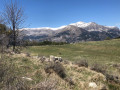
(5) From this area, we can see the wide grassy small pass known as “Le Collet de Larmelle”.
After this bend, walk for about a hundred metres and turn left 180°, off the path, across the fields. The grassy area climbs and joins a track, which you follow for about a hundred metres to the left.
Leave the track at the bend and take the clearly visible path to the right. After the climb, the path skirts a first peak to the left. After this bend, the route continues on sight along paths somewhat hidden by boxwood and pine vegetation. For the final few metres, cross the small wood.
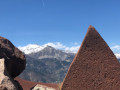
(6) The summit of the Tête du Giordanet is marked by a 3-metre-high wooden hunting blind. Take a moment to admire the peaks of the Alpes de Haute Provence. Turn back and retrace your steps, but veer off towards the south and then south-east towards the small pass of Larmelle.
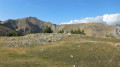
(7) At Small Pass de Larmelle: altitude 1,344 m, marker 252, a vast expanse of short grass surrounds us. Continue a few metres towards Col de Roua and climb up to the right to discover, behind a slope, a beautiful stone sheepfold. Then continue along the track.
(8) At marker 252a, turn left following the sign for Col de Roua along this pleasant, wooded, downhill path. Pass marker 252b. The end of the path marks a change in vegetation and colours.
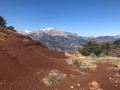
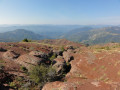
(9) At this point, you reach the Col de Roua, at an altitude of 1,244 m, amidst Californian-style vegetation. The reddish colour of the pelite contrasts with the green of the forest you have just left. Continue for about fifty metres and turn right at marker 251. Continue along the path towards the Vallon d’Amen. This joins a track at marker 141. Turn right and follow the track.
Fading yellow markings
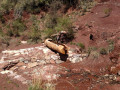
(10) At the bend to the right at the ridge, leave the track and head straight ahead, where two cairns mark the start of the path. Descend for 10 metres and turn right so as not to miss the start of the path, which winds through reddish and grassy areas. There are few yellow markings; the cairns are very useful, as are the Visorando app or a GPS. Walk past the stone barns at Roua and continue across these reddish fields towards the River Var, which flows below.
(11) At marker 110, at the crossroads of paths, turn left towards Pont de Durandy, the only path leading down to the Var. Continue down this section to the Himalayan bridge.
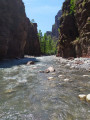
(12) Cross the Himalayan bridge, a recent construction about a hundred metres long spanning the Var. The reddish cliffs at the entrance to the Gorges du Daluis are nearby. At the end of the bridge, climb the steps and the steep path to reach the D2202. Continue along the path below the road.
(13) Walk past the picnic area, then follow the road towards Daluis. Please note that this tourist road has heavy traffic – take care.
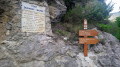
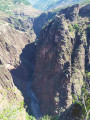
(14) At the signpost, leave the D2202 and turn left towards Pont Durandy. Follow the stony path. Magnificent cliffs line the path. Towards the end, the sheer edge is very well secured by a metal barrier (S/E).



 Visorando Member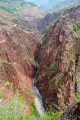
 Moderate
 Easy
Easy 
 Extremely difficult