Country:

 City:
City:


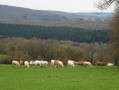
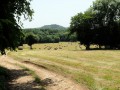
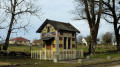
(S) Car park in Rurey, Rue de l’Église, below the Church of the Nativity of Saint John the Baptist. Head right towards the wash house and drinking trough. Take the time to walk around it. Pass between the drinking trough and the church wall to reach the botanical trail. You’ll pass by spring catchments and various botanical information boards. At a sign prohibiting cyclists, the path forks; take the left-hand track which runs alongside the pasture. Continue along this path until it joins a farm track, which you cross to continue in the direction indicated by a ‘Belvédère’ sign.
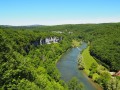
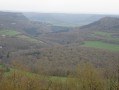
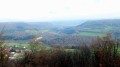
(1) You arrive at the viewpoint overlooking Cademène, the Loue valley and the Jura mountains. At the picnic table, two paths branch off; take the one on the left which runs alongside the small rocky outcrop. Take care where you step, as the stones can cause you to trip. From this point, follow the description carefully, as there will be no further signposting to guide you. You will be accompanied throughout by the scent of boxwood, typical of the limestone hills of our region. The path joins a wider one that continues to follow the rocky ledge, moving away from it very slightly. A landmark: an ONF Cademène No. 6 signpost. The path is marked with orange forestry strips. Ignore the cross-trails leading into the woods. You won’t get lost if you follow the path, which never strays more than ten metres from the rocky edge. At an old fallen boundary stone and an ONF Cademène 31 sign, there is a fork. Take the left-hand path. Your path joins a track running down the hillside at a right angle. Follow this track uphill to the right for about a hundred metres.
(2) Circling round a tree, the path turns left. At another marker, a track branches off at right angles towards the woods (ONF sign for the Commune of Rurey No. 32); keep going to the left. Look for the ONF Communes de Rurey No. 33 & 34 signs on the right-hand side of the path; they will point you towards a path that climbs straight up into the woods. If you go past the junction, the path ends abruptly a few metres further on, at a track that runs straight down the hillside. Turn back a few steps.
(3) Follow this path straight up to reach a stony forest track, which you follow down to the left.
(4) At the start of a right-hand bend, take the first forest track that branches off to the left. Caution! At this bend, other paths join; make sure you take the first one. 100m further on there is a fork: take the right-hand path. At the start of the descent, an ONF sign No. 37 marks a crossroads; continue straight on along the descending path. After about thirty steps, take the path on the left.
(5) The path approaches a clearing; leave it here and head into the pasture, climbing over the fence with its sagging barbed wire – watch your trousers, I left mine there! If you want to avoid them, you’ll need to continue along the path to Cademène, adding 5 kilometres to the hike. Head down the pasture towards the cattle shelter. There’s a lovely view of the Déservillers and Montmahoux hills and the Gouille Noire. Go through the gate, making sure to close it properly.
(6) You’re now on a small tarmac road, Le Chemin des Barraques, which you’ll take to the right and which will lead you back to Rurey. Follow the signposting for the VTT 91 route, ignoring the roads branching off to the left. Along the way, there are lovely views of Mont Poupet and the castle at Châtillon-sur-Lison.
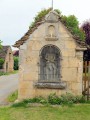
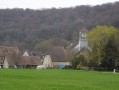
(7) A short stop at the wayside shrine, where a lovely statue of the Virgin Mary and a bench await you, and you will soon come within sight of the village and its church, nestled amongst the greenery. There is also a view of Mont d’Or, more modest than that of Métabief, and the village of Epeugney with its bell tower, cosily nestled in the hollow of the hills
.
(8) Head back up the D101 towards Rurey until you reach the fountain. Then turn right into Rue du Bourbat, then left into Grande Rue, following the signs for the botanical trail, taking the time to stop at another wash house fountain. You will soon reach the car park.
 The route includes rocky ledge paths. You must therefore walk carefully and cautiously, as the rocky outcrops could cause you to trip; wearing good shoes is essential and the use of walking sticks is recommended.

 Visorando Member


 Average