Country:

 City:
City:



(S) Parking is available on the small square in front of the cemetery at the entrance to the village when coming from Cléron.
Take the path that runs along the cemetery wall towards the village (yellow-red and yellow-blue markings). You will reach the D107, head towards the centre of Amondans, in the direction of the source of the Lison. At the war memorial, turn right towards the village square and continue with your back to the monument in the Grande Rue. Don't forget to take a look at the old 18th-century farm at 3 Grande Rue and the cheese dairy lintel at No. 2, dating from 1846.
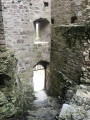
(1) Turn into the first street on the left (Rue Pommery). You will pass in front of the church and a little further on, at the corner of Rue de la Fontaine, you will see an old house with an overhanging turret, the oldest remains of the Château d'Amondans, whose defensive nature is confirmed by the presence of arrow slits and embrasures. Pass to the left of the turret until you reach the entrance to the new castle, built at the end of the 19th century by the Pommery champagne family. Retrace your steps.
(2) Go down Rue de la Fontaine on your right. You will pass an old wash house and drinking trough on your left, dating from 1852. Four symmetrical pilasters support a roof of lauzes, flat stone tiles commonly used in the Lison valley, which are five to six times heavier than traditional tiles and therefore require a more solid framework. This fountain replaced the drinking trough on the D103, which was set into the rock and had become dangerous due to falling rocks.
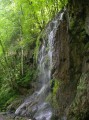
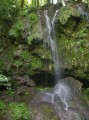
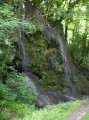
(3) You will reach the D103 road at the edge of the village, which you will follow downhill. You will pass the old drinking trough under the rock. After the bend, as you leave the grove, you will have a charming view of the back of the village. You can also continue 50 metres to the left on a stony path that leads to a waterfall.
(4) Return to the D103 and continue for 2 km until you reach a fork in the road. Turn right onto the D103 towards Lizine. About a hundred metres after the small bridge over the Malans stream, on your left in the bend, you will see a small oratory hidden among the fir trees, containing a statue of the Virgin and Child. You will need to enter the pasture.
(5) Continue towards Val Sainte-Marie with its old holiday camp with retro charm. From 1834 to 1849, 34 Trappist monks from Switzerland lived in this cloister. Pass the Roucheret farm and you will soon arrive at the Gouille Noire viewpoint.
(6) You will spot it by two green signs about a kilometre from the holiday camp, in a hairpin bend, where a small gravel path on the right will lead you there. At the bottom of the valley, a waterfall ends its descent into a pool of water: the Gouille Noire. The term gouille, from the Germanic gullja, refers to a depression filled with water. Back on the departmental road, follow it towards Lizine, ignoring a signpost on the right about 60 metres away inviting you to visit the Piquette viewpoint. We will get there by another route.
(7) At the edge of the woods, turn left at the Conseil Général signposts and take the stony path that climbs into the forest. There are few signposts to guide you, but follow the path without fear. It runs along the edge of the forest for most of the way, then moves away from it as it climbs. This forest path joins a small tarmac road at a bend, which you will follow downhill to the right. You will soon see the village of Lizine.
(8) 200 metres from the village, on the left, look out for a sign pointing to the pretty Villevoz fountain and its stepped basins, built in 1663. After 50 metres, turn left again, passing between wooden barriers.
(9) You will arrive in the village via Rue de la Tendue. Turn right onto the main street and, at the corner with Rue de l'Église, you will see a wash house dating from 1884 and an oratory dedicated to the God of Mercy, built in 1668 in gratitude by the villagers for having escaped cholera. The niche contains two statuettes, a Saint Céphalopore and a kneeling saint, and in the centre a Christ awaiting torture, which is probably older than the oratory. My route takes you to the church, but don't hesitate to explore this charming village. On the way up to the church on the left, you will see an old lean-to with a slate roof. Walk around the church. Just before you reach it, you will see the old presbytery with its terracotta tile cladding and a magnificent calvary erected around 1500 within the parish enclosure. Push open the church gate to take a look at the war memorial and the bell tower.
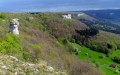
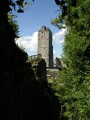
(10) When you reach the town hall, turn your back on it and walk down Rue du Moulin, ignoring the grassy hiking trail, theGR®590, and continue on the D135 despite the yellow-red and yellow-blue crosses that invite you to turn back. On your left, you will see the castle and hill of Châtillon-sur-Lison. Enter the woods and follow the departmental road for 100 metres. On your left, after a wooden bench, you will find the Moulin Sapin viewpoint, which offers a beautiful view of the Lizine bell tower and the Lison valley.
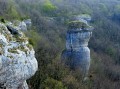
(11) Return to the road and cross it to reach a small path about fifty steps away, which joins perpendicularly with a wider path that you take to the left. Soon you will come to a fork; head right towards the Piquette viewpoint. The path approaches the cliffs, which are blocked by a rustic barrier. Climb up to the right for about a hundred metres to reach the viewpoint over the Loue valley. It took more than five million years to create this magnificent landscape of meanders and gorges.
(12) Retrace your steps back to the previous fork at the fir tree trunk barriers and, despite the yellow-blue cross blocking the way, go down the path that runs along the cliffs. You will reach the D135 at a bend, go down it for a few metres and immediately turn right onto a small descending path. Cross the departmental road again to reach another path on the opposite side, and do the same again at the next bend. Cross the D135 once more and follow a beautiful, marked stone path for about 30 metres, which descends towards the Lison. At a signpost, where the sign was at the foot when I passed by, take the forest path on the right overlooking the Lison (towards Ornans). Cross the main road one last time and take the gravel path opposite, marked with yellow-red and yellow-blue signs, towards Amondans 6km.
(13) You will walk along the banks of the Loue for nearly 3km, crossing gorges and meanders visible from the viewpoint. As the Loue curves to the left, the path moves away from the riverbank and climbs slightly up the hillside and into the woods. Less than a kilometre further on, look out for the path on the left marked by a yellow-blue-red Conseil Général signpost, which descends towards the Malans stream, which you will cross by fording.
(14) Beyond the ford, you will come to a pasture, which you will follow to the right for 300 metres until you reach another marker inviting you to climb to the right into the forest. You are now beginning the most difficult part of the route: the climb up to Amondans. Follow the well-marked forest path, which is marked at intervals by General Council signposts.
(15) The forest track joins a gravel farm track, which you continue to follow uphill. You are now only 2 km from the village. This track joins another, but you continue straight ahead. After 200 m, you will find a bench where you can rest and enjoy a splendid view of the Loue valley and the hill of Châtillon-sur-Lisine through a clearing created by the local council.
(16) As you leave the woods, the path becomes tarmac and when you can see the village, at a crossroads near the water treatment plant, take the left turn towards Ornans-Cléron. Follow the signs to Rue Choulet, at the end of which you turn left to reach the village square and its old fountain. At the war memorial, turn left and then right at a beautiful old renovated house with a slate roof onto Rue du Repos, which will take you back to the cemetery.



 Visorando Member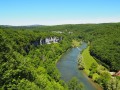


 Easy
Easy