


Refine your search for walks in Rosières
Rosières walks


 Circular around Balbiac in Rosières
 Visorando Member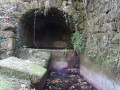
 8.42 mi
 +971 ft
 -968 ft
 4h 45
4h 45
 Moderate
 Departure from Rosières (Ardèche)
This vast south-facing valley surrounded by wooded areas (mainly pine trees) has retained its agricultural activities (vineyards, orchards, olive groves) and is dotted with several hamlets that are characteristic of southern Ardèche, even if there is some sprawl from recent residential developments. Streams and springs were equipped long ago with fountains and wash houses, sometimes in unexpected places.
Loop around La Baume at Rosières
 12.18 mi
+1,368 ft
-1,388 ft
7h 00
12.18 mi
+1,368 ft
-1,388 ft
7h 00
 Difficult
Departure from Rosières (Ardèche)
Difficult
Departure from Rosières (Ardèche)
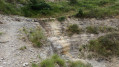
This is a long hike that follows the Baume, first along the ledge on its left bank, then high up on its right bank (Falaise de Lunel). The final section, after point (21) , requires a lot of attention as the path entrances are often somewhat hidden, but after (23), the view is magnificent. From (12), you are in the middle of the heath and it can get very hot. I recommend setting off at dawn and taking plenty of drinks with you.
Rosières – Chapias – Ruoms (Peyroche) – Labeaume
 9.87 mi
+1,647 ft
-1,614 ft
6h 00
Difficult
Departure from Rosières (Ardèche)
9.87 mi
+1,647 ft
-1,614 ft
6h 00
Difficult
Departure from Rosières (Ardèche)
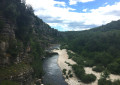
A walk starting from Les Vernades, in the commune of Rosières, passing by the Maison Bulle, the Chapias Tower, the heights of Labeaume, the hamlet of Peyrole in Ruons, the submersible bridge at Labeaume, and returning via the Gorges de la Baume and the hanging gardens. (See practical information).
A short tour of Les Gras de Perret
 5.66 mi
+331 ft
-331 ft
2h 55
Moderate
Departure from Joyeuse (Ardèche)
5.66 mi
+331 ft
-331 ft
2h 55
Moderate
Departure from Joyeuse (Ardèche)
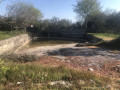
The gras are limestone plateaus characteristic of southern Ardèche. Here you can see low vegetation or trees: picards, junipers, Mediterranean shrubs, old mulberry trees left over from silkworm farming, various oaks and Montpellier maples. You will cross a karst landscape that is sometimes spectacular. This hike also offers a view from the top of the Beaume cliffs. You can stray from the path in search of karstic caves ( be careful at Réméjadou) and dolmens, sometimes lost in the woods.
In search of underground water and megalithic sites
 6.38 mi
+420 ft
-440 ft
3h 20
Moderate
Departure from Joyeuse (Ardèche)
6.38 mi
+420 ft
-440 ft
3h 20
Moderate
Departure from Joyeuse (Ardèche)
This hike will take you through an enchanting forest above one of the region's large underground water networks, which can be seen in several places: in an underground cistern, at the bottom of a karstic cave, in the bed of an almost dry river, or at a resurgence. You will also see one of the most beautiful dolmen sites in southern Ardèche.
Please note that the Aven du Reméjadou is extremely dangerous.
Rebord des Gras - Tour of the Chapias plateau
 8.52 mi
+269 ft
-282 ft
4h 10
Moderate
Departure from Labeaume (Ardèche)
8.52 mi
+269 ft
-282 ft
4h 10
Moderate
Departure from Labeaume (Ardèche)
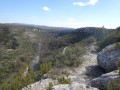
The Plateau des Gras is a limestone plateau, cut by rivers, which stretches from the Païolive woods in the south-west to the slopes of Coiron in the north-east. The path along the edge offers unobstructed views of the entire Monts d'Ardèche mountain range and leads to several viewpoints over the Ligne valley.
This route winds its way across a quasi-desert plateau dotted with numerous stone walls and piles of stones, evidence of a time when every square metre was exploited.
Rancs, heath and faïsses around Labeaume
 9.17 mi
+863 ft
-876 ft
5h 00
Moderate
Departure from Labeaume (Ardèche)
9.17 mi
+863 ft
-876 ft
5h 00
Moderate
Departure from Labeaume (Ardèche)
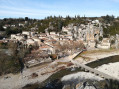
Between Baume, Ardèche and Ligne, vast areas cleared of stones have been, and are still partly, cultivated; olive trees now dominate the landscape.The former silkworm farms have now been converted into homes but retain their old-world charm.Along the riverbank, terraced gardens are still maintained and clearly visible on the sun-facing banks of the Baume.The Ardèche and Chassezac rivers have created a vast plain where vineyards, fruit trees and gardens occupy the landscape.
The Remène ravine from Chapias
 3.35 mi
+430 ft
-446 ft
1h 55
Difficult
Departure from Labeaume (Ardèche)
3.35 mi
+430 ft
-446 ft
1h 55
Difficult
Departure from Labeaume (Ardèche)
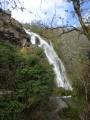
A short walk that will take you past many interesting sites around Chapias: the Notre-Dame Tower, the Maison Unal, the Remène waterfall and the Rocher des Curés site.Take care on certain tricky sections; please read the practical information carefully.
Le Chapeau du Gendarme du Toufache
3.22 mi
+423 ft
-417 ft
1h 50
 Easy
Departure from Laurac-en-Vivarais (Ardèche)
Easy
Departure from Laurac-en-Vivarais (Ardèche)
This short family walk through pine and oak woods will take you to the unmissable Chapeau du Gendarme, where you can stop for a picnic if you wish. The walk ends along the little Toufache stream, with a few small fords to cross.
Balcon de Joyeuse circular loop
 3.64 mi
+174 ft
-187 ft
1h 50
Easy
Departure from Lablachère (Ardèche)
3.64 mi
+174 ft
-187 ft
1h 50
Easy
Departure from Lablachère (Ardèche)
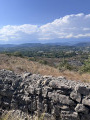
The path winds across the aptly named Plaine des Mûres plateau, which runs along the foot of the Cévennes. There are beautiful panoramic views of the Monts d’Ardèche Regional Nature Park.You’ll discover this arid, rocky plateau, which is home to the Mediterranean heath.A very easy walk with very little elevation gain and few technical difficulties.
Circular route from Lablachère to Rosières along the edge of La Baume
8.84 mi
+568 ft
-558 ft
4h 35
Moderate
Departure from Lablachère (Ardèche)
This is an easy hike, but it includes a fairly slippery ford and two passages that may be submerged in the event of flooding or storms. In this case, simply stay on the west bank until you reach Rosières. Conversely, in hot weather, set off at dawn and take enough water with you. The section between Garel and Rosières is shaded by riparian vegetation and cliffs; only the climb after Le Freyssinet will be hot. After that, the cliff-top path (not at all vertiginous) is slightly windy and very pleasant.
The Bourbouillet Trail
 9.22 mi
+413 ft
-404 ft
4h 35
Moderate
Departure from Lablachère (Ardèche)
9.22 mi
+413 ft
-404 ft
4h 35
Moderate
Departure from Lablachère (Ardèche)
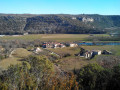
Les Gras, the limestone plateaus of southern Ardèche, may seem monotonous at first glance. This route allows you to discover varied vegetation and sometimes surprising terrain. Walking here in spring, with the green of the woods, or in autumn, with the beautiful colours, may be preferable to summer, with its high temperatures; however, part of the route is shaded. The hike passes near a karstic cave (caution!) where the underground river of the Bourbouillet resurgence flows.
Laurac-en-Vivarais - Montréal loop
 7.88 mi
+1,079 ft
-1,073 ft
4h 35
Moderate
Departure from Laurac-en-Vivarais (Ardèche)
7.88 mi
+1,079 ft
-1,073 ft
4h 35
Moderate
Departure from Laurac-en-Vivarais (Ardèche)
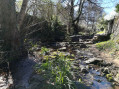
Discover the flora and, if you're lucky, the fauna, as well as the built heritage. This hike can be adapted to suit your preferences by following well-marked trails.
The Vignal Circular Route
 2.72 mi
+272 ft
-269 ft
1h 30
Easy
Departure from Lablachère (Ardèche)
2.72 mi
+272 ft
-269 ft
1h 30
Easy
Departure from Lablachère (Ardèche)
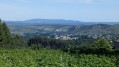
A short walk above Le Vignal, in the commune of Lablachère, with views of the village, Notre-Dame de Bon Secours, the Plateau des Gras, the Rocher de Sampzon and, in good weather, the Trois Becs and Mont Ventoux.
The rock tombs at Ribes
 4.66 mi
+948 ft
-948 ft
3h 00
Easy
Departure from Ribes (Ardèche)
4.66 mi
+948 ft
-948 ft
3h 00
Easy
Departure from Ribes (Ardèche)
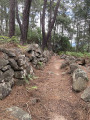
This is a short route without any major difficulties and is well marked (yellow and white from point2).The path is a little technical after the tombs but not really difficult.
La Grange aux Pères - Bourbouillet
 3.54 mi
+174 ft
-177 ft
1h 45
Easy
Departure from Lablachère (Ardèche)
3.54 mi
+174 ft
-177 ft
1h 45
Easy
Departure from Lablachère (Ardèche)
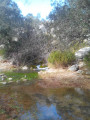
After crossing a forest that could have been used as a location for scenes from Tolkien's novels, the return to the ridge runs alongside a necropolis of dolmens.
In search of a few curiosities in the woods around Remejadou
 4.37 mi
+141 ft
-151 ft
2h 10
Moderate
Departure from Lablachère (Ardèche)
4.37 mi
+141 ft
-151 ft
2h 10
Moderate
Departure from Lablachère (Ardèche)
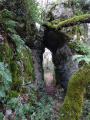
This hike is primarily a stroll along pretty trails in a relatively cool and humid area of the Plateau des Gras. The few points of interest marked on the map can be considered as a series of goals to achieve in what resembles an orienteering course. Avoid this route if you only hike on easy, well-marked routes. GPS and OpenStreetMap are recommended; see the practical information section.
Labeaume - Chapias loop
 5.83 mi
+571 ft
-564 ft
3h 10
Easy
Departure from Saint-Alban-Auriolles (Ardèche)
5.83 mi
+571 ft
-564 ft
3h 10
Easy
Departure from Saint-Alban-Auriolles (Ardèche)
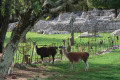
This pleasant circuit explores picturesque trails and places north of Labeaume.
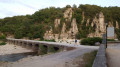
A loop around the Gorges de la Beaume
 3.30 mi
+558 ft
-564 ft
2h 00
Moderate
Departure from Saint-Alban-Auriolles (Ardèche)
3.30 mi
+558 ft
-564 ft
2h 00
Moderate
Departure from Saint-Alban-Auriolles (Ardèche)
Shortly before flowing into the Ardèche, the Beaume (or Baume) has carved out meandering gorges in the limestone plateau west of Ruoms. Two routes along paths, paved slanting streets and tracks, but also tarmac, run along one bank of the river and then the other between Labeaume and Ruoms.
Here you will find the typical landscapes and vegetation of karst areas, between abandoned farmland and new developments, and the unspoilt charm of the old village of Labeaume.