Roc de Galta

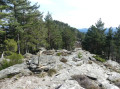
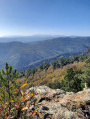
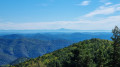
By taking the Route Royale between St-Germain-de-Calberte and Barre-des-Cévennes, you’ll reach the Galta rock ridge and discover beautiful views over the St-Martin-de-Lansuscle valley and the Cévennes, from Mont Lozère to the summit of Aigoual.

Details

27238893
Creation:
Last update:
Last review:
  • Walking
    Activity: Walking
  • ↔
    Distance: 3.38 mi
  • ◔
    Average duration: 2h 10 
  • ▲
    Difficulty: Moderate

  • ⚐
    Back to start: Yes
  • ↗
    Ascent: + 666 ft
  • ↘
    Descent: - 653 ft

  • ▲
    Highest point: 3,054 ft
  • ▼
    Lowest point: 2,408 ft

Photos

Description of the walk

(S/E) From the holiday village car park, take the path on the right to reach the first junction of the circular route.

(1) Take the path on the right leading up through the chestnut grove. Keep to the right when you reach a Fork in the road until you reach the track. Turn left to reach the junction of the second circular loop at a reservoir.

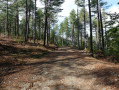
(2). Follow the wide track (the old “royal road”) which branches off to the right. Follow it until you reach the start of the path on the right. Take this path up to the Col de la Pierre Plantée.

(3) Take the track to the left, ignore a path leading downwards and continue climbing along the track running parallel to the royal road until you reach a Fork in the road.

(4) Follow the path on the right which runs along the ridges. Pass the cist grave, then ignore two junctions on the left, to reach a third.

(5) Turn left. Descend below the ridges to reach the reservoir junction.

(2) Take the path opposite (east). Keep right at the T-junction, then turn left to return to the starting point (S/E).

Waypoints

  1. S/E : mi 0 - alt. 2,408 ft
  2. 1 : mi 0.08 - alt. 2,451 ft
  3. 2 : mi 0.41 - alt. 2,612 ft
  4. 3 : mi 1.61 - alt. 2,927 ft
  5. 4 : mi 2.11 - alt. 2,927 ft
  6. 5 : mi 2.72 - alt. 2,841 ft
  7. S/E : mi 3.38 - alt. 2,411 ft

Notes

Access:
From St-Germain-de-Calberte, take the road that climbs up opposite the church, towards Le Serre de La Can (holiday village)

Car park:
Car park in front of the holiday village

Tips:
Please note: in wet weather, the rocky ridge can be slippery. Ensure your kit is suitable for the day’s weather conditions. Remember that the weather can change quickly in the mountains. Make sure you bring plenty of water, good walking shoes and a hat. Please close gates and fences properly.

In the heart of the park:The National Park is a natural area, open to all, but subject to regulations that are worth knowing about when planning your visit

Worth a visit

The “royal road”
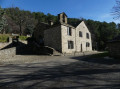
You pass a small building that once housed the roadmender’s tools. The path you are taking is the “royal road” between St-Germain-de-Calberte and Barre-des-Cévennes, rebuilt in the early 17th century on the orders of the Intendant of Languedoc, who was tasked with suppressing the Camisard uprising. The royal roads enabled troops to advance in a region where access was very difficult. This road is built on retaining walls and, in places, is carved out of the rock.

Menhir
At the pass, a menhir—a slab of schist 1.5 m high and 80 cm wide—features circular hollows (cup marks) and engraved lines. From prehistoric times, dating back to 3,000 BC, numerous remains attest to human presence in the schist valleys of the Cévennes: graves, menhirs, engraved symbols. Around fifteen menhirs have been counted in the Gardons valleys. Situated on ridges or passes, they are not grouped together. Their significance remains highly speculative: orientation markers, symbols linked to a cult, territorial markers…?

Galta
Galta appears to derive from the Indo-European root Kar, gal: rock, stone. Schist is ancient sediment formed by the erosion of landforms. In the Cévennes, these sediments, dating back some 500 million years, were likely deposited on the shores of an ancient ocean that separated the north and south of what would become France. Around 350 million years ago, these sediments were buried deep underground, subjected to high pressures and temperatures of around 500°C. They were then transformed into schist composed of new minerals: feldspars, micas and quartz. This transformation, combined with deformation, is known as metamorphism. Water runs off the impermeable schist and eventually carves out deep gullies, creating one of the most rugged regions in France. The ridges run in a north-west to south-east direction.

Reviews and comments

4.9 / 5
Based on 3 reviews

Reliability of the description
5 / 5
Ease of following the route
5 / 5
Route interest
4.7 / 5
Bonnet Cath
Bonnet Cath

Overall rating : 5 / 5

Date of your route : Oct 11, 2025
Reliability of the description : ★★★★★ Very good
Ease of following the route : ★★★★★ Very good
Route interest : ★★★★★ Very good
Very busy route : Yes

Hike to enjoy the 360° view
Well marked
A bit crowded despite it being October

Machine-translated

jpvls
jpvls

Overall rating : 4.7 / 5

Date of your route : Aug 02, 2024
Reliability of the description : ★★★★★ Very good
Ease of following the route : ★★★★★ Very good
Route interest : ★★★★☆ Good
Very busy route : No

An interesting route through the schist-covered Cévennes
This short route makes it easy to explore the area

Machine-translated

Eléonore 84
Eléonore 84

Overall rating : 5 / 5

Date of your route : Jul 16, 2024
Reliability of the description : ★★★★★ Very good
Ease of following the route : ★★★★★ Very good
Route interest : ★★★★★ Very good
Very busy route : No

A lovely walk, easy and well signposted. It can even be done in summer if you set off early

Machine-translated

Other walks in the area

For more walks, use our search engine .

The GPS track and description are the property of this route's author. Please do not copy them without permission.