Reims through its streets, façades, sculptures and other curiosities

A easy route through Reims, to discover its streets with their magnificent façades, monuments and points of interest.

Details

30947084
Creation:
Last update:
Last review:
  • Walking
    Activity: Walking
  • ↔
    Distance: 6.47 km
  • ◔
    Average duration: 1h 55 
  • ▲
    Difficulty: Easy

  • ⚐
    Back to start: Yes
  • ↗
    Ascent: + 10 m
  • ↘
    Descent: - 10 m

  • ▲
    Highest point: 91 m
  • ▼
    Lowest point: 78 m
  • ⚐ Country: France
  • ⚐ District: Reims (51100)
  • ⚑
    Start/End: N 49.261112° / E 4.030706°
  • Accessible from the train station Gare de Reims.
  • ❏
    IGN map(s): Ref. 2812O
  • Hour-by-hour weather

Photos

Description of the walk

Start from the Boulingrin car park (pay-and-display from Monday to Saturday, free on Sundays). The car park is accessible by bus (line C, Boulingrin stop) and by tram (Schneiter stop). It is also possible to start this route at the Langlet and Gare Centre tram stops.

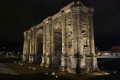
(S/E) Head to the south-west corner of the car park, at the junction of Rue de Mars and Rue Andrieux. Cross Rue de Mars, then Rue Henri IV, take Boulevard Désaubeau and walk past the newly restored Porte Mars. Take the first left onto Rue du Général Sarrail. Cross Rue du Petit Four on the right-hand side and, at the next junction, turn left onto Rue de la Grosse Écritoire, running alongside the town hall. Then rejoin Rue de Mars and follow it to the right until you reach the town hall forecourt.

(1) Continue straight on along Rue de Tambour and cross Rue Cotta on the left-hand side. Turn left at the next junction to go round Place du Forum. Three-quarters of the way round, turn left into Rue Bertin and arrive at Place Royale.

(2) Then turn left onto Rue Cérès. Go straight on, then turn right onto Rue des Marmouzets. Take the first right, Rue d’Avenay. At the end (on the right, note the rear of the Comptoir de l’Industrie), continue left onto Rue de la Gabelle. At the T-junction, turn left onto Rue Eugène Desteuque, then right onto Rue des Trois Raisinets. At the junction, turn left onto Rue Voltaire, then right onto Rue de Mâcon. At the end, turn right onto Rue Ponsardin. Continue straight on until you reach Place Paul Jamot.

(3) Take the second right, Rue Marie Stuart. Arrive at Place Godinot and turn left onto Rue Saint-Pierre les Dames. At the end, turn right onto Rue des Murs then right onto Rue de l’Université. Continue straight ahead along this street, cross Boulevard Voltaire and note the Carnegie Library on the left.

(4) Then turn left onto Rue du Cardinal de Lorraine. Walk past the Palais du Tau on your right and, at the corner, turn right to reach the cathedral forecourt.

(5) Walk around the cathedral on the left to take Rue Robert de Courcy. At the North Gate, turn left onto Rue du Préau. Cross Place du Chapitre and pass under the Porte du Chapitre. You will emerge onto Rue Carnot; follow it to the left. Then turn right onto Cours Jean-Baptiste Langlet. Go straight on along the tram tracks and pass the Langlet stop.

(6) Shortly afterwards, turn diagonally left onto Rue du Carrouge. At the end, first turn right then left onto Rue Noël. At the first junction, turn left onto Rue de Talleyrand. Continue straight on until you reach the Opéra-Cathédrale tram stop.

(7) Turn right onto Rue de Vesle and walk alongside the tram tracks. Turn right onto Rue Marx Dormoy and walk past the base of Saint-Jacques Church.

(8) Turn left, pass the Fontaine de la Solidarité and follow Rue de Thillois (on the left, the Art Deco façade of the former Opéra cinema). Take the first right onto Rue Jeanne d'Arc. Continue straight ahead and, at the end, cross Boulevard du Général Leclerc.

(9) Turn left and walk along the Basses Promenades on your right. At the end, turn right to reach the Porte de Paris (wrought-iron gate, painted blue and gold). Turn right again and walk back up the Basses Promenades. Then go round Square Colbert on the left, leaving the statue on your right. Cross the tram tracks at the Gare Centre stop.

(10) Continue straight ahead along the Hautes Promenades and pass the monument to the martyrs of the Resistance. At the end, leave the Porte de Mars (covered) on your right, cross the Place de la République in two stages and return to the Boulingrin car park.

(S/E) For those wishing to visit the Cimetière du Nord, turn left to cross Boulevard Lundy and follow Rue du Champ de Mars to the right. Turn left immediately to enter the Cimetière du Nord. Turn right straight away, leaving the Chapelle Sainte-Croix on your left. The route from here is a guide only: let your own instincts lead the way.

Leave the cemetery via the same entrance you used on the way in. Turn right to cross Boulevard Lundy again and head for the Boulingrin car park (S/E).


Waypoints

  1. S/E : km 0 - alt. 88 m - Place du Boulingrin
  2. 1 : km 0.56 - alt. 86 m - Town Hall forecourt
  3. 2 : km 1.02 - alt. 86 m - Place Royale
  4. 3 : km 1.81 - alt. 91 m - Place Jamot
  5. 4 : km 2.54 - alt. 88 m - Bibliothèque Carnégie (Reims)
  6. 5 : km 2.82 - alt. 85 m - Cathédrale Notre-Dame (Reims)
  7. 6 : km 3.5 - alt. 85 m - Former Place des Boucheries
  8. 7 : km 4.08 - alt. 82 m - Opéra de Reims
  9. 8 : km 4.32 - alt. 81 m - Église Saint-Jacques (Reims)
  10. 9 : km 4.79 - alt. 80 m - The Walks
  11. 10 : km 5.46 - alt. 83 m - Tram stop - Gare de Reims
  12. S/E : km 6.47 - alt. 88 m - Car park

Worth a visit

- The Boulingrin market halls, opened in 1929, listed as a historic monument in January 1990, and restored in 2012.

- At No. 29 Rue du Gal Sarrail, note the magnificent horse’s head on a red-brick façade.

- In Rue de la Grosse Écritoire, the beautiful façade of the Caisse d’Épargne, and the rear of Reims Town Hall.

- In Rue de Mars, the Art Nouveau façade (1898) of the former Jules Mumm dispatch cellars and the Maison de Champagne Jacquart until 2009, featuring mosaics depicting work in the vineyard and cellar.

- On Rue de Tambour, the former 13th-century Hôtel des Comtes de Champagne, which served as the residence of the Counts of Champagne during the coronations of the Kings of France; the Musicians’ House or House of the Mémétriers, where statues of the flute and tambourine player, the chevrette player, the listener in the centre, the harp player and the hurdy-gurdy player have been repositioned on the façade.

- From the Place du Forum, the Hôtel Le Vergeur, situated opposite the Square Charles Sarazin (1879–1953), archaeologist and industrialist from Reims, the square stands on the ruins of the house of Noël-Antoine Pluche, or Abbé Pluche (1688–1761), writer, naturalist and benefactor of the city of Reims.

- In Rue Cérès, the birthplace of Jean-Baptiste Colbert (1609–1683), Minister and Controller of Finances to Louis XIV; the Art Nouveau façade of the Comptoir de l’Industrie, built in 1870, destroyed in 1914 and rebuilt in 1922 by the architects Emile Thion and Marcel Rousseau, who also designed the Opéra cinema on Rue de Thillois in Reims.

- At No. 44 Rue Ponsardin stood the former workshop of master glassmaker Simon-Marq (stained-glass windows of Reims Cathedral, in collaboration with the painter Marc Chagall).

- Place and Godinot Fountain: Jean Godinot (1661–1749), founder of the first hospital for cancer patients, founder of free schools, and the man who provided the city of Reims with numerous fountains of clear water.

- At No. 35 Rue de l’Université stands the Porte Bazée, a 3rd-century Roman monument and one of Reims’ four medieval gates: the Porte Mars and Porte Bazée on the Cardo (north-south axis), and the Porte Cérès and Porte de Vénus on the Decumanus (east-west axis); these roads intersected at the Forum.

- The Art Deco-style Carnegie Library, opened in 1928, was built by the architect Max Sainsaulieu, thanks to a donation from the American magnate Andrew Carnegie.

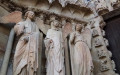
- Reims Cathedral, in the Gothic style, was the setting for the coronation of many kings of France. Traces of the original paintings can still be seen on the north portal.

- The gate of the Porte du Chapitre once closed off the cathedral chapter’s courtyard. The Chapitre district formed a town within a town, with its own church, prison, school of theology and shops.

- Opposite the Porte du Chapitre stands the former Reims Municipal Conservatoire of Music.

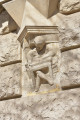
- On Cours Langlet, on the left, at the corner of Rue des Élus, above a bank, are statues of Atlanteans supporting the pediment; on the right, at No. 14, stands the Hôtel de Bezannes, built around 1450 and destroyed during the First World War, then rebuilt by J-Baptiste Langlet in the Flamboyant Gothic style; at No. 40, on the ground floor, a sculpture of a child sitting at a table, known as ‘the studious child’.

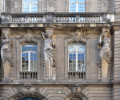
- In Rue de Talleyrand, at No. 43, a superb façade adorned on the first floor with three caryatids. At No. 41, the Talleyrand Swimming Pool, built in 1931 by the architect Lucien Pollet, who designed the Molitor swimming pool in Paris; it was known as the “Reims Aquatic Stadium” until 1938. At No. 11 is the Maison Lebœuf, an Art Deco building constructed in 1922 and inaugurated on 26 March 1923, designed by the architect Émile Fanja and the mosaic artist Antoine Giudici.

- On the corner of Rue de Vesle stood the Hôtel Ponsardin, destroyed during the 1914–1918 war; a commemorative plaque marks the spot.

- In Rue de Thillois, the Art Deco and Art Nouveau façade, designed by architects Émile Thion and Marcel Rousseau in 1922.

- On Rue Jeanne d'Arc, at No. 18, is the Square des Victimes de la Gestapo; after Rue Buirette, at No. 22, stands a magnificent townhouse dating from 1890.

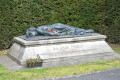
- At the northern cemetery: take the path on the right, which runs alongside the wall, and turn into thefirst path that bends to the left, until you reach a junction where the recumbent statue of Abbé Miroy is located.

Reviews and comments

4.8 / 5
Based on 4 reviews

Reliability of the description
5 / 5
Ease of following the route
5 / 5
Route interest
4.5 / 5
CaGo
CaGo

Overall rating : 5 / 5

Date of your route : Jan 31, 2026
Reliability of the description : ★★★★★ Very good
Ease of following the route : ★★★★★ Very good
Route interest : ★★★★★ Very good
Very busy route : No

Circuit très intéressant pour visiter Reims: il y a des quantités d'informations sur chaque sujet à visiter ou à admirer. Bref, il s'agit ici non seulement d'une balade agréable, mais également d'un guide touristique. Très intéressant lorsqu'en cette période de l'année l'office du tourisme est fermé.
Cette balade nous a donné l'occasion d'avoir une impression très favorable de cette ville que nous ne connaissions pas.

Machine-translated

Nini94
Nini94

Overall rating : 4.7 / 5

Date of your route : Feb 24, 2026
Reliability of the description : ★★★★★ Very good
Ease of following the route : ★★★★★ Very good
Route interest : ★★★★☆ Good
Very busy route : No

An interesting and very easy way to discover the centre of Reims. However, you pass by some beautiful sites that are not mentioned in the tour. Combine it with information from the Tourist Office.

Machine-translated

TOLPHIN Marc
TOLPHIN Marc
• Edited:

Thank you, PHG77145, for your interest in this walk. Reims is a beautiful city, steeped in history.
Marc.

Machine-translated

PHG77145
PHG77145

Overall rating : 4.7 / 5

Date of your route : Apr 03, 2024
Reliability of the description : ★★★★★ Very good
Ease of following the route : ★★★★★ Very good
Route interest : ★★★★☆ Good
Very busy route : No

Taken on Easter Monday; the descriptions of the points of interest were excellent; a very pleasant and enriching walk.
Very satisfied

Machine-translated

TOLPHIN Marc
TOLPHIN Marc

Hello SophiRRando, thank you for your message. I really enjoyed mapping out this walk, and I’m delighted that you enjoyed discovering it as much as I did.
Marc.

Machine-translated

sophieRRando
sophieRRando

Overall rating : 5 / 5

Date of your route : Mar 24, 2024
Reliability of the description : ★★★★★ Very good
Ease of following the route : ★★★★★ Very good
Route interest : ★★★★★ Very good
Very busy route : Yes

It’s hard to say whether the route is popular, given that it takes place in the city centre.
It allows you to discover the town through its façades, which are the result of the reconstruction of a town that suffered greatly during the First World War.
Many of its current residents are unaware of them, so follow this walk to see the city with fresh eyes.

Machine-translated

Other walks in the area

For more walks, use our search engine .

The GPS track and description are the property of this route's author. Please do not copy them without permission.