


 Country:

 City:
City:


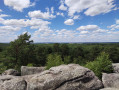
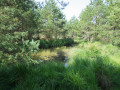
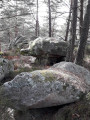
(S/E) From the Platières d'Apremont car park, take the erosion trail (yellow markings) and head straight to the viewpoint over the Gorges.
Then, turn right and continue to follow the yellow markings to find the wooden staircase (106 metres long and 149 steps) that takes you to the bottom of the gorges, in the "desert". But why is it called a desert when it doesn't really look like one? It's because at the beginning of the 19th century, there were no trees, only heather and rocks, and it was decided to plant pine trees there...
When you reach the bottom of the stairs, turn left and follow the erosion path until it opens onto a clearing, next to a bench installed beside a remarkable tree (a six-trunk birch) and opposite a small sandy area.
(1) Leave the bench behind you, leave the erosion path and head straight ahead to follow a wide sandy path that passes to the right of a first remarkable pine tree (blue dot on the trunk).
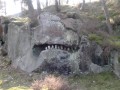
190 m further on, the path crosses the erosion path. Do not take this path, but use it to find your bearings, with the sign on the left fixed to a tree indicating "Route de la Chouette" and plot 710. Continue straight ahead until you reach the junction with trail no. 6 Denecourt-Colinet (blue markings), where you will find the rock known as "Le Cerbère du Désert" (letter N).
(2) Take trail no. 6 on the right towards Carrefour du Désert.
(3) The trail crosses the Route du Chaos d'Apremont and 350 m further on arrives at Carrefour du Désert, which is partly covered with short grass.
(4) Continue to follow trail no. 6, which gradually climbs to reach the landmark known as "Descente d'Orphée" (Orpheus' Descent), marked with the letter K. A little further on, on the right, a beautiful shelter is marked with an asterisk (Grotte des Dryades).
(5) Immediately after, at the fork, take the left-hand path, trail 6-6, which descends rapidly to the bottom of the valley, crosses the Route du Clair Milan and immediately climbs back up the opposite slope.
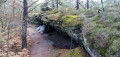
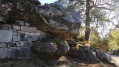
Before reaching the summit, you will pass a small chasm, but work undertaken to slow down erosion has prevented me from finding it again! When you reach the plateau, the Mare aux Sangliers appears on the left. The trail goes around it and, at the end, makes a turn of more than 90 degrees to run along the right side of an old quarry where stone masons extracted sandstone blocks in the 19th century. You can still see a few piles of stones, remnants of this bygone era. On the right, it overlooks a small valley at the bottom of which you can see the path (the Route du Chaos d'Apremont) that you will use to descend into the gorges.
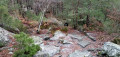
(6) When you reach the crossroads (be careful, there are no signs), leave trail no. 6 and follow the Route du Chaos d'Apremont, which you have just overlooked, on the far left. The road, or rather the path, descends along a beautiful valley, which is quite steep in places and strewn with rocks. Once at the bottom, continue straight ahead along the path, which first crosses the Route du Hochepied and then the Route de Clair Bois before rejoining path no. 6 at the junction you passed on the way up.
(3) Turn right and you will pass the rock known as "Le Cerbère du désert" (the desert's Cerberus) for a second time.
(2) Stay on trail no. 6. It soon joins the erosion trail (yellow markings) before slowly climbing up to a new plateau via the "Val des Mohicans".
(7) When you reach an intersection at the foot of a huge rock formation (look to your right and you will see "les Roches de Rude", which you will pass on your return), continue straight ahead on the path with two markings (yellow for the erosion trail and blue for No. 6-6) to the top of the plateau.
From there, a beautiful trail begins, winding its way through the rocks. This section, known as the "Apremont ridge trail", is the most "delicate" part of the hike as it is quite uneven for a little over 500 m. When the trail finally moves away from the rocks and reaches flat ground, it comes to a fork.
(8) Return to trail no. 6.
- If you are tired or short on time, you can return to the starting point by following the erosion path that branches off to the left towards the Platières d'Apremont car park.
If you decide to continue the hike, take trail no. 6 on the right and you will soon find yourself in a pretty valley that descends gently westwards towards the Boute Forestière de Sully (closed to traffic).
(9) Cross the road near a remarkable oak tree, the Sully oak.
There are at least two others nearby (walk a little way along the Sully road towards the Gorges d'Apremont crossroads). Continue along trail no. 6, which climbs back up to the André Billy crossroads, where you join theGR®®1. From there, turn right and follow the northern slope of the plateau. You will reach a new viewpoint from where you can see, on the right, the beginning of the Apremont "chain" and, in the distance, the Cuvier Châtillon chain.
The hike then continues along a beautiful stretch of path under the pine trees, passing by the poetically named Lavabo du Chasseur Noir (letter K), which is actually a kind of drinking trough in a rock hollow, Tortue d'Apremont (letter J) on the right at the bend in the path, and the Trois Mausolées (letter I).
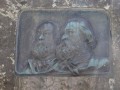
(10) Shortly afterwards, theGR®®1turns sharply to the right to descend the slope: continue straight ahead, still on trail no. 6, which continues to wind its way along the plateau, passing near the Mousseron d'Apremont (no. 6) and the Grotte des Barbizonnières (no. 3). When you reach the edge of the plateau, descend alongside huge rocks (the "Alpinistes" trail) before entering a peaceful valley that leads to a forest dotted with numerous rocks, including the famous "Éléphant d'Apremont". Continue on trail no. 6, which passes in front of the Millet-Rousseau monument before arriving at the entrance to the village of Barbizon, i.e. the end of the very touristy main street.
(11) If you have time, don't hesitate to take a look around.
Otherwise, take the road on the right (or Allée des Vaches) to the Carrefour du Bas-Bréau, where you will find the Caverne des Brigands chalet and refreshment bar.
(12) Here, you can enjoy a meal or a drink.
- Behind the chalet-restaurant-refreshment bar, trail no. 6 winds its way between the rocks to climb up to the plateau. Don't forget to say hello to the Dame d'Apremont as you pass by!
The climb is long and follows a staircase that was built there to slow down erosion. Once you reach the plateau, you'll find another viewpoint and, further on, you'll come to the Caverne des Brigands.
(13). For the record, it was never used as a hideout by brigands, as it was Denecourt who had it dug in 1844. The place is, of course, very popular.
The trail continues along the edge of the plateau, passing close to the Mare aux Biches. A little further on, you will reach the spectacular Roches de Rude gorge, which I mentioned earlier.
(14) After crossing it, descend into the "Val des Mohicans" to quickly find the fork you passed earlier.
(7) Turn right to follow the erosion path (yellow markings) and trail no. 6-6 (blue markings) and walk the "sentier des crêtes d'Apremont" trail for a second time.
(8) When you reach the fork with trail no. 6, continue on your left, following the erosion path to the Platières d'Apremont car park where you started the hike. (S/E)


 Visorando Member
 Difficult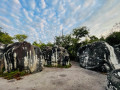
 Easy
Easy 
