Country:

 City:
City:



Parking at the Hôtellerie de la Sainte-Baume on the D80 east of Plan-d'Aups-Sainte-Baume.
(S/E) From the car park opposite the Hôtellerie, turn left (eastwards) and walk past the building towards the Trois Chênes car park.
(1) Once you arrive at the Trois Chênes car park, head to the back of the car park, locate and follow the path starting on the left behind the trunk of the old oak tree, marked in yellow.
(2) After 300 metres, leave the forest track and turn right onto the Sentier Merveilleux (marked in yellow). You will soon reach the Ravel spring.
The trail winds through lush, dense undergrowth with beautiful beech trees. The trail heads mainly north-east, running parallel to the forest track (below on the left).
Pass the rock with the plaque honouring Dr Joseph Poucel. Continue along the path marked with yellow markings. About 700 metres after the rock, look out for a cairn on the right.
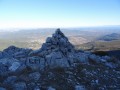
(3) At the cairn marked with a black line, leave the Sentier Merveilleux trail and turn right onto the path. From here, follow the black markings (lines) carefully to avoid getting into awkward situations.
The path quickly becomes steep, crossing scree and climbing sharply.
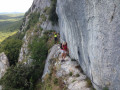
Then come the first steps and ledges, requiring you to use your hands very regularly to overcome the obstacles. The route is marked by small balconies before continuing with small steps and more exposed crossings. The black markings are present regularly.
(4) Cross the Marcel Estruch trail (marked with several yellow dots) and continue vertically, following the black markings. Higher up, at a cairn, the Gombault route crosses another balcony trail and the markings become common with the "Cheminée des Grimpeurs". From there, the markings become yellow and black. Continue along this path until you arrive below the Croix des Béguines.
(5) On an east-west track below the ridges, turn right to pass under the Croix des Béguines. There are no markings. Join theGR®®9by crossing the rock, climb to the left to reach the Croix des Béguines. On the south side, below the dome of the cross, there is a small cave (Grotte de la Croix).
(6) Climb back up, retracing your steps, pass the Croix des Béguines and then descend on the path above the cliffs.
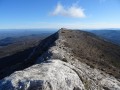
Turn right towards the east, following this track which runs along the ridge above the cliffs (ignore theGR®®9on the right). No markings. Continue for 1.3km. The track then joins theGR®®9below the ridge. Continue east on theGR®®9for about 800m.
(7) At Pas de Villecroze, leave theGR®®9and continue on the path to the left which continues along the ridge. Yellow markings.
(8) At the cairn, take the path that skirts the limestone slab and, once you reach the path below, turn right. No markings.
The path goes around the cliff until it comes out onto an open area at Pas de l'Aï.
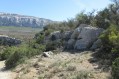
(9) Continue left to cross the north face, passing close to large boulders. The cliff has several climbing routes. Continue along the path, which descends and joins the undergrowth. No markings. You will arrive at the foot of the descent on a wider track.
(10) Turn left and you will soon come to a clearing with a large dead tree. Turn onto the small path to the right of the dead tree and climb up to the third hairpin bend. Yellow markings.
(11) At the hairpin bend, look for the yellow cross and the small path leading off to the right. A sign indicates the danger of the path and the precautions to be taken when using it.
This is the start of the Marcel Estruch trail. A partially faded yellow mark bearing its name can be found on a small rock on the left a few metres further on.
Follow the path, following the yellow markings (either dotted lines or a solid line).
This east-west trail along the cliffside has two parts:
- The first part, although on a balcony, does not present any particular difficulties, as it is a well-marked and fairly wide path.
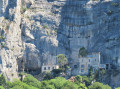
- The second part of the route is more exposed, on more difficult terrain. It includes a few technical sections: no climbing (one of them is rated 3b), pendulum chains (not necessarily necessary), two narrow ledges (with horizontal chains) and a 4-5m drop equipped with a vertical chain. The route is well marked.
The east-west crossing of the cliff is via a series of short ascents and descents, cutting across the Gombault route taken on the ascent.
(4) Continue straight ahead to the end of the path, following the yellow markings, and join theGR®®9via the Chemin des Roys.
(12) Turn left and take the large carved steps leading to the Col du Saint-Pilon.
(13) At Col du Saint-Pilon, continue on theGR®®98to the right towards Chapelle du Saint-Pilon. White and red markings.
(14) When you reach the Chapelle du Saint-Pilon overlooking the cliff, continue along the ridge for about 1.4 km on theGR®®98to Pas de la Cabre.
(15) At Pas de la Cabre, take the path that descends to the right along the cliff. Red markings.
(16) At the bottom of the descent, take the path on the right. Green markings which, after about ten metres, become green and red. When you reach the foot of the cliff and the Sainte-Madeleine Cave, take the stairs to access the cave. Yellow markings.
(17) After your visit, turn around and go back down the stairs. Turn left to return to the previous crossroads.
(16) Continue straight ahead. Green markings (solid line)
(18) At the next fork, stay on the path with the green markings (1 line) straight ahead. Do not take the green dotted line path on the right which descends. Arrive at the Grotte aux Œufs. Continue on the path which descends, green markings.
At the intersection, turn left, following the green markings. At the second intersection at the foot of the descent (marked by a large cedar tree), continue along the wide forest track on the left. Green markings.
(19) In front of the oratory, take the small path on the right. No markings. Continue straight ahead until you cross a track.
(20) Turn right onto the track, then left after 400 metres onto a nice track. Follow this track to the original car park (S/E).

 . I didn't meet anyone on this part of the trail, whereas the rest of the massif was very busy. However, at the end of October, it remains in the shade all day...



 ; as indicated in the description, this guide is intended for those who are familiar with this type of terrain.

 Visorando Member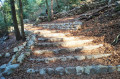
 Moderate
 Easy
Easy 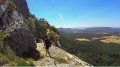
 Difficult