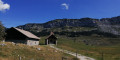
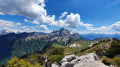
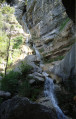
Mont Téret plateau via the Col de la Bourse and Col du Pertuis

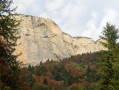
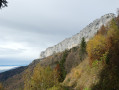
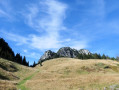
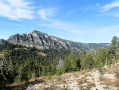
From La Balme-de-Thuy, I suggest you take a lovely walk around the southern part of Mont Téret via the Col de la Bourse, Les Grands Prés and the Col du Pertuis. This is a fairly challenging route in terms of distance and elevation, with a few difficulties, mainly on the Passage de la Bourse.

Details

65293847
Creation:
Last update:
Last review:
  • Walking
    Activity: Walking
  • ↔
    Distance: 22.43 km
  • ◔
    Duration according to the author: 8 hrs 
  • ▲
    Difficulty: Very difficult

  • ⚐
    Back to start: Yes
  • ↗
    Ascent: + 1,760 m
  • ↘
    Descent: - 1,764 m

  • ▲
    Highest point: 1,746 m
  • ▼
    Lowest point: 545 m

Photos

Description of the walk

Updated by the author on 17/11/2025 in the practical information section (paragraph "From (9) to (10)").

Start the route in the centre of the village of La Balme-de-Thuy near the town hall (parking spaces available).

(S/E) Take the Route des Challes uphill towards the Col de la Bourse.

(1) At a bend in the road, take a path on the left and continue to a new intersection.

(2) Continue to the left and you will arrive near the Ruisseau des Challes.

(3) Turn right and continue climbing until you reach another intersection.

(4) Follow a path on the left that makes a small circular loop and leads to another intersection.

(5) Continue right on the path, ignore a path on the left and continue for a long climb up some steep slopes with the Ruisseau des Challes on your left.

(6) Turn northeast, away from the stream. The path approaches the cliffs to reach the Passage de la Bourse: this is a difficult section (but less so in this direction) and a cable runs along the entire length to help you navigate the rough terrain and steep slopes (caution: this section is potentially exposed to rockfalls).

(7) The rest of the route is relatively easy, with a few switchbacks leading to a pass.

(8) At the pass, continue straight ahead for a descent. After reaching the Combe d'Ablon, turn right almost due north onto a path that is not very visible at first (look for the yellow arrow markings). After a descent into the combe, you will reach an intersection.

(9) Continue left on the path uphill: the route is a little rough atfirst on a rocky section, but then becomes easier. You will come to an overturned post.

(10) Leave the marked trail. Look for an intersection and continue straight ahead. Follow the slightly uphill trail for a short while until you reach a fairly inconspicuous intersection (not very visible in this direction).

(11) Continue straight ahead on a similar route (marked in blue or red from this point) and you will reach a large, rather pretty grassy area where the path disappears.

(12) Continue left for about a hundred metres, following an angle of approximately 45° in a south-westerly direction. Then continue on a path that is visible again until you reach an intersection.

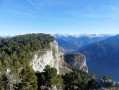
(13) Continue left on the path. The route then descends through some slightly rugged areas, staying away from a cliff. At one point, the path disappears and this is the end point I suggest: go right towards the nearby cliff for the viewpoint.

(14) Then retrace your steps back to the previous intersection.

(13) Don't miss the intersection to the right marked by a cairn, then return to the Grands Prés area.

(12) As on the way there, part of the route is off-trail in the Grands Prés area. Return to the fork you passed on the way there.

(11) Shortly after a small passage over a sharp limestone pavement, look for the markings (two round blue markings) and turn left onto a path that is not very visible for the first few metres. The route then climbs and descends on a clear path, following the regular markings. You will arrive at an intersection.

(15) Further down, continue straight ahead at the two junctions you come to until you reach the Col du Pertuis.

(16) After the pass, continue straight ahead downhill on a fairly well-maintained rocky path. A little further on, continue along a forest path until you reachthe second hairpin bend.

(17) Continue almost straight ahead (south) following a downhill path. After a few metres, continue straight ahead at an intersection and descend the winding path for a long time. At most, at one point, ignore an access road on the right leading to a forest path overlooking this area. You will come out near a building.

(18) Join a forest track and follow it to the left. After a short while, continue straight ahead at an intersection.

(19) Not far away, follow a path on the left (marked by a sign). Further down, continue straight ahead at the junction with a path at elevation 889.

(20) After joining a path at a bend, follow it to the left downhill. A little further on, the path climbs uphill for a short while.

(21) After a turning area, continue straight ahead on the path downhill, cross the Tasset stream and arrive at an intersection.

(22) Turn left towards Chessenay on a path downhill (yellow markings).

(23) Further down, continue right on a path. Shortly afterwards, follow a series of different sections of path: turn left twice, then right once (note that the sign is not very visible). You will arrive at a small road.

(24) Follow it through a built-up area until you reach the D216.
(25) From the hamlet of Chessenay, there are two options:
- either continue left on the road to return directly to the starting point,
- or continue right on the route suggested in this description.
After about 300 m on the right, continue left on Chemin Sous la Ville, then immediately after, turn left onto Chemin de Tasset. After the last houses, the route follows a path to its end, then turn left at an intersection.

(26) Immediately afterwards, turn left again, following the signs, cross a stream that flows into Le Fier and continue for a short while.

(27) At two intersections close together, continue to the right, then to the left. A little further on, continue straight ahead until you reach another path that runs alongside Le Fier. Be careful when crossing a few small streams.

(28) At a place called Terrain du Rodéo Cascades, take the small road uphill via the multi-sports grounds, then continue to the right to return to the starting point (S/E).

Waypoints

  1. S/E : km 0 - alt. 621 m - La Balme-de-Thuy
  2. 1 : km 0.7 - alt. 713 m - Les Challes
  3. 2 : km 0.87 - alt. 760 m - Intersection
  4. 3 : km 1.12 - alt. 803 m - Ruisseau des Challes
  5. 4 : km 1.56 - alt. 887 m - Fork
  6. 5 : km 1.82 - alt. 949 m - Fork in the path
  7. 6 : km 2.42 - alt. 1,198 m - Fork in the road to the north-east. Near the - Source des Charbonniers (La-Balme-de-Thuy)
  8. 7 : km 3.1 - alt. 1,480 m - Passage de la Bourse
  9. 8 : km 3.67 - alt. 1,661 m - Col de la Bourse
  10. 9 : km 4.72 - alt. 1,503 m - Le Freu d'Ablon
  11. 10 : km 5.13 - alt. 1,635 m - Freu signpost
  12. 11 : km 5.93 - alt. 1,669 m - Intersection - Access to the viewpoint
  13. 12 : km 6.37 - alt. 1,737 m - Les Grands Prés
  14. 13 : km 6.86 - alt. 1,728 m - Fork
  15. 14 : km 7.22 - alt. 1,637 m - Viewpoint
  16. 15 : km 10.03 - alt. 1,553 m - Intersection
  17. 16 : km 10.43 - alt. 1,566 m - Col du Pertuis (1566m)
  18. 17 : km 10.71 - alt. 1,460 m - Intersection with the trail
  19. 18 : km 13.12 - alt. 1,139 m - The Cudry building
  20. 19 : km 14.2 - alt. 937 m - Fork
  21. 20 : km 14.57 - alt. 850 m - Lacet Chemin
  22. 21 : km 15.96 - alt. 915 m - Le Cuinier
  23. 22 : km 16.27 - alt. 881 m - Fieuty Wood
  24. 23 : km 16.73 - alt. 791 m - Path intersection
  25. 24 : km 17.35 - alt. 676 m - Fraisy road
  26. 25 : km 18 - alt. 619 m - Road D216
  27. 26 : km 18.64 - alt. 559 m - Intersection
  28. 27 : km 20.27 - alt. 555 m - Fork in the road. Follow the - Fier (rivière)
  29. 28 : km 21.78 - alt. 566 m - Rodeo Cascades grounds
  30. S/E : km 22.43 - alt. 621 m - La Balme-de-Thuy

Notes

The starting point can be viewed on Google Maps: click here.

Good walking shoes and walking sticks are recommended.

Take your rubbish with you, nature cannot digest it.

Alternatively, I suggest a variation starting from the point (13) on a route that runs more or less close to the cliff tops: Mont Téret - Cliff Trail
Please note:
- Some tricky sections require caution on fairly uneven terrain.
- The route is quite rugged, and it is not always easy to follow despite the presence of regular markings (at the risk of ending up on more complicated terrain).
This route is not recommended for people who are not experienced in difficult terrain.

Below is a difficulty rating for each section (a route is not uniform):
- Green: fairly easy terrain with no significant elevation changes or difficulties.
- Blue: steeper slopes and/or elevation changes on a well-marked route.
- Orange: route presenting some technical difficulties and/or poor route viability (markings or visibility of the path).
- Red: difficult route due to significant elevation changes that may require some climbing, in an environment with some hazards.
- Black: fairly difficult route and/or involving contiguous hazards.
- White: route in very difficult technical environments requiring certain equipment.

From (S/E) to (1): Green difficulty
A road, then a carriageway, are followed with relative ease.
Signposts.

From (1) to (4): Blue difficulty
The route follows a path with minimal difficulty.
Signposts + yellow arrow markings.

From (4) to (5): Green difficulty
A wide path is used without difficulty.
Yellow arrow markings.

From (5) to (7): orange difficulty
A trail leads us to the vicinity of the Source des Charbonniers (reported by IGN) on steep slopes but without technical difficulty. The rest of the route is then on more moderate slopes.
Yellow arrow markings.

From (7) to (8): Red difficulty
Near the cliffs, we approach the Passage de la Bourse, which is a difficult section: in a rocky environment, the route follows steep slopes with the help of a cable along the entire length (caution, these areas are potentially exposed to rock falls). Access to the pass is then easier.
Signposts + yellow arrow markings.

From (8) to (9): Blue difficulty
The path downhill is not difficult. Once you reach Combe d'Ablon, I suggest you take a short detour to the left towards the large unnamed pass above it. From there,
the path is moderately visible at the start but does not pose any problems in terms of orientation.
Signposts + yellow arrow markings.

From (9) to (10): Blue difficulty
The route starts off on a rough trail.
Signposts + yellow arrow markings.

From (10) to (11): Blue difficulty
The slight difficulty lies in finding the fork in the path after a fallen post. Shortly after continuing straight ahead, the path becomes clear, with a relatively even surface and moderate ascents.
No markings.

From (11) to (12): Blue difficulty
The rest of the route follows a similar pattern, mainly ascending slopes.
Markings in blue and red.

From (12) to (13): Blue difficulty
The difficulty lies in the azimuth crossing of the Grands Prés. After that, the route continues on a path without any notable difficulties.
Blue and red markings.

From (13) to (14): Blue difficulty
After the fork to the left, the trail is relatively easy at first, but then becomes a little more chaotic, requiring you to look for the route to follow at times.
Blue markings.

From (14) to (12): Blue difficulty
Same route as above. The minor difficulties are finding the intersection on the right and then crossing part of the Grands Prés off-trail.
Blue and red markings.

From (12) to (11): Blue difficulty
Follow the same trail as before. The only difficulty is finding the intersection located just after a short crossing of sharp limestone pavement.
Blue and red markings.

From (11) to (15): Blue difficulty
The trail is not very inviting at the start, but then becomes more obvious as it is regularly marked. The difficulties encountered are moderate.
Blue and red markings.

From (15) to (16): Blue difficulty
A trail with moderate slopes accompanies us.
Marked with yellow arrows.

From (16) to (17): Blue difficulty
There is a slightly rough but well-maintained section, then the route continues along a fairly easy track.
Marked with yellow arrows.

From (17) to (18): Blue difficulty
After the hairpin bend, there is a short section of steep descent. The rest of the route is a long, fairly comfortable walk along a path.
No markings.

From (18) to (19): Blue difficulty
A carriage road is followed for a short while.
No markings.

From (19) to (20): Blue difficulty
Follow an easy trail.
Yellow markings

From (20) to (21): Green difficulty
The route is fairly easy to follow on a carriageway that slopes downhill, then uphill for a good while. No difficulty noted.
No markings

From (21) to (22): Green difficulty
Continue along the path downhill without difficulty
Signposts

From (22) to (23): Blue difficulty
A path with minimal difficulty, then a trail.
Yellow markings + signposts (old)

From (23) to (24): Blue difficulty
Various sections of trails are to be explored.
Yellow markings + signposts (old). Please note: shortly after the picnic table, the signpost pointing to the right is rather damaged.

From (24) to (25): Green difficulty
A small road is easy to follow downhill.
No markings.

From (25) to (26): Blue difficulty
Initially, you follow a section of roads (take care in the RD216 area), then a wide path.
No markings.

From (26) to (28): Green difficulty
This section is fairly easy overall. Be careful when crossing a few small streams, which must be forded.
Yellow arrow markings + signposts

From (28) to (S/E): Green difficulty
Return to the starting point by following a small road.
Signposts.

Worth a visit

Other walks in the area

For more walks, use our search engine .

The GPS track and description are the property of this route's author. Please do not copy them without permission.