Country:

 City:
City:


Head to the Ossoue Dam in the commune of Gavarnie-Gèdre, then to the start of the walk above the stone hut near the dam.
(S/E) Take theGR®®10on the left bank of the Gave d’Ossoue, following the Ossoue Dam along its entire length. Head up the Ossoue Valley, known as the Oulettes d’Ossoue (oulettes = small glacial cirque in the Bigourdan dialect). The path is partially signposted, as it should be, with red and white markings.
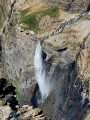
Cross the Gave via the footbridge and begin the ascent on the right bank. Pass thefirst Ossoue waterfall on your right; the path climbs steeply, carved into the rock. Shortly before 1,994 m, you’ll pass a double waterfall formed by the Gave d’Ossoue and the Ruisseau de Pouey Mourou (pouey = hillside in the Bigourdan dialect); the path continues its ascent. At 2,092 m, the path crosses the Pont de Neige (snow-free in summer) then the Ruisseau de Montferrat and continues climbing.
(1) At 2,303 m, the path splits into two. To the left, it heads towards the Baysselance Refuge (2,651 m) and the Pique Longue du Vignemale; to the right, it heads towards the Lac des Gentiane, the pass of the same name and the Estom Refuge. A signpost indicates the main directions.
Take the unmarked path to the right towards the Gentianes. Follow the Ruisseau des Oulettes valley upstream (the stream flows into the Gave d’Ossoue, which rises near the Baysselance Refuge).
The path is still well-trodden by walkers heading up to Lac des Gentianes or setting out to walk around the Oulettes d’Estom Soubiran lakes (estom = summit, soubiran = south; estom soubiran = the southern summit in Bigourdan). Stay on the path until, just after a slightly exposed section over a smooth, sloping slab, you reach a small plateau, made quite marshy by the Ruisseau des Oulettes and dotted here and there with a few erratic boulders or rockfalls.
(2) Leave the well-marked path and head off-trail to the left, first alongside the stream, then through a waterfall of water and scree. A persistent snowfield may remain here late in the season, but rarely in August or September. You can see the ridge line straight ahead, cut across by the Col d’Estom Soubiran on the right, much lower down.
Keep heading north-east down the slope, avoiding the steepest sections.
Near the ridge (elevation 2686), at an altitude of around 2675 m, begin a series of zigzags up the slope to find the best route through the rocky outcrops, grassy slopes and scree slopes. There are a few cairns and some visible paths. On this south-facing slope, it is rare to find snowfields from July to October. Continue the ascent.
(3) Reach the summit of the Pic de Labas (labas = steep cliffs in the Bigourdan dialect), a long, flat ridge that is easy to walk along and where you can take a break in safety. Two large cairns mark the summit: an eastern cairn, which you approach from, and a western cairn.
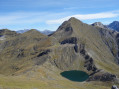
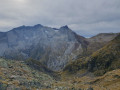
From the summit, the 360° view is exceptional. Due south: the border ridge, with the Oulettes d’Ossoue and the Montferrat lakes in the foreground; due north: the ‘Pain de Sucre du Labas’, the Lutour Valley and the Labas Valley; due east: the lakes of the Oulettes d’Estom Soubiran; Finally, to the south-west: the Vignemale massif in all its splendour! To the south-east: the 3,000-metre peaks of Gavarnie and the clearly visible Brèche de Roland. In the distance, Spain!
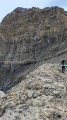
Continue north of the Pic de Labas, practically behind the large eastern cairn. The descent is tricky but not exposed. The first 50 metres are very steep, on scree, with rock covered in small pebbles that roll under your feet; high risk of falling!
Head for the small pass between the Labas and its ‘sugar loaf’. At the small pass, there’s another exceptional view of the lakes route.
Then take the North-East Couloir, which descends into the Vallon de Labas. The descent is fairly easy over a scree slope of medium-sized stones, but they slide like water…
At the bottom of the couloir, head into the valley coming from the Cols de Labas and then proceed north-west, then north, over another scree slope of large boulders, where the ‘kangaroo’ technique seems the best way to make quick progress! Lac d’Estom at the bottom of the valley begins to come into view. After 1 hour 15 minutes of arduous descent, you’ll reach a proper descending path. This path leads to the Fork in the road at 2,186 m.
(4) Lac d’Estom, its refuge and La Fruitière on the left as you descend; the Oulettes d’Estom Soubiran lakes on the right as you ascend! Turn right. Climb 100 metres along a comfortable, well-trodden path alongside the Gave de Lutour, which flows down from the lakes, with the Pic de Pébignau towering high above on the left.
(5) Reach the first small pool on the Gave, at the junction with the path leading down to Lac d’Estom at 2,240 m.
Continue along the path to the right.
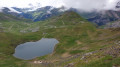
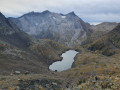
(6) You’ll reach thefirst large lake on the route, Lac de Labas, at 2,281 m. To the right, it is dominated by the Tuc de Labas (tuc = ‘mound’ in the Bigourdan dialect) and the Pic de Labas, which you passed earlier. Walk round it on the right-hand bank, continuing along the path, which remains clearly visible and is sometimes marked with cairns.
(7) Reach the spillway of the largest of the lakes, Lac des Oulettes d’Estom Soubiran, at 2,387 m. Walk round it on the left-hand side, crossing the ridge between the two lakes. A quick glance back halfway round allows you to see both of them. Continue along the path.
(8) Reach the spillway of Lac Couy (couy = ‘bald’, meaning ‘without vegetation’ in the Bigour dialect) at 2,445 m. It is one of the smallest in the series of large lakes, but it is flanked by two small satellite lakes, not to mention Lac de Malh Arrouy, situated slightly higher up (which cannot be seen) and which also flows into the Couy. Continue along the same path. Pass a lovely camping spot on a summer pasture.
(9) Reach Lac Glacé at 2,565 m, via the top of a deep gorge acting as a spillway.
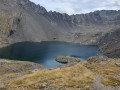
A small island sits near the northern shore. It’s idyllic and very secluded… The path climbs further to the right to cross the Estom Soubiran plateau, so curiously criss-crossed by geological veins of all kinds – white, brown, black… The closer you get to the Col des Gentianes, the more lunar the landscape becomes.... Reach the Petit Lac du Col des Gentianes. This is the last lake in the Oulettes d’Estom Soubiran range.
(10) Continue towards the nearby pass. Reach the Col des Gentianes (or Brèche des Oulettes d’Estom Soubiran) at 2,729 m.
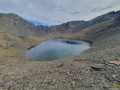
(11) Further down lies the Lac des Gentianes, which you’ll reach shortly. The path isn’t really visible, so don’t head straight for the lake and don’t go too far to the left of the rocky ridge. Reach the Lac des Gentianes and its large bivouac area, at 2,642 m.
(12) Follow the right-hand shore of the lake and head for the hillock known as “Belvédère Russel”, to admire the landscape and the secluded surroundings of this high-mountain lake, the highest in the Ossoue Valley. Off the trail, rejoin the pass path and descend 200 metres towards the valley. Reach the plateau below the Gentianes from the route.
(2) Then follow the same route as on the way out, in the opposite direction, of course.
(1) Turn left on the descent and return to the car park (S/E).
 Visorando Member
 Moderate
 Difficult