

 Country:
 City:


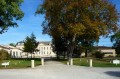
Parking is available in the avenue lined with century-old cedar trees, opposite Château Laroque.
The route is signposted. The numbers indicate landmarks that you will come across along the way.
(S/E) Head towards the château’s entrance gate.
Landmark No. 1, Cedar-lined avenue: you are facing the majestic entrance gate to Château Laroque. Go through it, bearing in mind that it was once the choir gate of Soissons Cathedral, and continue straight on until you reach the balcony, which forms a terrace with the château on your right.
(1) Landmark No. 2, Balcony overlooking the valleys: you are facing the Dordogne valley. Continue by passing ‘beneath the château’, below it, and head towards the tree-lined slope.
(2) Landmark No. 3, on the wooded slope: continue along this tree-lined strip which marks the boundary between the plateau and the hillside.
Landmark No. 4, at the corner of the wooded plot: a setting of woodland and limestone. Walk along the wall of the old enclosed garden, then go round the house to the left and reach the upper part of the plateau by climbing the embankment.
(3) Landmark No. 5, mills: Head left and, at the corner of the field, turn right (follow the arrows on site). Climb up to the mills and continue for a few more metres.
(4) Landmark No. 6, quarries: discover the opening in the ground leading to the old limestone quarries.
For safety reasons, do not go under the arches. However, you are in the right place to understand and sense what lies beneath the ground, where the vines send down their roots.
Landmark No. 7, eastern viewpoint: a panoramic view to the east and of the estate’s other highest point, opposite.
Turn round, walk past the mills and you’ll reach the corner of the vineyard plots. Turn right.
Landmark No. 8, about Merlot: a chance to take a look at the estate’s old vines here. These Merlot vines, whose diversity is what makes them so fascinating today: complexity, flavour, resilience…
At the copse, continue to the left and begin the descent.
Landmark No. 9, terraces, hillsides: on the slope, there’s nothing quite like these traditional dry-stone walls.
Head down to join the white path, which was once the access route to the château.
(5) Head back up to the left until you reach the tree-lined ridge.
(2) Leave the “clos” near the wine cellars, continue to the right along the road and rejoin the avenue of tall cedars (S/E).

 Visorando Member

 Moderate