Country:
 City:
City:


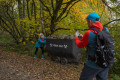
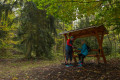
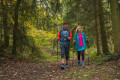
Start/finish: Alte Wiesenburger Landstraße near Kirchberg
Parking: Car park at the Burkersdorf waterworks/HBK Kirchberg, Wiesenburger Straße; coordinates: 50.62764106760906, 12.559842207991505
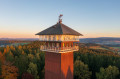
Markings: The route is marked with a green diagonal bar on a white background or the orange Turmhügelburg tower. Duration approx. 1:30h
The starting point of the approximately 6 km long circular hike is the Alte Wiesenburger Landstraße near Kirchberg. From here, there is an impressive view over the Ore Mountains foothills to Thuringia and Leipzig. The route continues to the "Schöne Aussicht" (beautiful view), where you can see the Silberstraße and the village of Weißbach with its baroque Salvator Church. Shortly afterwards, hikers reach the lovingly designed hiking rest area with the "Engländerstolln" – once created by prisoners of war and now an important natural habitat for bats, birds and rare plants. A field of pits marks the historic "Martin-Römer-Stolln". The path continues to the impressive hilltop castle of the deserted mountain town of Fürstenberg and through a 10,000 m² former mining area with relics from the Middle Ages. The Reitsteig trail leads to the "Kleiner Hirschenstein", a mystical-looking rock massif on the edge of the Kirchberg granite. Then come the deep "Hechtlöcher" – striking pingen of the Martin-Römer-Tiefen-Erbstolln. Finally, the trail leads across the species-rich Große Forstwiese to the old court oak – the last witness to Wiesenburg's historical jurisdiction. Here, magnificent views of the varied hilly landscape open up in all directions. The nature trail ends back at the starting point with many impressions of nature, history and Ore Mountain tradition.
Station 1: Old Wiesenburg country road
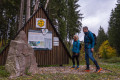
(S/E) The starting point of the 5.9 km long hiking trail, created in 2001/2002, is the path between the Kirchberg district hospital and the Burkersdorf waterworks, a district of the town of Kirchberg in the southern part of the Zwickau region. The nature trail begins at the Alte Wiesenburger Landstraße.
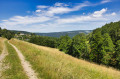
Once you arrive at station 1, the trail leads you to the first information board with directions for the nature and mining nature trail. This area offers a charming view of the Ore Mountains foothills with the town of Zwickau, its Marienkirche church, the districts of Marienthal and Eckersbach, and the Volkswagen factory in Mosel. On a clear day, you can see as far as Thuringia and Leipzig. The Kuhberg near Stützengrün and the neighbouring mountains of the Vogtland complete the panorama.
Station 2: Beautiful view of the Silberstraße and Weißbach
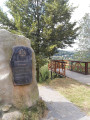
(1) After about 1 km, a seating area at the edge of the forest invites you to linger. You can see the Silberstraße below and the village of Weißbach in the valley with its beautiful half-timbered houses and the Salvatorkirche, built in 1515 and rebuilt in Baroque style in 1693. The wooded mountains of the Ore Mountains stretch to the horizon. An information board provides details about the Silberstraße between Schneeberg and Zwickau. In the immediate vicinity of the seating area, above the forest, there is a former mining facility dating from the 13th to 20th centuries.
Station 3: Hiking rest area, nature conservation station and "Engländerstolln"
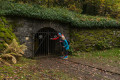
(2) Between 1943 and 1945, a search tunnel was dug here to extract tungsten-containing ore by 20 English and later South African prisoners of war under the guidance of German miners. In 1991, the mouth of the tunnel was sealed with a 6-metre-thick concrete plug by the Freiberg Mining Authority. In 2001, the Kirchberg Nature and Heritage Society purchased the overgrown slag heap site from the Treuhand privatisation agency and began to transform it into a mining site in accordance with historical records. In 2002, the nature trail was officially opened and the Kirchberg Mining Brotherhood was founded with a flag dedication ceremony. On 1 January 2003, the brotherhood joined the Saxon Association of Miners, Smelters and Miners' Associations and has participated in the mining parades ever since.
The opening and restoration of the "Engländerstolln" in 2003 was a prerequisite for gaining access to the old "Martin-Römer-Stolln" from the 13th/14th century. Since then, our mining brothers have been trying to restore it step by step.
The association's "Zechenplatz" property, located on the nature and mining trail, covers an area of 6,490 m². Various biotopes exist here:
- the "Engländerstolln" as a typical winter quarters for bats (greater mouse-eared bat and brown long-eared bat, barbastelle, Daubenton's bat), amphibians, insects and reptiles
- the mixed forest area
- the old mining slag heap
- habitat for many bird species (wren, tit species, woodpeckers, warbler, etc.), insects, small mammals and rare plant species.
- In addition, various models of nesting boxes, insect hotels and display boards have been set up as visual aids for schoolchildren and visitors.
The entire core centre in the "Hoher Forst" area is integrated into our work as part of guided tours on the interconnection of natural cycles, forestry and nature conservation in its biological diversity.
Station 4: Pingenfeld of the "Martin-Römer-Stolln"
After visiting the tunnel, walk back past Station 2 and take the path slightly to the left past the "Wolfsschacht" (wolf shaft), our new weather shaft building constructed in 2016. This is where the pingenzug (pingen field) of the old "Martin-Römer-Stolln" begins. Before we enter the walled mining area – where an information board tells the story of its history – the path leads uphill to the next station.
Station 5: Centre of the deserted mining town of Fürstenberg
(3) Here we find relics of the old medieval motte-and-bailey castle, which was surrounded by a rampart and moat and has a cistern approximately 2.80 metres deep. The complex is one of the largest in the district. There is another information board on the rampart.
A few metres further on, we can then enter the former mining centre.
The entire mining area, covering approx. 10,000 m², has numerous pits, and with a trained eye, you can also see where the miners' houses once stood. The deserted mining town of Vurstenberg or Fürstenberg naturally had a much larger radius. The pottery found in the ground can be dated to the period between the 13th and 18th centuries.
After leaving the mining area, we come to the Reitsteig (salt trail), which leads towards the Salzstraße and ultimately connects the "Zum Hohen Forst" nature and mining trail with the Schneeberg-Neustädtler mining trail.
Along the Reitsteig, where the former "industrial facilities" can be assumed to have been located based on the slag finds, our tour leads us at about 566 m above sea level to the right towards "Kleiner Hirschenstein", an impressive rock massif.
Station 6: At the "Kleiner Hirschenstein"
(4) An old beech tree, whose mighty roots cling to the rock, and the silence, interrupted only by the soft rustling of the leaves, exude a sense of times long past. Our ancestors say that it was once a sacred grove. From a geological point of view, this is the boundary of the Kirchberg granite massif, as shown on an information board. The ancient tree disappeared a few years ago, but a new one is growing in its place.
(5) A forest clearing leads hikers downhill to a forest path, the "Kleiner Flügel" (small wing), which we follow to the Wiesenburger Landstraße junction. To the right and left of the path are further reminders of the old mining industry.
Station 7: "Die Hechtlöcher" (the pike holes) and the "Martin-Römer-Stolln" adit
(6) After crossing the Alte Wiesenburger Landstraße, you will come to two large pits of the "Martin-Römer-Tiefen-Erbstolln", which are popularly known as "Hechtlöcher" (pike holes).
An information board provides details about the second phase of mining between 1795 and 1820 and commemorates Martin Römer, the successful mining entrepreneur and district administrator of Zwickau.
After returning to Alte Wiesenburger Landstraße, you have the option of returning to the starting point of the hike. However, we recommend continuing.
Station 8: "Große Forstwiese"
(7)Visitors reach the Große Forstwiese via an old sunken path. The name Große Forstwiese is mentioned in old maps and historical documents. It is a natural, extensively used meadow with a rich variety of flora and fauna. An information board provides details about mining and ore processing in the upper Rödeltal valley and introduces hikers to old mining tunnels in the village of Hartmannsdorf. The last stop is on the Gerichtsweg trail at the Gerichtseiche oak tree.
Station 9: "Gerichtseiche"
(8) For centuries, most of the villages in the Rödeltal valley belonged to the Wiesenburg domain, whose seat of power and administration was Wiesenburg Castle. The owners of the domain exercised jurisdiction. Anyone from Hartmannsdorf who was summoned to court in Wiesenburg used the shortest route between the two places, the Gerichtsweg. An information board describes mining in the town centre and the hammer mills in the old Kirchberg. The presentation of the "Am Graben" mining tunnel, which was opened to the public as a visitor mine in 2001 by the Kirchberg Nature and Heritage Society, has created another opportunity to learn about mining in the region and its history. In 2012, the "Alt-Kirchberg" museum was opened directly on the town's Altmarkt square. The listed building houses exhibition rooms on the history of the town of Kirchberg and provides information about our nature conservation work.
From the Gerichtseiche, our nature trail finally leads back to the starting point of the hike at the car park, to Station 1.(S/E)
 Tourist office
 Moderate
 Difficult