The vineyards of Montigny

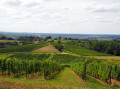
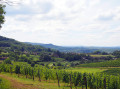
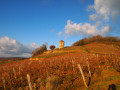
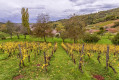
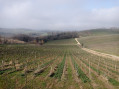
This walk in Montigny-lès-Arsures invites you to discover the soul of a wine-growing village in the Revermont region. Between the rows of vines that shape the Jura landscape, the beautiful winegrowers' houses with their vaulted cellars and the picturesque Tour du Zouave Coco, the route reveals a rich and living heritage. All along the way, superb views open up over the Arbois vineyards, providing an ideal setting for a walk combining nature, culture and local history.

Details

83187041
Creation:
Last update:
Last review:
  • Walking
    Activity: Walking
  • ↔
    Distance: 8.60 km
  • ◔
    Average duration: 2h 55 
  • ▲
    Difficulty: Easy

  • ⚐
    Back to start: Yes
  • ↗
    Ascent: + 165 m
  • ↘
    Descent: - 170 m

  • ▲
    Highest point: 425 m
  • ▼
    Lowest point: 318 m

Photos

Description of the walk

Parking aroundthe Church of Saint-Grégoire-le-Grand in Montigny-lès-Arsures. Yellow and white-redsignposts .

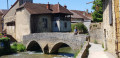
(S/E) Enter the parish enclosure through the large gate opposite the town hall. Visit the church. Go down the steps opposite the porch and turn right into Rue Quartier Bernard until you reach the next crossroads in front of the castle gates. Turn right and walk about 30 metres, passing under a strange footbridge, and you will see the start of a path on the left, next to the beautiful new entrance gate to the park.

(1) Continue straight ahead along the path (Chemin des Oiseaux), passing below your first vineyards (you won't miss them during your walk!). Join the Chemin de la Tour du Zouave Coco.

(2) Climb up to the left for 200 m to see the tower on your left.

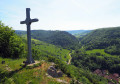
(3) Walk around it to discover a viewpoint over the Arbois vineyards and the Montigny viaduct. Turn back to the point (2).

(2) Continue straight ahead until the next junction and turn left onto Chemin de l'Allée. At No. 4, the road turns right, but continue straight ahead for 200 m along the gravel path for another beautiful view of the vineyards and the viaduct.

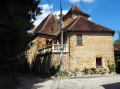
(4) Return to the street and continue downhill, leaving the D249 on your left, continuing straight ahead to the small square with its fountain and the beautiful Lornet winegrower's house.

(5) Continue straight ahead through the Quartier de l'Abbaye, which quickly becomes the Quartier de la Boutière at the first junction. Continue to the next crossroads with Rue de l'École.

(6) Continue straight ahead until you reach Chemin Saunier. Then turn left towards the beautiful winegrower's house marking the nearby fork. Continue left, soon leaving a path on your left. You will quickly come to another fork.

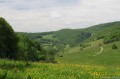
(7) Continue along the gravel path on the left, which runs through this charming valley covered with vineyards. Quickly leave a path that climbs up to the left, continuing gently through the vineyards. The path descends with views of the Quingey mountains, becomes concrete and joins a gravel path.

(8) Turn right for a few steps and leave the path for a grassy path that branches off to the left (a round blue sign with a white arrow clearly indicates the way). You will come to a tarmac path descending to the right. Continue straight ahead until you reach the next fork.

(9) Continue straight ahead (right-hand lane), ignoring the signposts. At the next fork (after a wooden shelter), turn left between the two yellow posts indicating the presence of a gas pipe. Continue to the crossroads with a tarmac road. Views of Mont Poupet. Take this road and climb up to the right until you reach the edge of the forest and a signpost. Take the time to turn around and enjoy the view.

(10) Enter the woods on the left for about 50 metres to find a small path on the right that climbs towards a small tunnel. Go under the railway tracks. The signposts change to red and white. On the other side, follow the railway line on your right. This is the most monotonous part of the walk. But soon you will come to a more pleasant forest path which, a little further on, brings you back to the railway line.

(11) Take the path downhill to the right that passes under the railway line. Turn left at the exit and, about 20 metres further on, at the fork, take the grassy path downhill to the right. You will once again have a beautiful view of the vineyards and the Arbois mountains. The road crosses a small stream at a ford and, shortly afterwards, on the left, you will see the arches of the viaduct, hidden in the vegetation. You will come to a path which you follow downhill to the right until the next fork, marked by a signpost for "Viaduc de Montigny" and a farm building.

(12) Continue on the left. You will come to the beautiful houses of the Quartier Saint-Laurent and descend to the right until you reach Rue de l'École at a wayside cross. Turn right, returning to the point (6).

(6) Continue left until you reach the small square in front of the Maison Lornet.

(5) Turn left onto Rue du Château and continue to the crossroads, fire hydrant 007.

(13) Turn into the small street Quartier Litré located between the fire hydrant and No. 7. When it turns right, it becomes a charming alley lined with old stone walls. You will find the old castle gate.

(1) Turn left, then left again into Rue du Quartier Bernard to find the church and the car park (S/E).

Waypoints

  1. S/E : km 0 - alt. 346 m - Église Saint-Grégoire-le-Grand (Montigny-lès-Arsures)
  2. 1 : km 0.31 - alt. 349 m - The castle gates
  3. 2 : km 0.54 - alt. 357 m - The Chemin des Oiseaux
  4. 3 : km 0.71 - alt. 364 m - Tour du Zouave Coco
  5. 4 : km 1.14 - alt. 356 m - View from Les Vallières
  6. 5 : km 1.36 - alt. 343 m - The Lornet House
  7. 6 : km 1.57 - alt. 351 m - Boutière district
  8. 7 : km 2 - alt. 364 m - The valley
  9. 8 : km 3.29 - alt. 319 m - Round Blue Sign - White Arrow
  10. 9 : km 3.81 - alt. 322 m - La Grillolière
  11. 10 : km 4.86 - alt. 389 m - Passage under the railway line
  12. 11 : km 6 - alt. 422 m - Les Enseinges
  13. 12 : km 6.71 - alt. 383 m - Crossroads
  14. 13 : km 8.03 - alt. 351 m - Litré district
  15. S/E : km 8.6 - alt. 346 m - Église Saint-Grégoire-le-Grand (Montigny-lès-Arsures)

Worth a visit

Montigny-lès-Arsures: the name of the village evokes the land that was once burned and then ploughed to gain agricultural and wine-growing space from the surrounding forests (from mons ignis, 'mountain of fire', and arsure, 'burning'). The village is organised into hamlets, which is probably where the name "quartier" (neighbourhood) comes from for certain streets. This does not have the modern meaning of a "large urban area", but the older meaning of a locality, a group of a few families who, over time, have kept this traditional name.

(S/E) The Church of Saint-Grégoire-le-Grand, originally Romanesque (12th century), had its nave rebuilt in the Gothic style in the 15th century. Burned down during the siege of Arbois in 1638, it was restored several times, with a bell tower built by the architect Gabiot in the 18th century and work carried out by Papillard in the 19th century. Listed as a historic monument since 1981, it combines exposed ochre stone, coated rubble stone, flat tile roofing and a choir covered with lava. Its bell tower is distinguished by a flattened dome, typical of the Franche-Comté region.

(3) The Tour du Zouave Coco: on 25 January 1871, a small group of French francs-tireurs came up against a Prussian reconnaissance platoon. Retreating towards Montigny-lès-Arsures, the French delayed the enemy with harassing fire, forcing them to spread out. Isolated in the village since the previous day, the zouave Léopold Coco took up position on a circular mound three to four metres high, surrounded by dry stone walls and topped by a narrow terrace overlooking the Arbois valley and the Arsures corridor. Accessible by a spiral ramp, this position enabled him to hold off the Prussian detachment until his ammunition ran out. During the final assault, he continued to defend himself with his rifle butt before being overwhelmed and killed by the enemy. His hands, lacerated to the wrists, bear witness to his heroic resistance. Coco was buried in the cemetery at Montigny, where his grave bears the epitaph: "Here lies, beside an unknown brother in arms, Léopold Coco Tonnel, a zouave born in Chesne (Ardennes). He died heroically on 25 January 1871. the tower was completely restored in 1988 by the Scouts de France of Haillerourt-Nancy.

(5) The Abbey of Genne Mont-Sainte Marie: the home of the winegrower Lornet is the remains of a former Cistercian abbey. From the 12th century onwards, the Counts of Burgundy donated land to various monasteries for the purpose of growing vines. It enjoyed a period of prosperity before suffering the ravages of the Hundred Years' War. Confiscated as national property during the French Revolution, it was then acquired by the Lornet family, who now cultivate 16 hectares of Trousseau grapes.

(12) The Montigny viaduct, an iconic monument of the village, is 230 metres long, 28 metres high and has 11 arches with a 15-metre span. Built on the Mouchard-Pontarlier line, inaugurated in 1862 and converted to double track in 1900, it allowed trains to cross a deep valley in the heights of Montigny. During its construction, ox-drawn carts carried the cut stones up to the site. False geological data led to the bankruptcy of the company in charge of the work, as the firm ground was covered with a thick layer of alluvium, requiring costly drilling without additional funding.

Reviews and comments

5 / 5
Based on 1 review

Reliability of the description
5 / 5
Ease of following the route
5 / 5
Route interest
5 / 5
MaelleN
MaelleN

Overall rating : 5 / 5

Date of your route : Sep 28, 2025
Reliability of the description : ★★★★★ Very good
Ease of following the route : ★★★★★ Very good
Route interest : ★★★★★ Very good
Very busy route : No

A superb autumn walk, the vineyard landscapes are very nice, and the village of Montigny is also worth a visit with its beautiful winegrowers' houses and its château (open for Heritage Weekend). The section along the railway line was a little muddy but no problem to get through. Thank you very much for this country walk!

Machine-translated

Other walks in the area

For more walks, use our search engine .

The GPS track and description are the property of this route's author. Please do not copy them without permission.