Country:
 City:
City:


To get to the start of the hike, go to Solliès-Toucas via the D554 and then turn onto Avenue Thyde Monnier.
Cross the village and join the Route Forestière des Morières (closed during periods of fire risk)
At a hairpin bend, turn right onto the track known as Chemin des Morières à Montrieux (the IGN map has a spelling mistake).
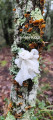
At the entrance to the path, there is a hiking sign attached to an oak tree. Park in the car park just after it.
Prerequisite: Read the "Practical Information" carefully.
(S/E) From the car park, take the Chemin des Morières in Montrieux for about 500 m, heading north-north-west. At the intersection after passing under the high-voltage power lines, turn right onto a newly created track that climbs north-north-west.
About 250 m further on, at a flat section, turn left onto the path heading north-northwest and follow the cairns. The path approaches Chemin des Morières in Montrieux, but do not join it. Continue towards the bottom of the valley on a cairned trail that does not appear on any map.
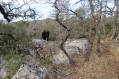
Pass a natural dolmen on the left and look for a passage on the left between two rocks further on.
(1) Pass between the two rocks and then in front of a distinctive mushroom-shaped rock. Go around a group of rocks and bushes and, going back and forth, climb up to the Petit Puits at the top of a slab.
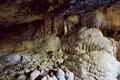
Retrace your steps for about 40 metres and look for a path on the right that climbs between two trees towards the east-north-east, marked by cairns, one of which has a blue dot. From this path, make another round trip to the Baume du Paradis. The interior of the cave is easily accessible. In the second room, a reservoir collects water from the ceiling.
From Baume du Paradis, it is possible to reach the rock shelter of Les Lumes (red dots), but we will pass by it on the way back.
Return to the path at the Blue Dot and continue north-northwest. Pass a dolomite rock covered with vegetation on your right and you will come to a T-junction. At the junction, turn right and head northeast for a few dozen metres until you reach a clearly visible cairn.
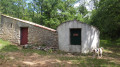
(2) From this cairn, continue left, heading north-northwest, and join the path that leads to Citerne Neuve. Pass this and then, at a Y-junction, take the path on the left, which runs roughly parallel to the ET19, and join the remains of a charcoal burner's hut.
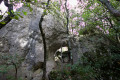
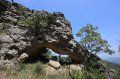
(3) From the hut, turn left towards the north-northwest, follow the cairns and pass a karstic cave. The path turns west, descends slightly, passes between two rocks and joins a large arch with a shelter at its foot.
(4) At the Hippopotamus Arch, from the north side of the arch, take a path marked by cairns on either side that climbs through the undergrowth towards the north-west. This path does not appear on any maps. Cross a flat area and then a fault in a small rocky ridge before returning to level ground in the middle of a corridor of large rocks.
There, look for a cairned passage on the left that climbs up to an arch that is invisible from the path.
It is possible to access the other side of the arch by going back a few metres via an ascending passage marked by cairns with a tree in the middle. Take the path north-northwest to a T-junction marked by a large flat stone in a hollow between some trees.
(5) From the intersection, turn left onto the path that heads roughly south (visible on OSM). After a mushroom-shaped rock, don't miss the first arch on the left, five metres below, which is slightly elevated and can be accessed. The rest of the path has been ploughed up by wild boars, so it is advisable to follow the cairns placed on tree forks and rocks. Further down, at a sloping rock close to the ground, note a path on the right, the start of which is marked by a stone placed on the fork of a bush. This path does not appear on any map.
(6) Turn right onto this cairned path, which climbs west-northwest for about ten metres to a barely visible Y-shaped intersection, each direction of which leads to an arch:
- Access to the arch on the right: easily climb a few moss-covered rocks and climb between the rocks. Caution! The end of the path, which crosses ground ploughed by wild boars, is very steep, slippery and requires you to hold on with your hands. From the arch, return to the previous Y and turn right.
- Access to the arch on the left: from the Y, continue between the large rocks; the arch is opposite, somewhat hidden by vegetation. Pass under the arch, continue west-northwest and end at a dead end at the foot of several resurgences (fed only during heavy rains).
Return to the main path (visible on OSM), continue south-west and follow the cairns closely.
At a large rock on the right, pass the Source du Bousquet and further on the left, a tabular rock surrounded by several trees. At a T-junction with a path that does not appear on any map (leading to Chemin de Morières in Montrieux), turn left. At a hairpin bend to the left, you will come to a small cirque of moss-covered rocks on the right, where you will find the remains of a charcoal burner's hut, a few faults and a karstic cave.
Walk around this circle, then return to the path and head back to the Hippopotamus Arch.
(4) From the arch, take the path you came on and pass by the charcoal burner's hut again.
(3) Leave the hut on your left and take a short cairned path opposite that climbs south-east to join the ET19. Turn left onto this path, climb north-east for about a hundred metres, then turn right onto a cairned path that heads south-east to a group of remarkable rocks, which you can visit at your leisure.
Cross a fault requiring the use of your hands, pass in front of some rock shelters, then turn right at a dead tree to reach a slab with a view close to the summit. Return to the ET19, continue for about 150 metres towards the north-east until you reach a large fallen tree on the left. At the tree, turn right onto a cairned path that heads south and leads to another remarkable rock formation. To reach the summit, cross the rock via a small corridor. Return to the ET19 and continue north-east.
(7) Look for a path on the right marked by two cairns, one of which is in the middle of four closely spaced trees, and continue on the ET19 for about 100 m until you reach a small karstic cave on the left, behind which are a few standing stones.
(8) Behind the karstic cave, take a well-marked path heading north-west to a rock slab that requires a little climbing to reach. The easiest access is from the south-west of the rock.
This slab is a good place for a picnic, with one of the most beautiful views of Siou-Blanc. Then return to the ET19 and follow it in the opposite direction, towards the south-west, for about 100 m, until you reach the path you spotted on the way there, which branches off to the left, marked by two cairns, one of which is in the middle of four closely spaced trees.
(7) Take this path, which does not appear on any map, heading roughly south. Pass a rock on your left that resembles a turtle, then turn west-southwest. Pass the remains of a charcoal burner's hut, then turn right towards the Rocher des Sambles. Walk around the rock to enjoy the view and see its surface riddled with cup marks, from which it gets its name.
Return to the path a little further down and continue south-west to the Baume des Enfers.
Pass the cave, descend about 50 metres and turn left at the intersection.
Pass a rock that looks like a mille-feuille cake; this is a trail junction that we will pass again on the way back.
Continue straight on towards the south-south-west until you reach the remarkable rock known as Tête de la Marquise. Return to the mille-feuille-shaped rock, turn left and join the ET19, which you follow towards the south-south-west. At the watering hole, turn left towards the east-south-east onto a cairned path that does not appear on any map.
Cross a flat area and pass the remains of a charcoal burner's hut located a few metres from a group of remarkable rocks. There, turn right along the rock, pass a rock shelter, cross a ravine with moss-covered rocks, join the Citerne Neuve path and then rejoin the path taken on the way out at a clearly visible cairn.
(2) At the intersection, turn left onto a wide path that does not appear on any map. A hundred metres further on, pass a path on the right, then a tree lying across the path, and you will reach a Y-shaped intersection. Turn right, then 20 metres further on at another Y-shaped intersection, turn right again. A cairn marks the Baume des Lumes and its entrance is marked by a fallen tree.
(9) From Baume des Lumes, take the path that first heads south-east before reaching an intersection on a flat section (the path on the left leads to the track that we will join further on). There, turn right towards the east-southeast until you reach another intersection with the remains of a charcoal burner's hut, then at the next intersection, turn left towards the west-southwest onto a path that then heads south.
Pass a viewpoint on the right marked by cairns, then about 100 m further on, take a path on the left marked by cairns and climb a few dozen metres to the Aven des Cistes. Behind the cave, a grove to the south-west hides a viewpoint with a beautiful view.
Return to the intersection and take the path heading south-east, which is sometimes marked with red dots. At a large rock on the left, the Lumes shelter is hidden below, under the rock. Shortly after the shelter, at a barely visible Y-shaped intersection, turn left (on the right, the path marked with red dots descends to the Baume du Paradis).
Pass the remains of a charcoal burner's hut, then turn left, about ten metres from the path, and walk to the Aven du Sortilège and back. Return to the path, which leads to a newly created track where the intersection is marked by a flat rock. Turn right onto the track and, about ten metres further on, turn left onto a path that descends along a small valley. Pass under the high-voltage power line, then reach a crossroads.
(10) From the intersection, turn right. The trail first heads west, then climbs and branches off slightly south, rejoining the car park at the entrance to Chemin des Morières in Montrieux (S/E).



 Visorando Member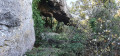
 Difficult
 Easy
Easy