Country:

 City:
City:


The route begins at the Pont des Espels. This is located at the junction of Boulevard Ernest Esclangon and Boulevard des Amandiers.
This bridge supports an aqueduct that allows the Manosque canal to cross the ravine. Beneath the road, another buried bridge once allowed the Gaude water to cross the stream as well.
(S/E) Head west towards the school and turn right at the first street onto Montée des Genêts. Ignore the streets branching off to the left.
(1) 50 m before passing under the power line, do not take Montée des Spels but continue left onto Montée des Genêts.
(2) The climb ends at two private properties. A few metres before this, take the small path on the right which climbs the embankment. This path, which is sometimes difficult to follow, goes round the top of the house at the end of Montée des Spels, so it bends to the left after about a hundred metres.
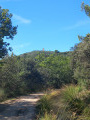
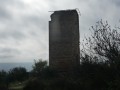
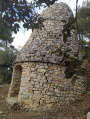
(3) It opens out onto a wide track, just opposite the Bòri Pain de Sucre. Take the track on the right, heading east.
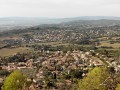
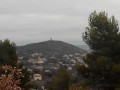
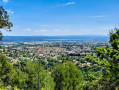
All along the track, there are magnificent views of Manosque, the Durance valley, the Valensole plateau and, beyond, Sainte Victoire.
After the water reservoirs, the track joins the Chemin du Relais (tarmac road), which you take to the left.
(4) 600 m further on, at the barriers, turn right onto the Piste des Ubacs des Spels.
400 m further on, at the junction, take the track on the right which descends towards Gaude.
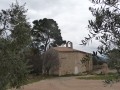
(5) 400 m after the track’s second hairpin bend, at a ruined house, take the path on the right, marked by a signpost with a green ring.
You are now on the Chemin de l’eau de Gaude, which dates back to 1497. Beneath the path, or sometimes running alongside it, is a stone channel that once carried water from the Gaude spring to the Porte du Soubeyran, 3 km further on.
''The spring is located a few hundred metres upstream, beneath the latest Géométhane facilities (under construction in 2021). The Chemin de l’eau de Gaude has a very gentle gradient for over 2 km.
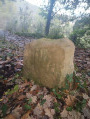
The channel is visible in several places, and you will also see several stone markers, some of which are engraved with a hand.”
300 m after the start of the path, an aqueduct bridge, now gone, used to cross the small ravine. At the start of the steps, on the right, you can clearly see the channel.
Go down the steps and climb back up on the opposite side to rejoin the path.
Continue along the path, which leads to a tarmac section. Shortly afterwards, at the junction, turn right onto the Chemin des Écrivains. The path resumes 150 m further on, on the left, heading towards a small indentation in the rock.
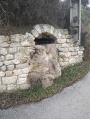
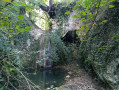
(6) This is not a natural formation; it was dug out to allow the water of the Gaude to flow through. At the threshold, you can make out the drainage channel, almost completely buried.
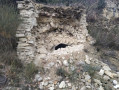
Continue along the path, which leads onto a tarmac road. 100 metres further on, on the right, next to a small cottage on private property, you can see the ruins of a lime kiln.
Take the path on the left. 150 m further on, just before a wrought-iron gate, take the path on the right indicated by a green-ringed signpost. This leads into a housing estate. Turn left onto Chemin du Mourvenc.
(7) This leads onto Chemin de Sainte-Roustagne, which you follow to the right.
After 350 m, turn right onto the Montée de Sainte-Roustagne, which will be a downhill stretch for you.
(8) After 100 m, the road turns left at a 90° angle.
In the bend, you will see limestone concretions, the last remaining trace of the Chemin de l’eau de Gaude.
Continue along the path which takes you back to the starting point (S/E), the buried bridge over which the Gaude water once flowed.

 Visorando Member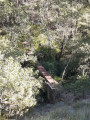

 Moderate