The Balconies of Manosque: the Thomassine Water Trail

"Les Balcons de Manosque" is the title of a series of walks organised by the Manosque Heritage Committee (CPM) that allow visitors to discover the town’s heritage “beyond the walls”.
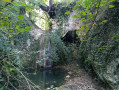
This first route broadly follows the Thomassine watercourse, one of the springs that once supplied Manosque. The route includes the remains of an aqueduct, a sulphurous spring, a 15th-century bridge, animal footprints dating back 30 million years, an asphalt mine and a water mine.

Details

4413954
Creation:
Last update:
Last review:
  • Walking
    Activity: Walking
  • ↔
    Distance: 9.50 km
  • ◔
    Average duration: 3h 30 
  • ▲
    Difficulty: Easy

  • ⚐
    Back to start: Yes
  • ↗
    Ascent: + 286 m
  • ↘
    Descent: - 277 m

  • ▲
    Highest point: 560 m
  • ▼
    Lowest point: 386 m

Photos

Description of the walk

The walk starts at the Porte du Soubeyran, where there are a few parking spaces. You can also park at the Parking de la Vilette, right next to the cinema (3 hours free: just enough time for the walk).

(S/E) Take Boulevard Louis-Martin Bret northwards. You will pass the Lycée Félix Esclangon and the old cemetery, walking along the wall on your left. At the end of the road, turn left onto Chemin de Villémus, which goes round the new cemetery on the left.

Cross the Route de la Mort d'Imbert (D 5) and continue straight on along Chemin de Villémus. On your left, you’ll see large reservoirs that were once used to store drinking water.

(1) Cross the D 5 again; take the Chemin de la Thomassine opposite. The road climbs slightly to a small pass. Continue along the road for about 300 m. In the bend after the passing place, you will see a wooden post on the right, marked with a green band and a directional arrow.

(2) This section is reserved for agile hikers with sturdy footwear; if you do not wish to tackle this part, continue along the road.
To the left of the dry stream, take a barely marked path. Head straight up for about a hundred metres. If you lose the path, don’t panic; you’ll eventually reach the end of the detour anyway: the “Chemin de l’eau de la Thomassine”. These are the remains of a small canal that carried water from the Thomassine springs to Manosque. Follow the canal to the left. You’ll notice a stone on the left. This is a marker; engraved on it is a hand, the symbol of Manosque. Continue for about 200 metres until you see a second post marked with a green band. Pass this post and continue to the end of this small canal, where a landslide washed it away and led to its replacement by a cast-iron pipe; retrace your steps back to the post marked with a green band, which indicates the path leading back down to the road.

(3) Continue along the road. The road on the right at the bottom of the descent leads to La Thomassine; this is the way you will return. Do not take it; continue straight ahead. The road climbs quite steeply.

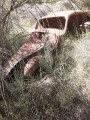
(4) Less than 100 m past a dilapidated shed, you can see on the left, in a bend, the start of a path, where the remains of a front-wheel-drive vehicle lie, evoking the battles between the Resistance and the occupying forces during the Second World War. Continue along the road, which loses its tarmac surface after the ONF barrier. The path levels out.
100 m after the barrier, turn left onto the path marked by a yellow sign. It descends to the sulphurous spring at Bourne, which also supplied water to Manosque.

(5) In the stream bed, you can see the remains of the cast-iron pipework through which the spring water flows (note the whitish marks, characteristic of the presence of hydrogen sulphide). You can clearly smell the scent of rotten eggs, especially when there is no wind.
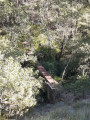
Follow the stream upstream until you see the ‘Roman’ bridge (which actually dates from the 15th century!). Do not go near it; it is in danger of collapsing.

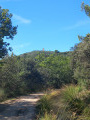
Take the path climbing up the right bank, marked by a post with a green band. The path, which is very steep, leads onto the track; turn right, then 50 metres further on, left onto the path in the small valley. Follow it up until you see a large scree slope, followed by a 90° bend to the right.

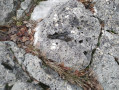
(6) The end of this bend is the “footprint slab”. Some 30 million years ago, animals (including a ronzotherium) passed through here and left traces of their footsteps in the mud, which subsequently fossilised.
Continue along the path until you climb up the side of a small slope. Once at the top, the path takes a sharp right-hand bend.

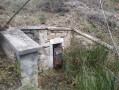
(7) Stop at this bend and look straight ahead. Hidden by the vegetation is the entrance to the mine where bituminous limestone was extracted to produce asphalt (or bitumen = very heavy oil used, in particular, for road surfacing).
Continue along the path until you reach a track, which you take to the right. 200 m further on, before the Canadian crossing, turn left onto the path marked by a post with a green band. Follow it for about 700 m. Watch out for the fork marked by a post with a green band. You will arrive near a cistern and a spring.

(8) Head towards the cistern, walk past it and take the yellow-marked path below. After 400 m, this path branches off to the right. Below, you can see the Thomassine.

(9) Walk past the slightly sulphurous spring at Château-Briant and, a few hundred metres further on, you’ll reach the Route de la Thomassine. Head down this road.

(10) After 400 m, at a right-hand bend, look down at the metal structure spanning the ravine. It supports the pipework that carried water from the various springs of the Thomassine and the Bourne spring towards Manosque, routing it along the other side of the valley to the small canal of the Chemin de l’eau de la Thomassine.
Continue down the road. You will arrive at the junction marked on the way there.

(3) Turn left and follow the path to the Porte du Soubeyran. Instead of walking alongside the cemeteries, you may choose to cross through them(S/E).


Waypoints

  1. S/E : km 0 - alt. 386 m - Soubeyran Gate. Towards the - Canal de Manosque
  2. 1 : km 1.33 - alt. 442 m - Crossroads. Opposite
  3. 2 : km 2.54 - alt. 425 m - Alternative route to the right
  4. 3 : km 3.05 - alt. 414 m - Common junction A/R
  5. 4 : km 3.43 - alt. 452 m - Front-wheel drive
  6. 5 : km 3.82 - alt. 472 m - Source de Bourne
  7. 6 : km 4.18 - alt. 484 m - Slab with footprints
  8. 7 : km 4.38 - alt. 511 m - Bituminous limestone mine
  9. 8 : km 5.35 - alt. 558 m - Citerne des Tours
  10. 9 : km 5.95 - alt. 487 m - Chateau-Briant Water Mine
  11. 10 : km 6.47 - alt. 435 m - Aqueduct
  12. S/E : km 9.5 - alt. 386 m - Soubeyran Gate

Notes

The brochure "Les Balcons de Manosque", published by the Manosque Heritage Committee (CPM), which created the route, provides full details on the heritage sites encountered along the walk. Available at the Tourist Office and in all good bookshops in Manosque, by purchasing it you will be contributing to the upkeep and promotion of Manosque’s heritage. It describes six other heritage-rich routes.
The CPM maintains the route and has installed the green-ringed posts, which are very useful for finding your way.

Worth a visit

Along the route, you will see numbered wooden posts. These are placed at the notable sites listed by the Manosque Heritage Committee (see the brochure *Les Balcons de Manosque*).

Reviews and comments

4.1 / 5
Based on 6 reviews

Reliability of the description
4.3 / 5
Ease of following the route
4 / 5
Route interest
3.8 / 5
User 15637932

Overall rating : 3.7 / 5

Date of your route : Aug 25, 2025
Reliability of the description : ★★★★☆ Good
Ease of following the route : ★★★☆☆ Average
Route interest : ★★★★☆ Good
Very busy route : No

Very nice route, easy to follow but very easy to catch up. I enjoyed it

Machine-translated

ojeannot
ojeannot

Overall rating : 5 / 5

Date of your route : Aug 01, 2025
Reliability of the description : ★★★★★ Very good
Ease of following the route : ★★★★★ Very good
Route interest : ★★★★★ Very good
Very busy route : No

A very pleasant and interesting walk with varied sections.

As I don't have a car, I appreciate having a starting point in the town centre, one kilometre from the bus station and two kilometres from the train station, despite the tarmac.

Regarding the detour after the point (2), I think that being an agile hiker with good shoes is not enough; walking sticks are more than useful, and I appreciated having a third point of support. The green-circled post indicating the descent has fallen to the ground, and I don't know if it will still be there for future hikers.

Machine-translated

Lechatoscar34
Lechatoscar34

Overall rating : 3 / 5

Date of your route : Jul 16, 2024
Reliability of the description : ★★★☆☆ Average
Ease of following the route : ★★★☆☆ Average
Route interest : ★★★☆☆ Average
Very busy route : No

Despite the difficulty in making out the markings, the route is relatively easy to follow.
The old markings aren’t really visible; as vegetation has overgrown the bridge, we could barely make it out, and as for the footprints… we didn’t see any.
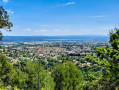
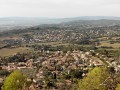
Given the name of the walk, “Les Balcons de Manosque”, we thought we’d be treated to panoramic views, but on this walk, there were no panoramic views – what a shame!
What disappointed us was the tarmac road leading to the start of the hike (there and back).
As we weren’t staying in the area for long, we didn’t have the chance to try any of the other walks on the ‘Balcons de Manosque’ theme.
When we return to the area in the autumn, we’ll try another one to compare, and perhaps we’ll be luckier with the panoramic views.

Machine-translated

Fandol
Fandol

Overall rating : 4.7 / 5

Date of your route : Sep 19, 2023
Reliability of the description : ★★★★★ Very good
Ease of following the route : ★★★★☆ Good
Route interest : ★★★★★ Very good
Very busy route : No

Because of the difficulty finding parking in Manosque, we drove up to La Rochette. It’s an excellent starting point for this walk, which does involve quite a bit of tarmac on the way there and back, but is really informative, especially thanks to the detailed instructions provided throughout the route description. Although we got a bit lost a few times, we managed to find our way back without any trouble.
A big thank you to the author of the walk and to Visorando!

Machine-translated

titougroot
titougroot

Overall rating : 4.7 / 5

Date of your route : Jan 21, 2023
Reliability of the description : ★★★★☆ Good
Ease of following the route : ★★★★★ Very good
Route interest : ★★★★★ Very good
Very busy route : No

A really interesting walk. I’m from Manosque, but I’d never heard of this remote spot before... Just so you know, the old, run-down shed has been restored: it’s now made of aluminium...

Machine-translated

lupy
lupy
• Edited:

Overall rating : 3 / 5

Date of your route : Aug 24, 2021
Reliability of the description : ★★★★★ Very good
Ease of following the route : Not used / Not applicable
Route interest : ★☆☆☆☆ Very disappointing
Very busy route : No

Hello,
We used the GPX track.
Point 2: green sign visible but then no path (and it seems we are on private property: several signs indicate this). We therefore continued along the road.
Between points 4 and 5: after the barrier, the path down to the stream is not maintained and is impassable: we had to turn back.
So very disappointed: nothing but tarmac!

Machine-translated

Other walks in the area

For more walks, use our search engine .

The GPS track and description are the property of this route's author. Please do not copy them without permission.