Country:

 City:
City:


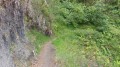
Access: whether you’re coming from Saint-Denis or La Possession, head towards La Montagne via the D41 and park at the start of the path leading up to the Fenêtre de l’Îlet à Guillaume, which is clearly signposted on the right-hand side of the road when coming from La Possession and on the left-hand side when coming from Saint-Denis.
(S/E) Set off along the path. It climbs gently at first under a beautiful canopy of jamrosats. Some sections may be slippery in wet weather. The climb to the escarpment is, however, short. Then cross a stream before passing through an open area for a very short while.
(1) In about 20 minutes, you’ll reach the edge of the Rivière Saint-Denis rampart and turn right at the first junction onto the Sentier des Goyaviers. The path runs the entire way through a pleasant forest of guava trees, whose fruit is a welcome treat even though the species is invasive. The path sometimes runs very close to the riverbank, but the vegetation is so dense that you cannot see it.
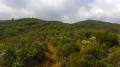
This section of the Sentier des Goyaviers is a succession of ascents and descents, with occasional flat stretches, and you’ll be walking mainly through guava trees for nearly 45 minutes. Towards the end of the trail, a few clearings offer views of Piton de la Grande Chaloupe and the vegetation changes slightly with the appearance of ferns. The fact that you can see Forest Road 20 from the Plaine d’Affouches indicates that you are about to reach it.
You’ll come to a track that looks abandoned; follow it to the left. At the next bend, enjoy a lovely view towards Grande Chaloupe and the coastline.
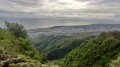
(2) Turn left at the junction. It’s about a 45-minute walk along Forest Road 20 from the Plaine d’Affouches. Some sections may seem endless, but the track is magnificent. Some lovely picnic areas have been set up here and there, though they see very few visitors. Some sections run alongside rock faces where the ground is very loose. The vegetation changes completely here, giving way to scrubland. A few stretches along the edge of the escarpment offer magnificent panoramic views of Le Colorado, Saint-Denis and the valley of the river of the same name.
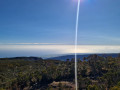
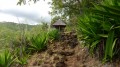
After passing close to a mast and then a kiosk, a sublime view of Îlet à Guillaume comes into view. You can see the Plaine d’Affouches and the road that winds along the cliff face towards it. There is also the ridge along which the path runs, which you will take later. Before reaching the Kiosque d’Affouches, enjoy one last view of the ocean.
(3) You’ll come to a gate and a shelter known as the Kiosque d’Affouches. Take the first path to the right of the shelter, which climbs towards the Piton de la Grande Chaloupe. The climb is steady all the way to the peak but remains pleasant and not very steep. The first section is through dense forest and the second is open, offering beautiful panoramic views of Le Colorado and the route you have covered.
The summit of the peak is reached after a 20-minute climb at the next junction.
(4) Continue straight on, leaving the old path on your left which leads to the Plaine d’Affouches. Further on, you’ll catch your first glimpse of the Cimendef and Gros Morne. To the right lies the undulating landscape of the Grande Montagne, whilst to the left is the Plaine d’Affouches and its forest of hemlocks. The path varies in width depending on the section. A large part of the route follows the ridge, offering stunning views of the Plaine d’Affouches, the Grande Montagne and, further up, the peaks surrounding the Cirque de Mafate.
After about an hour’s walk, you’ll reach Piton Batard.
(5) Begin a 100-metre descent. Weather permitting, you can see a few huts on the Dos d’Âne side, as well as towards the Roche Vert Bouteille.
(6) At the next junction, turn left towards La Roche Écrite on the GRR2, marked in red and white. The first panoramic views of the cirque appear quickly and the spectacle is simply breathtaking. It is impossible to see all the islets, but a large part is visible. To fully enjoy the view, however, it is essential to arrive there before 9 am, otherwise the clouds will spoil the panorama. The path runs along the edge of the ridge but is rarely vertiginous on this section, which is very popular with hikers. However, there are a few steep sections, and most of the route consists of a series of ascents and descents. The path then gradually leaves the rampart before entering a forest of tamarinds, fanjans and other plant species, not forgetting, unfortunately, the brown vines.
(7) Leave the GRR2 at this junction, where you’ll find the face of a terrifying snake. Then turn left. Begin the descent towards the Plaine d’Affouches. At the start, you’ll need to duck to pass under large tree branches that have grown horizontally. The descent is steady but not particularly difficult. A few sections along the cliff edge offer beautiful views to the north, whilst others may be unsuitable for those prone to vertigo. Towards the end of the descent, the path crosses a small culvert.
You arrive at the Plaine d’Affouches and the end of the road of the same name.
(8) Take the path that continues straight ahead. The entire crossing of the Plaine d’Affouches takes place in a forest of cryptomerias. This section is very pleasant for the shade it provides but hard on the ankles. Some sections may seem long, but a few rare panoramic views offer glimpses of the Entonnoir.
Join the forest road and turn right. Pass a hairpin bend and then walk past some old abandoned buildings.
(9) Take the next path on the right.
(10) At the next junction, take the path on the right and begin the descent towards Îlet à Guillaume. The first part of the descent consists mainly of hairpin bends on a steep, somewhat slippery path.
Caution: the first two ladders come up quickly and may cause difficulty for those prone to vertigo.
The switchback section takes place under a canopy of vegetation. The path then follows a ridge and becomes exposed. However, the views over the Rivière Saint-Denis and the surrounding hills are magnificent.
Please note that some sections here may also affect those prone to vertigo, but certain sections are secured by handrails or guardrails.
To the left, you can see the impressive Bras Guillaume waterfall, which must be very beautiful when there is water. Then pass a third and final ladder before reaching the camphor tree forest of Îlet à Guillaume.
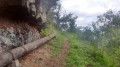
You’ll come to a large pipe; follow it to the left.
(11) Pass close to some old stone walls and, at their level, turn left towards the Îlet à Guillaume cemetery. The cemetery is very small and the graves far too small for an adult. These may be the graves of children who once lived on the islet.
Please be careful here: this is a place of worship; under no circumstances should you litter the area.
Return then to the stone walls and continue straight on along a wide path that one could easily imagine as a driveway several decades ago.
You will then arrive at a sort of clearing where there is an old abandoned house on the right and a water source on the left. The path then descends towards the riverbed; the first bend includes a very short paved section. The descent to Bras Guillaume takes about 30 minutes but is not particularly difficult. The path crosses the large pipe encountered earlier a few times.
At the next junction, turn left towards the ravine and leave the path that continues straight on towards the footbridge , which is in danger of collapsing. Once you reach the footbridge, head back down the right bank.
This section is very pleasant and is much better than going over the footbridge.
(12) Pass under the footbridge then rejoin the path on the left bank, which climbs quite steeply towards it. Take the path on the right.
(13) You’ll soon reach a platform from which you can see the route you’ve taken from the Plaine d’Affouches. Start a few switchbacks before reaching the pipe and following it.
Caution: some sections may affect those prone to vertigo.
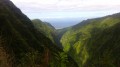
The path climbs steadily but offers some beautiful views over the Saint-Denis River valley. The path is reminiscent of the Orangers canal path. Water leaks are not uncommon on this section along the rampart.
Reach the first junction.
(1) Continue straight on and return to the starting point via the same route as on the way out (S/E).

 Visorando Member
 Moderate
 Easy
Easy 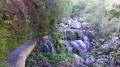
 Tourist office