Country:
 City:
City:



Parking is available on the esplanade of the Liberation Monument at the Chapelle des Buis. Yellow and red, yellow and blue markings and mountain bike trail 113. Some sections are unmarked.
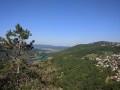
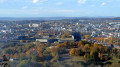
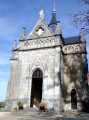
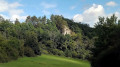
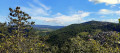
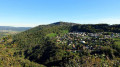
(S/E) To begin with, there is a superb view of the old town, topped by its citadel. Then head towards the Virgin Mary statue via the small concrete path on the left to walk around it. At the back, there is a 180° view of the countryside and the Jura mountains. In the late afternoon, the illuminated Hautepierre rock lives up to its former name: the Rock of the Sun. To its right is the Grand Taureau, above Pontarlier, and to its left are the Mahoux and Poupet mountains. Go down to the crypt, which is open.
Leave the esplanade via the small tarmac road, crossing the small bridge. Walk about forty steps, then go down the hill via the path on the right, towards the town centre until you reach the first fork (marker post no. 71).
(1) Go up the hill on the right (towards Morre via the medieval road). At the top, you will reach a wider path (marker post 69, Trail 5), which you follow downhill to the left for about ten steps. Leave the marked path.
(2) Climb up the small path on the right, where young trees form a hedge of honour all the way to the top. The path then forks. Take either the right or left fork. The right fork is slightly preferable as it leads to views of the small valley below. Follow the ridge for a while and the path turns left and descends. You will reach a trail junction (with mountain bike trail 113).
(3) Continue straight ahead. A little further up, you will pass between a pile of stones and the path will fork. Take the right-hand path, passing three small rocky ridges on your left. At the last one, there is a fork.
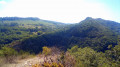
(4) Continue straight ahead (the path on the right could do with a bit of clearing) to reach a small promontory, an unsecured viewpoint over the Montfaucon valley and the upper Doubs valley. Turn back to the rocks, point (4).
(4) Carefully descend to the right along the rocky path that passes between the rocks. You will reach a path perpendicular to it below. Turn right, following the markings. Descend the winding path through this wooded hillside, whose wild beauty is somewhat marred by too many fallen trees, but which do not hinder your progress. Go around the beautiful rocks of the promontory where we were earlier and you will reach an uphill path, rejoining the mountain bike trail.
(5) Descend to the left. Cross at the pedestrian crossing and reach Rue de l'Échangeur via the small path opposite. Walk up Rue de l'Échangeur, staying on the cycle path. When the street begins to curve to the left, look for the dead-end road on the right.
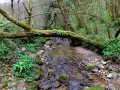
(6) Climb up to the right onto Chemin de Vignier. At the top, before the last house, turn left onto the grassy path (green sign for Sentier Piéton). It becomes a picturesque path, running alongside a stream, and you pass under the arch of an old fallen tree, which, "no, indeed!" has not given up, still green, forming a beautiful triumphal arch for your climb. You reach a beautiful stone road at a crossroads, where you will find the markings again.
(7) Turn right. On your right, you will see the beautiful rocks of the ridge you have just crossed. Soon you will see the steep, stony path leading up to the left (marker post no. 68). At the antenna, turn right to find the small bridge and the car park (S/E).


 However, it must be very pleasant in dry weather, as the forest trail is surprisingly varied and the views are well worth the detour. All in all, an excellent discovery in hills that we thought we had already explored from top to bottom. Don't forget your walking sticks!
 Visorando Member

 Moderate