Country:

 City:
City:


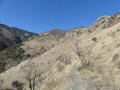
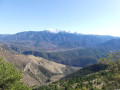
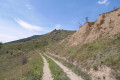
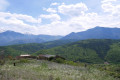
Park at the entrance to the village in the car park on the left-hand bend. If the car park is full, continue along the N116 for 500 m and park on the right opposite the Bistrot de Pays or on the left at this point. You can reach the starting point via the village centre to avoid walking on the narrow pavement along the N116.
Recentyellow markings: observed on 2 June 2022)
(S/E) From this car park, where there are two separate benches, set off on the left-hand side along the N116 for a few metres and climb up to the left via a wide path with concrete steps. Leave the track on the left. The path quickly becomes narrower and stony and climbs almost continuously to the refuge.
Cross the Rec Nou (New Canal of Jando), which is actually an irrigation canal (under construction and dry on 7 May 2019). Continue climbing.
(1) You will come to an old ruined sheepfold at the end of a dirt track. Go around it on the left.
Look for a cairn to the left of the track and then another one a little further on opposite. The path, which is still well marked on the ground, climbs up through a meadow. Just look for the cairns and the very sparse yellow markings.
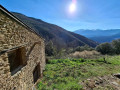
Very soon after, two farmhouses in good condition come into view.
(2) Hamlet of Marinyans (Marignans). Pass between the two farmhouses undergoing renovation. Find a track to follow north for a few metres. Pay attention at the next fork.
(3) Continue straight ahead, still heading north and climbing steeply. Leave the Chemin de l'Histoire leading to the Church of Saint-Marcel on your left. This will be the way back.
The path to follow is clearly marked on the ground. Sparse yellow markings and cairns help you find your way. The path continues to climb. Pay attention to the markings; you will need to turn right before a black water pipe, after spotting a yellow marking on your right. Continue towards the mountain. You will need to cross the Costa de Campinya (Campinya ridge).
This part of the mountain is particularly beautiful and pleasant, with a steep, rocky path winding its way between the rocks.
(4) At the fork, follow the recent yellow markings and continue straight ahead, still climbing.
The path to follow is very well marked on the ground.
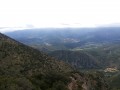
You must head due north. Don't hesitate to stop on this climb to admire the beautiful landscape of Conflent. Ruins are visible on the right. The path descends very slightly.
No markings
(5) Els Horts (the vegetable gardens). When you reach the ruins, you will see a fountain, built like a small chapel. The water supply is no longer working.
Caution: do not cross the Torrent dels Horts (garden stream) under any circumstances.
Climb to the left above the fountain despite the yellow cross. There is a good cairn at the top.
Ignore the recent markings (observed on 2 June 2002).
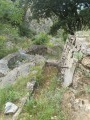
Observe the work carried out to collect water from the stream and mountain runoff.
From this point onwards, you need to find and follow this good path, which is very steep and well marked on the ground.
At the confluence of two streams (altitude 917), now walk along the Torrent de Querllong at a good distance. The path is steady on this good path on the right bank of the stream. The exact route recorded does not correspond to the route on the IGN map.
At the barely marked fork, at an altitude of 1070 m, continue the steep climb towards the thalweg.
The path heads north-west, often close to the stream, which is often dry. When the path ends at the stream, look for the continuation of the very good path on the left, which climbs in close hairpin bends. Higher up, it passes along the left bank, still climbing in hairpin bends, and ends up running alongside the stream, overlooking it. There is a large bend at a resurgence, then another to the left, heading due north-west. After crossing the valley, the path then heads due south-west, climbing in hairpin bends at first, then changing sides. It emerges from the forest into an open area and a fork in the path.
(6) There is an old wooden signpost (illegible). Turn right and continue climbing along this beautiful, well-maintained path. Leave the path on your left that descends directly to Flaçà and the Chapel of Saint-Marcel. This is useful if you need to shorten the hike.
The path continues to climb, offering beautiful views on the left. After a few bends, the path leads to an open area where it joins thePR® (Tour du Coronat or Chemin Vauban).
Recentyellow markings: observed on 2 June 2022. Other old markings are crumbling.
(7) At the fork, turn left into the forest of tall fir trees where large and magnificent stone terraces (earth retaining terraces) have been built. This was a development carried out by Vauban. The path, which heads due west, is now very wide, and it is easy to imagine that it was once an important communication route. Climb towards the building, which is clearly visible in an open area.
You will arrive at the Roque Fumade Refuge (smoky rock). This refuge is self-catering with basic facilities. The lower walls have been renovated. There is a fireplace, a table and benches in good condition.
There is also a spring and drinking troughs below. It is a beautiful place for a well-deserved break.
Off the trail
(8) Leave the drinking troughs on your left and continue on flat ground for a few metres. The roof of Cortal del Soler (Solé sheepfold) is clearly visible on the left below and serves as a landmark to indicate the direction to follow.
Descend towards this cortal. It is a very beautiful spot. Go around it on the right and continue along the correct path.
The view is unobstructed, allowing you to see a beautiful landscape on the left. Continue downhill, overlooking the track on your right (Route de Roquefumada). Numerous cairns help you find your way. Go around the Cortal del Draper (Drapé sheepfold) on the right and join a bend in the track at Pla del Farré. Continue straight ahead on the clearly visible path. Two other ruined cortals help you to follow the right direction.
At the next bend in this same track, continue straight ahead on the clearly visible path, which will eventually run alongside the track below on the right-hand side.
Caution: when you reach the track, do not descend under any circumstances.
(9) At the fork, take the left-hand path. Cairns will also help you find your way.
Caution: the descent is very steep on a well-marked but stony path.
The exact route recorded does not correspond exactly to the route on the IGN map.
The path then winds down in tight bends to arrive at a small open area.
Crossroads. On the right, the path leads to a promontory where you can admire the landscape.
On the left, head towards the pretty hamlet of Flaçà (Flassa) located a little further down. Pass a ruin.
A little further on, the dry stone houses are in very good condition and inhabited during certain seasons. Please respect the peace and quiet of this place and its inhabitants. Stay on the OSM base map paths.
At the entrance to the hamlet, descend to the right along the wall of the first house. Find a path or track that leads off to the right, heading south-west towards the church
Reach the Church of Saint-Marcel de Flaçà, built on a promontory, by going back and forth on the right.
Recentyellow markings: observed on 2 June 2022)
(10) Then return to the track and find a path on the right that heads north-east, descending.
The path then heads due north, revealing a beautiful landscape at the bottom of the Têt valley.
Cross the Torrent del Bonàs (de bonnes) stream. Head due east to cross the Torrent de la Solana (la solitude) stream. Recent markings are ambiguous.
(11) After the torrent, continue downhill on the Chemin de l'Histoire opposite. Leave the path that climbs up into the pasture on your left. Continue downhill on this good path with a beautiful view of the Canigou massif. Join a track at a left-hand bend.
(12) Leave the left branch that climbs uphill.
Continue along the right-hand branch which descends slightly. The track curves to the right and heads towards Les Marinyans, which you passed on the way there.
(3) This time, turn right and follow the path you took on the way up in the opposite direction to reach (S/E).
You may hear or see the Canari or Yellow Train at the bottom of the Têt valley.





 Visorando Member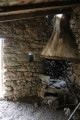
 Easy
Easy 
 Moderate