The Newfoundland Memorial at Beaumont-Hamel

A memorial hike in territory that became Canadian after the First World War, in tribute to the soldiers from the island of Newfoundland who were engaged here on the day the Battle of the Somme began (1 July 1916) and of whom the vast majority were killed or wounded. A moving, well-maintained route with well-preserved remains.

This walk is part of a multi-day hike: Paths of remembrance from the Great War

Details

89768415
Creation:
Last update:
Last review:
  • Walking
    Activity: Walking
  • ↔
    Distance: 2.38 km
  • ◔
    Average duration: 0h 45 
  • ▲
    Difficulty: Easy

  • ⚐
    Back to start: Yes
  • ↗
    Ascent: + 16 m
  • ↘
    Descent: - 16 m

  • ▲
    Highest point: 142 m
  • ▼
    Lowest point: 123 m

Photos

Description of the walk

Departure from the memorial car park, along the D73.

The route is marked with numbers that refer to a map and leaflet available at the entrance, which are also mentioned in this description.

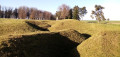
(S/E) Cross the D73 and enter the site (No. 1). Turn immediately left at the corner of a hut and follow a gravel path. A few steps lead over an old trench to the Route de Saint-Jean trench (No. 3). Then turn right. You will come to a cement path; follow it to the left.

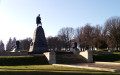
At the foot of the caribou monument, turn left and take a wooden walkway that crosses an old trench. At a fork, turn right, still in an old trench. You will arrive at the foot of the monument and face the plaque commemorating those who disappeared and were never found (No. 4).

(1) Take a small cement path that starts to the left of the plaque and climb the spiral staircase up the caribou monument. Descend by the same path.

(1) Take the wide concrete path opposite. Ignore the steps on the left and turn right onto a gravel path.

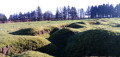
(2) At the intersection that appears immediately (No. 5, British trench), continue straight ahead. Pass No. 6 (dead tree), then No. 7 (Wellington trench).

(3) At the T-junction, turn left and pass the Ravin Y cemetery (No. 8). Pass No. 9 (German trench). You will then arrive at No. 10.

(4) On the left, Scottish monument. On the right, viewpoint over Ravin Y.

(4) Continue along the path and turn left at the T-junction. You will arrive at the chasseurs' cemetery (No. 11; cross; at the base, gravestones of soldiers who all died on 13 November 1916). Then turn right towards the visitor centre and you will reach Hawthorn Ridge Cemetery No. 2 (No. 12).

(5) Turn left and note the old trenches.

(2) At the T-junction (No. 5), turn right, then left onto the concrete path. This will take you back to the foot of the caribou monument (No. 4).

(1) Then turn left. Pass a memorial stone (No. 2) and continue straight ahead to leave the park. Cross the road and return to the car park (S/E).

Waypoints

  1. S/E : km 0 - alt. 139 m - Parking - Mémorial terre-neuvien de Beaumont-Hamel
  2. 1 : km 0.41 - alt. 141 m - Caribou Monument
  3. 2 : km 0.71 - alt. 140 m - Crossing of the North Circular
  4. 3 : km 1.04 - alt. 123 m - T-junction - Cimetière du Ravin Y
  5. 4 : km 1.32 - alt. 128 m - Scottish monument
  6. 5 : km 1.69 - alt. 135 m - Hawthorn Ridge Cemetery N°2
  7. S/E : km 2.38 - alt. 139 m - Parking - Mémorial terre-neuvien de Beaumont-Hamel

Notes

Good sports shoes are sufficient for this short hike on very well-maintained paths.

Public toilets are available at the visitor centre.

Please read the park regulations (Canadian territory, place of contemplation) posted at the entrance. Please note that dogs are not allowed. Stay on the designated paths, marked by ropes.

A detailed map is useful (at least the one accompanying this description).

Hike completed by the author on 30 December 2025.

Worth a visit

The main points of interest are indicated in the description and marked on the map.

As the site was left untouched after the war, the remains of the trenches give a good idea of the terrain in which the soldiers lived and fought.

On the morning of 1 July 1916, the day the Battle of the Somme began, the First Newfoundland Regiment assaulted the German lines, located less than 500 m from the British lines. During the artillery preparation that took place the previous week, the German lines suffered little damage. As a result, the regiment was wiped out in less than half an hour by machine gun fire: out of 800 men, 700 were put out of action (killed, wounded or missing).

Other walks in the area

For more walks, use our search engine .

The GPS track and description are the property of this route's author. Please do not copy them without permission.