The Fort du Vieux Canton route

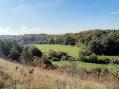
A beautiful nature walk exploring the Sensitive Natural Areas (ENS) of the communal forest and the meadows of Villey-Saint-Étienne, with their local flora and fauna. This route offers an interesting insight into the Fort du Vieux Canton and the military fortifications of the Séré de Rivières defence system (1874–1914).

Details

22801023
Creation:
Last update:
Last review:
  • Walking
    Activity: Walking
  • ↔
    Distance: 10.04 km
  • ◔
    Average duration: 3h 00 
  • ▲
    Difficulty: Moderate

  • ⚐
    Back to start: Yes
  • ↗
    Ascent: + 52 m
  • ↘
    Descent: - 53 m

  • ▲
    Highest point: 247 m
  • ▼
    Lowest point: 209 m

Photos

Description of the walk

The car park is located on Rue de Toul, next to the football pitch. Alternatively, there is parking along the D10A (Rue de la Libération) on the outskirts of Villey-Saint-Étienne, just before the ‘Village Exit’ sign. Access: from Toul, take the D191 to Villey-Saint-Étienne.

(S/E) Leave the car park via Rue de Toul (D191), heading towards the village centre, northwards. Follow it for about 150 metres until the junction with Rue du Faubourg on the left. Follow this road (Green Disc signposting), and continue to Rue de la Libération (D10A). Turn left onto Rue de la Libération and continue straight on for about 500 metres to leave the village. Ignore the path on the left with the yellow sign for “Fort du Vieux Canton”. Shortly afterwards, you will pass a mission cross on your left; continue until you reach a junction with a path on either side of the road.

(1) Turn left onto a dirt track heading south-west. Continue straight on until the track curves at a right angle in front of a hedge, behind which there is a junction with a path on either side.

(2) Continue straight ahead along a grassy track (thus leaving thePR® marked path); the track heads towards the forest of Villey-Saint-Étienne and enters it about five hundred metres further on. Continue to the junction with aPR® path on the left. (At this point, the track straight ahead is alsoPR®).

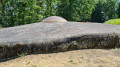
(3) Turn left onto the path heading south, climbing slightly, before skirting around the Fort du Vieux Canton. Beautiful view of the fort. After turning at a right angle to the south-west of the Fort du Vieux Canton, the path joins theGR®5F. Turn right onto theGR®5F, taking the path shortly after the previous right-angle bend. Head down, heading south-west, on a gentle slope towards a shallow valley where a small intermittent stream flows, then climb back up, still on a gentle slope, to reach a plateau. In the forest at the edge of the plateau, you will find the Ouvrage du Mauvais Lieu on your left. Continue to the four-way junction.

(4) Turn left onto thePR® path, leaving theGR®5F. This path heads south-east.
About 900 m further on, you will see the Vieux Chêne on your left, a remarkable tree dating from the time of Stanislas (see the “During the hike” section). Continue straight on before turning left at the final crossroads, a good hundred metres before the D191. About three hundred metres further on, you’ll come to a path on the right leading to the Refuge du Mordant (path blocked).

(5) Continue straight on along the main path, which curves slightly to the left and heads north. Further on, cross the Pré Amand clearing, where there is an antenna on the left and the intermittent stream of the Mauvais Lieu flows. Go straight on until you reach a junction with a path on the right.
Turn onto this path and follow it for about two hundred and thirty metres.

(6) Then turn left and follow the winding path, marked with a Green Disc. Join theGR®5Fbelow the East Fortification of the Vieux Canton, which features a 75R 05 turret (a path leads there). TheGR®5Fis blocked on the left-hand side. Turn right to join theGR®5Fheading north-east. Leave the forest about 300 metres further on and continue straight ahead to a four-way junction (gas installation).

(7) Continue straight ahead on theGR®5Ftowards the village. At the first houses, the path becomes Rue de Banivaux. Follow it to Rue de Toul (D191), turn right and head to the car park (S/E).


Waypoints

  1. S/E : km 0 - alt. 236 m - Sports ground car park. Near the - Moselle (la)
  2. 1 : km 0.91 - alt. 244 m - Road D10a x Path
  3. 2 : km 2.17 - alt. 222 m - Grass-covered path
  4. 3 : km 3.12 - alt. 218 m - Junction with the PR path. Towards the - Fort du Vieux Canton ( Villey-Saint-Étienne)
  5. 4 : km 4.93 - alt. 224 m - GR5f x PR. Towards - Le Viel Étienne (Villey-Saint-Étienne)
  6. 5 : km 6.2 - alt. 215 m - Chemin du Refuge du Mordant
  7. 6 : km 7.28 - alt. 209 m - Crossroads - Antenne
  8. 7 : km 9.4 - alt. 234 m - Crossroads - Antenne
  9. S/E : km 10.04 - alt. 236 m - Sports ground car park

Notes

This hike across varied terrain requires suitable footwear.

This walk follows the Meurthe-et-Moselle Nature Walk No. 16 published by Grand Nancy, entitled "The Fort du Vieux Canton Route". The route is marked by a Green Ring. It follows part ofthe GR®5fand sections of the Petite Randonnée (PR®) trails. In addition, it is advisable to follow the directions in this description and on the map, whilst also observing the landscapes you pass through. Distance markers from the starting point, or even the GPS coordinates of waypoints (including the start), can also help hikers find their way

Worth a visit

The Meadows, home to amphibians and butterflies
In the forest of Villey-Saint-Étienne, near the Fort du Vieux Canton, a meadow is home to remarkable plant species such as the marsh helleborine and the common adder’s-mouth. In the wettest parts of the forest, seven species of amphibians, including the spectacular yellow-bellied toad, live
in peace. The Villey-Saint-Étienne Meadows Sensitive Natural Area is characterised by ancient, traditional farming practices: a network of pastures interspersed with hedgerows, much like the famous Normandy bocage.
This area is also home to five remarkable species of butterfly (the Common Blue, the Plantain Moth, etc.), which are indicators of the excellent quality of the meadows.

The works of the “Vauban of the 19th century”
Raymond Adolphe Séré de Rivières, a military engineer and general, was the “Vauban of the 19th century”. Between 1874 and 1914, he created a defensive network of underground polygonal forts around Verdun, Toul, Épinal and Belfort. This new eastern frontier was dubbed by the Germans themselves “the iron barrier”. The Fort du Vieux Canton was one of the last to be built in France, alongside the Vacherauville fort near Verdun. This stronghold in the Villey-Saint-Étienne sector, north-east of Toul, was manned by 245 men.
To find out more about the Séré de Rivières system: click here.

Le Vieil Étienne
The villagers call it “le Vieil Étienne” and connoisseurs “Quercus robur”. For walkers, this
impresses with its great age. It was born 300 years ago, is a contemporary of Stanislas, and will live for several more centuries. Standing 33 m tall, with a girth of 3.80 m, it “weighs” 14 m³ of timber and 14 cubic metres of firewood. But respect is called for...

Villey Saint Etienne
The site of Villey has been inhabited since the end of the Bronze Age. The Celts, Gallo-Romans and Alamanni left traces of their occupation. The archaeological finds are on display in the museums of Nancy and Toul. You can find all the information about the Museum of Toul by clicking on the link below.
The village was donated to the bishopric in the 7th century. It developed in the Middle Ages around Saint-Martin’s Church and its defensive bell tower. At the end of the Middle Ages, the fortified house was built, like a sentinel, to watch over the valley.
The canons, lords of the manor, made it their residence from 1609 onwards. This property and its outbuildings were sold by candlelight as national property in 1792.
From the Ancien Régime, heritage features linked to the privileges of yesteryear remain: the 18th-century wine press, the communal oven and the 17th-century dovecote.
(source: book "BEAUX VILLAGES LORRAINS", ISBN 978-2-9551266-1-5)

The fortified forest of Villey-Saint-Étienne
The artillery revolution of 1885 forced the high command to review the existing defences by modernising the fortifications and creating a new “Centre of Resistance” to the north-east of the entrenched camp at Toul. In July 1887, the decision was taken to establish the future defensive organisation of the Villey-Saint-Étienne forest.
Initially, two fortifications were built on the northern edge of the Vieux Canton woods: one to the east to open up the Moselle valley and the railway line, and one to the west, near the Route de Dieulouard, to control traffic coming from Germany.
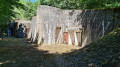
The eastern fortification was to form thefirst pivot of this new defensive sector. The barracks, well concealed, had a façade built of rubble stone and could accommodate around a hundred men. The battery, situated on a slight rise, was modernised in 1892 with a counterscarp wall and a special concrete substructure in which a retractable turret equipped with two 57 mm guns was installed. This experimental turret, of which four were built, foreshadowed its larger counterpart with its 75 mm guns.
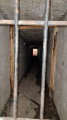
In 1905, the eastern fortification was improved by constructing a reinforced concrete underground access tunnel between the barracks and the turret; then, in 1913, an armoured observation post accessible from the gallery was added. This turret was equipped with two 75 mm guns in 1909.
The High Commission for Fortifications decided to modernise the defensive system known as the "Séré de Rivières", particularly in the new sector of Villey-Saint-Étienne.
Find out more: Villey-Saint-Étienne and the network of local authorities.

Civil heritage
The Great House: a fortified house rebuilt in the 15th century, it was then under the jurisdiction of the Chapter of Toul: stair turret, mullioned windows, cellars with loopholes dating from the late 12th century
The Grosse Maison

Saint-Martin Church, its history, stained-glass windows, bells and defensive bell tower.
Saint-Martin Church and also Saint-Martin Church

__Crosses and Statues__

__The cemetery__

Source: Nature walks in Meurthe-et-Moselle and the municipality’s official website (excerpts)

Always be cautious and plan ahead when you're outdoors. Visorando and the author of this route cannot be held responsible for any accidents occurring on this route.

The GR® and PR® markings are the intellectual property of the Fédération Française de Randonnée Pédestre.

Reviews and comments

4.1 / 5
Based on 5 reviews

Reliability of the description
3.7 / 5
Ease of following the route
4.4 / 5
Route interest
4.2 / 5
juno7
juno7

Overall rating : 3 / 5

Date of your route : May 20, 2024
Reliability of the description : ★★☆☆☆ Disappointing
Ease of following the route : ★★★☆☆ Average
Route interest : ★★★★☆ Good
Very busy route : No

does not correspond to the route as marked on the ground

Machine-translated

franchie
franchie

Overall rating : 4.5 / 5

Date of your route : Jun 01, 2023
Reliability of the description : Not used / Not applicable
Ease of following the route : ★★★★★ Very good
Route interest : ★★★★☆ Good
Very busy route : No

I had a bit of fun doing this route in the opposite direction; I came across lots of people walking their dogs coming from the Refuge du Mordant. Just like Christecol, I came across a lovely fox before point 2, in the hedgerows where not goats but sheep were grazing. I also saw a sheep carcass that must have been a feast for the lovely fox... I took the path running parallel to the D10a to get back to the starting point.

Machine-translated

lgn68
lgn68

Overall rating : 5 / 5

Date of your route : Oct 30, 2022
Reliability of the description : ★★★★★ Very good
Ease of following the route : ★★★★★ Very good
Route interest : ★★★★★ Very good
Very busy route : No

A lovely walk with great historical interest. It’s true that after point 2, you end up in a field with no path, which is a bit confusing!

Machine-translated

gerard hua
gerard hua

Overall rating : 4 / 5

Date of your route : Oct 10, 2022
Reliability of the description : ★★★★☆ Good
Ease of following the route : ★★★★☆ Good
Route interest : ★★★★☆ Good
Very busy route : No

Before reaching the local fort, the signposted path runs through a fenced-off track that is rarely used at both ends...

Machine-translated

Christecol
Christecol

Overall rating : 4.5 / 5

Date of your route : Jul 05, 2022
Reliability of the description : Not used / Not applicable
Ease of following the route : ★★★★★ Very good
Route interest : ★★★★☆ Good
Very busy route : No

A lovely little walk with no particular difficulties in the Villey-St-Etienne community forest. Point No. 2 is a fenced-off meadow with a gate, where some goats were grazing when I passed through. I came across a magnificent red fox there on that occasion. The ‘Est du vieux Canton’ structure can be visited by arrangement with the Villey-St-Etienne town hall.
On the way back, I took a slight detour along the greenway to avoid a bit of tarmac. I’ll do this walk again one winter’s afternoon when the days are short.

Machine-translated

Other walks in the area

For more walks, use our search engine .

The GPS track and description are the property of this route's author. Please do not copy them without permission.