


 Country:
 City:
City:


Park in the car park opposite the stadium, at the top of the village of Montfaucon.
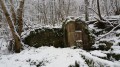
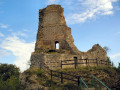
(S/E) Walk up Rue de la Comtesse Henriette, the path along the banks of the Château, following the yellow and blue markers. On the right is an old fountain and pump. When the road turns 90°, take Chemin du Donjon, signposted Château Fort - Montfaucon. There is a beautiful view of the valley topped by the ruins of the old castle that belonged to the powerful family of feudal lords of Montfaucon. It has been listed as a historic monument since 7 December 1976. The castle was abandoned after the Ten Years' War (1634-1644) when Richelieu attempted to reconquer the County of Burgundy from the Spanish Habsburgs. This path will take you to the foot of the castle, which has been renovated by a volunteer association. On the right is an old spring. The first written references to the existence of a castle appear around 1040. It was probably built in wood by Conon (nicknamed Faucon), a vassal of the Archbishop of Besançon.
Climb up to the castle, passing under the reconstructed old gate. Take the stone path on the left, which first leads you to the old parish church built in 1311, then along the entrance tower and ramparts to the old keep, inhabited by crows. There is a table here for picnics. Climb up to the foot of the keep via a small footbridge to admire the view of the Doubs valley and the valley you have just descended.
Retrace your steps for about 50 metres, then turn right to find a small stone staircase that leads back to the path around the ruins. Continue to the right, passing below the church. Return to the castle entrance, locate and follow the sign pointing towards the fortified village. You will walk alongside old ruins covered in ivy. Do not be foolhardy enough to approach them (risk of rockfalls). For the brave, after the last ruins, you can descend a dirt staircase held in place by wooden steps to discover more old stones. Climb back up and continue to the right until you reach the very tip of the rock. There are two options: for walkers who are not very sure-footed, it is best to turn back and return to the castle entrance; for the more agile, follow the small rocky path that winds around the rocks (take care, as the stones roll underfoot). At the low wall, do not go down, but go up to the left to find a small, well-marked path that will take you back to the castle entrance. Go back under the archway and down to the foot of the castle.
(1) Where the small tarmac road climbs back up to the village, you will see signs for two trails. Turn right onto the Sentier des Falaises du Château (yellow-blue markings).
(2) For the curious, halfway up the climb, leave the stone path and descend to the left to the Fontaine de la Dhuit. For others, continue along the path. At the ruins of the old fountain, turn back about twenty metres. For the adventurous, climb up the unmarked path on the left (always choosing the fork that goes uphill) to rejoin the gravel path. For others who are not too confident in their sense of direction, return by the same path.
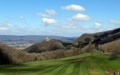
(3) At its highest point, the stony path turns 90° to the right. Continue for about 100 metres and a yellow-blue marker will invite you to climb up to the right onto the Sentier de Falaise du Château. You will walk along a pasture on the right, along the cliffs. Be careful! You will reach the edge of the woods and continue along the cliffs on the right. You will come to an unprotected viewpoint with a beautiful view of the ruins and the valley. Continue along the path that goes around the old Woirol fort and leads you to its entrance. On 16 September 1906, a terrible explosion rocked the small village of Montfaucon, frightening the inhabitants of Besançon and shattering the windows of the surrounding buildings. The powder magazine at Fort de Montfaucon had just exploded. Mishandling of the powder caused the death of eight soldiers and left many others wounded.
(4) Take the small tarmac road, ignoring the Sentier des Falaises du Château for now. On the first tree on the right, slightly hidden by the foliage, you will find a sign for Montfaucon via the belvedere. This road joins another road and, at a barrier, follow the signs to turn right. You will pass a memorial commemorating the explosion of the military fort. Climb up to the viewpoint.
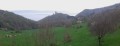
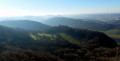
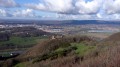
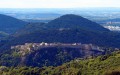
(5) The almost panoramic view, in the foreground, of the castle ruins, the Doubs valley, the city of Besançon, and the Vauban citadel, a UNESCO World Heritage Site. To the south are the Bisontine hills and Mont Poupet. And finally, on a clear day in the early morning or evening, you can see the Bernese Oberland Alps and Mont Blanc. Walk back down the road for about 200 metres, then take the path on the left after the high-voltage transformer, following the yellow-blue markings. At the clearing, continue straight ahead along the ridge to reach the entrance to Fort Woirol.
(4) At the entrance to the fort, take the path on the left that descends and forms a hairpin bend with the road. Be careful, as rockfalls are possible. You will pass the rock shelter of five casemates built between 1890 and 1893, which could be used as barracks in times of war, most of which have collapsed. Do not attempt to visit them. This stony path becomes the Chemin des Poudrières at the first houses at the top of the village of Monfaucon. Continue along this path until you reach the give way sign. Just before this, you will pass a pretty eco-friendly house.
(6) At the sign, leave the marked trail and turn left again at the hairpin bend into Rue du Château. On the right, you will have a view of the Bisontines hills. At the bakery, go down towards the calvary and the church which, despite its typical tulip-shaped bell tower, has a style that is unusual in our Franche-Comté region.
(7) Go down Rue des Fontaine opposite the church. Before the town hall, follow the various signs inviting you to turn left to reach the car park (S/E).

 Visorando Member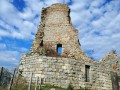


 Moderate
