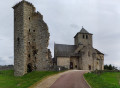
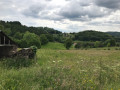
The Canal aux Moines, the Hermitage and the Cromlech of Puy de Pauliac

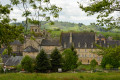
A very pleasant walk taking you right up close to a colossal structure built by the Monks of Aubazines in the 12th century. This route also takes you past a dolmen, a dry-stone ‘village’ built by a hermit, and the Puy de Pauliac with its orientation table and cromlech.
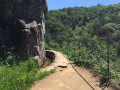
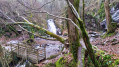
The Canal aux Moines skilfully follows the contours of the hill for around 1.5 km and feeds a reservoir within the abbey grounds. In the past, the waterfall was used to power the monastery’s waterwheel.

Details

954532
Creation:
Last update:
Last review:
  • Walking
    Activity: Walking
  • ↔
    Distance: 4.90 mi
  • ◔
    Average duration: 2h 55 
  • ▲
    Difficulty: Moderate

  • ⚐
    Back to start: Yes
  • ↗
    Ascent: + 807 ft
  • ↘
    Descent: - 804 ft

  • ▲
    Highest point: 1,706 ft
  • ▼
    Lowest point: 958 ft

Photos

Description of the walk

(Start/End) Set off eastwards and walk alongside the Abbey. Turn left onto Route de Vergonzac. About 130 metres further on, admire the covered washhouse – this is where the Canal aux Moines ends before it enters the convent. Retrace your steps for about 30 metres and turn left into a narrow, uphill lane.

(1) At the crossroads, cross Avenue Jean Baptiste Laumond at the pedestrian crossing. Walk up the steep cul-de-sac to reach a sort of platform at the edge of the Canal aux Moines.

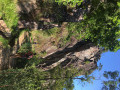
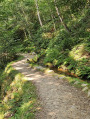
(2) Pass the barriers on the right, which are for vehicles. Walk along the canal on your left-hand side, on fairly level ground, and ignore all the side paths. A section over a rocky outcrop requires a little caution, even though steps have been cut into the rock. Before crossing it, look at the crevice in the rock through which water flows – said to be the result of a miracle attributed to Saint Stephen (see the ‘During the walk’ section).

(3) When you reach a wooden bridge on the right-hand side, carry on straight ahead towards the canal’s source. You’ll arrive at the water intake for the Canal aux Moines with its ‘sluice gate’. Retrace your steps.

(3) Cross the Coiroux via a bridge and continue along the path that runs alongside the river on your left, following it upstream. The path becomes more uneven and climbs in successive stages to cross small waterfalls on the Coiroux. Cross the river and you’ll come to a T-junction.

(4) Turn left onto the small, uphill road. At the end, turn right and proceed with caution onto the D48. At the junction, turn left towards the village of Rochesseux.

(5) At the junction, turn right onto a small road leading uphill. When it bends to the right, continue straight on along a path that climbs gently under the trees. Ignore the first path on the right and carry on downhill. Cross a road and pass through the hamlet of La Roche Bergère. At the end, first turn right then left and head towards the edge of the forest. Carry on to a hillock with large boulders: this is the village of L’Ermite.

(6) Retrace your steps towards La Roche Bergère. As soon as you enter the woods, take the path on the left which leads to a small tarmac dead-end road (above the hamlet of La Roche Bergère). Cross the vehicle turning area and head left to see the Pauliac quarry (mining wagon). Leave the quarry and immediately take the path uphill that starts next to the quarry (to the east).

The forest track skirts the summit of Puy de Pauliac. Approaching from the north, the track reaches a junction. Turn right onto the path which leads, after a few hundred metres, to the Cromlech at Puy de Pauliac. After visiting the cromlech, take the path heading westwards, which leads into the woods until it rejoins a forest track at a crossroads.

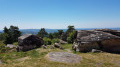
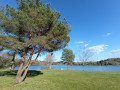
(7) Continue straight ahead along the track leading to the summit of Puy de Pauliac and its orientation table: the Puy de Pauliac site offers a remarkable panoramic view of the region, with the Monédières to the north, the Corrèze valley to the west, and the Causses to the south. Retrace your steps.

(7) Turn left onto the forest track that begins the descent from Puy Pauliac. Further on, pass the dead-end forest track on your right that leads towards the hamlet of La Roche. A little further on, the forest track takes a right-angle bend to the left and then to the right, before beginning a steeper descent. Continue straight ahead along this forest track.

(8) Turn right onto a path at the end of the wire fence that runs alongside this track on the right-hand side. The path leads to a clearing where the Rochesseux Dolmen is situated. Walk to the dolmen and continue the walk heading south-east. At the T-junction, take the path on the right. After about a hundred metres, at a fork in the road, take the path straight ahead (whilst the forest track veers off to the left). When you reach the first houses, the path turns into a road. Walk downhill and turn left. Cross the D48 and take the path almost directly opposite.

(2) Cross the canal and turn right onto the road you took on the way there.

(1) Cross Avenue Jean-Baptiste Laumond and continue along the alleyway opposite. At Route de Ségonzac, turn left. Turn right at the next junction and return to the car park (S/E).

Waypoints

  1. S/E : mi 0 - alt. 958 ft - Place d’Aubazines car park (near the Abbey)
  2. 1 : mi 0.24 - alt. 1,079 ft - Crossroads
  3. 2 : mi 0.32 - alt. 1,155 ft - Crossroads of the circular loop
  4. 3 : mi 1.07 - alt. 1,145 ft - Bridge over the Coiroux
  5. 4 : mi 1.83 - alt. 1,325 ft - Crossroads – farm track
  6. 5 : mi 2.26 - alt. 1,480 ft - Rochesseux
  7. 6 : mi 2.82 - alt. 1,558 ft - From Viallage de l’Ermite to Roche Bergère
  8. 7 : mi 3.28 - alt. 1,680 ft - Crossroads
  9. 8 : mi 4.11 - alt. 1,440 ft - Road–path junction
  10. S/E : mi 4.9 - alt. 958 ft - Place d’Aubazines car park (near the Abbey)

Notes

The car park is located on Place d’Aubazines (near the Abbey Church) or in the adjacent streets on the pavements designated as parking spaces (Route de Vergonzac on the left, just after the Abbey).

This walk across varied terrain requires suitable footwear.

This route is partly unmarked as it is based on the ‘Du Puy au canal’ route, which is marked in green, but deviates from it in various places. It is advisable to follow the directions in the description and on the map, whilst also reading the landscape.

Please note: for safety reasons, dogs, motor vehicles, mountain bikes and pushchairs are not permitted on this walk. It is not accessible to people with reduced mobility (rocky sections, narrow path in places).

Walk completed by the author on 30 May 2018.

Worth a visit

The Canal des Moines
The Canal des Moines is an irrigation canal situated in the commune of Aubazines, in Corrèze, built by the monks of Obazine Abbey in the 12th century.
It is listed as a historic monument.
Drawing water from the Coiroux upstream of Aubazines, it runs along the side of the valley until it reaches the village. In some places, the monks had to cut into the rock (Brèche Saint-Étienne, ‘baignoires’ and ‘bretèches’) and reinforce the structure with retaining walls to allow the diverted water to flow through.

History
As the site had only a few small springs, a canal was constructed in the 12th century, after 1142, by the monks of the Cistercian Abbey of Obazine under Étienne d’Obazine, the first abbot, in order to supply the water needed for the abbey, for daily life, hygiene, the operation of the mills and workshops, and the irrigation of the vegetable gardens and meadows.

The canal starts at a remote spot upstream of the village, where a diversion of the waters of the Coiroux has been constructed. At the site of this water intake, there used to be a mill and a fishpond, both of which have since disappeared. The canal runs along the mountainside to the village, with a gradient of 0.5 per cent, allowing the stream to become a torrent further downstream.
To complete this construction, the monks had to, in places, bypass or cut through the granite rock (the Brèche Saint-Étienne, ‘baignoires’ and ‘bretèches’) and reinforce the structure with thick, watertight retaining walls to allow the diverted water to flow some forty metres above the precipice.
Legend has it that the construction of the canal was halted by the presence of an enormous block of granite. Étienne then raised his hand, blessed the rock, which was then split open, and a breach appeared.

Despite the monastery being sold off during the Revolution, the canal has been maintained and continues to supply water to a large number of plots in the commune. It was listed as a historic monument on 12 April 1965 and again on 24 January 1966¹, but the storm of 1999 and the heatwave of 2003, combined with the passage of tourists and climbers, had greatly weakened it, leading to a restoration project carried out between 2006 and 2010.

The canal is accessible along its entire length via a footpath that runs alongside it for nearly 1.4 km; the water gains speed, due to a steep gradient, as it flows beneath the building of the former abbey mill and ends its course in a vast rectangular basin – the former fishpond – situated beneath the windows of the refectory.

The Shepherdess’s Leap (legend)
“A majestic, imposing rock rises above the Coyroux. And on the rock, very close to the precipice, one can see a footprint – that of the shepherdess.
Legend has it that, pursued by a wicked man, she chose to take her own life rather than be dishonoured. The man was about to catch up with her as she clambered onto the great rock. To escape him, she leapt into the void. But just as she was about to crash into the bed of the Coyroux, the shepherdess felt herself lifted by invisible arms, which gently set her down on the moss of a rock, whilst her assailant vanished into the turbulent waters of the stream . . . “

The hermit’s cottage at Puy de Pauliac
Several postcards from the 1900s, most of which belong to the series ‘La Corrèze Pittoresque’, are devoted to what they call ‘the Hermitage’ and ‘the Hermit’ of the ‘Puy de Pauliac’ in Aubazine, Corrèze. Was it the proximity to the village and its Cistercian architectural heritage that influenced the postcard publisher’s choice of these names? Be that as it may, our hermit did not live alone but with his wife, with whom he poses, in one of the postcards, in front of the entrance to their home. The couple, who appear to be of a certain age in the photograph, are wearing clogs and the peasant attire of the time: the man is dressed in a smock and a hat, whilst his wife wears a pocketed apron and a wide-brimmed straw hat. Their home does not give the impression of affluence and, judging by the various outbuildings visible in the postcards, is clearly a self-built structure: rough gneiss stones, presumably bound with earth mortar for the main house, and rough stones assembled without mortar for the outbuildings.
To find out more about the hermit and his works, one must turn to Father F. Brousse, who in 1953 wrote a booklet on the history, monuments and sites of Aubazine:
‘On the same hillside lies the Rochesseux dolmen at Puy de Pauliac: the Hermitage, a curious structure—or rather a complex of structures—made of flat stones stacked one upon the other without cement or mortar. There is a dwelling, a stable, a hayloft, an oven, two dovecotes and rabbit hutches, all creating a rather curious impression. This Lilliputian hamlet is the work of a disillusioned man who managed to clear this patch of land. It is a pity that the brambles and broom make it very difficult to visit.”
Editor’s note: this is no longer the case today. The site is remarkable.
Abbé Brousse’s description and explanations come at just the right time to shed light on the hermit. But there is more: our man had a name – Verlac – as we learnt during an investigation and survey carried out on site in October–November 1980. We were also told of the circumstances surrounding his death: towards the end of his life, he was surviving solely on the charity of his compassionate neighbours. When one of them brought him a loaf of bread fresh from the oven, Verlac, who was literally starving, ate the whole thing whilst it was still warm. He could not withstand it, and was found dead the following day.
To see the postcards
and for photos, visit michéle87’s blog

The Cromlech of Puy de Pauliac
The Cromlech is situated on the north-eastern flank of the Puy de Pauliac, a few dozen metres below the summit. It occupies a small, gently sloping plateau. It is situated at the edge of the steep slope that forms the north-eastern flank of the Puy de Pauliac.
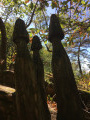
The cromlech, with a diameter of 40 metres, consists of 59 menhirs – naturally standing boulders – ranging in height from 0.2 to 1 metre. The southern side of the cromlech is the best preserved, with 38 menhirs.
In the centre of the cromlech stands a menhir, which is currently lying on the ground and broken into two pieces. It was originally over 2.50 m tall.

The Rochesseux Dolmen
The Rochesseux Dolmen is a simple dolmen consisting of two orthostats and a capstone. The capstone was replaced in 1944.
The chamber is oriented east–west, with the capstone on the western side. The two orthostats form the northern and southern sides. It is 1.90 m long, 0.82 m wide and 0.95 m high. The capstone is triangular in shape, with its apex on the eastern side. It is 2.5 m long and 1.50 m wide at the base of the triangle. It is estimated to have been built in the 3rd millennium BC.

Reviews and comments

4.8 / 5
Based on 39 reviews

Reliability of the description
4.9 / 5
Ease of following the route
4.6 / 5
Route interest
5 / 5
User 29387519

Overall rating : 5 / 5

Date of your route : Sep 07, 2026
Reliability of the description : ★★★★★ Very good
Ease of following the route : ★★★★★ Very good
Route interest : ★★★★★ Very good
Very busy route : No

A superb walk. Ideal in hot weather as it’s very shaded.
Please be careful when you’re out there – I recommend following the Visiorando route closely rather than the routes shown on the signposts, as these aren’t maintained and you risk getting lost.

Machine-translated

User 30182075

Overall rating : 5 / 5

Date of your route : Aug 04, 2026
Reliability of the description : ★★★★★ Very good
Ease of following the route : ★★★★★ Very good
Route interest : ★★★★★ Very good
Very busy route : No

A lovely, shaded walk, much of which runs alongside the water.

Machine-translated

JLC30
JLC30

Overall rating : 4.7 / 5

Date of your route : Jun 16, 2026
Reliability of the description : ★★★★★ Very good
Ease of following the route : ★★★★☆ Good
Route interest : ★★★★★ Very good
Very busy route : No

A lovely walk. We really enjoyed the canal and its ‘source’, the village of L’Ermite and the summit of the Puy de Paulliac, where we had a picnic under a huge tree in the shade – which was very refreshing during the heatwave. The GPS track is a bit rough, particularly for the village of L’Ermite, which is actually a good 300 metres past the houses at La Roche Bergère. A visit to Aubazine is well worth the detour.
Thanks for this brilliant hike

Machine-translated

pascal33500
pascal33500

Overall rating : 3.7 / 5

Date of your route : Sep 08, 2025
Reliability of the description : ★★★☆☆ Average
Ease of following the route : ★★★☆☆ Average
Route interest : ★★★★★ Very good
Very busy route : Yes

Please note that the route indicated may sometimes differ from the actual route, so you may need to adapt accordingly.

Machine-translated

User 21099049

Overall rating : 4.7 / 5

Date of your route : Aug 20, 2025
Reliability of the description : ★★★★★ Very good
Ease of following the route : ★★★★☆ Good
Route interest : ★★★★★ Very good
Very busy route : No

The first part of the hike is very good, the only slight downside being that there are a lot of obstacles across the path towards the end. These forests are not maintained. Otherwise, it's a very pleasant hike that I would recommend.

Machine-translated

User 26795681

Overall rating : 4.7 / 5

Date of your route : Jul 29, 2025
Reliability of the description : ★★★★★ Very good
Ease of following the route : ★★★★★ Very good
Route interest : ★★★★☆ Good
Very busy route : Yes

Many trees block the path and force you to contort yourself on the second part of the hike. Not suitable for young children

Machine-translated

baboutravel
baboutravel

Overall rating : 5 / 5

Date of your route : Mar 18, 2025
Reliability of the description : ★★★★★ Very good
Ease of following the route : ★★★★★ Very good
Route interest : ★★★★★ Very good
Very busy route : No

What a treat! Very varied and enjoyable; the elevation is very gentle (except for the short climb from the village).
be sure to follow the GPS route carefully as there are quite a few other paths along the way.
during the week in March, there wasn't a soul around ;-)
thanks for sharing

Machine-translated

Romain2409
Romain2409

Overall rating : 5 / 5

Date of your route : Mar 17, 2025
Reliability of the description : ★★★★★ Very good
Ease of following the route : ★★★★★ Very good
Route interest : ★★★★★ Very good
Very busy route : Yes

A magnificent route without any major difficulties and numerous points of interest from start to finish.

Machine-translated

BUBU33
BUBU33

Overall rating : 5 / 5

Date of your route : Jan 06, 2025
Reliability of the description : ★★★★★ Very good
Ease of following the route : ★★★★★ Very good
Route interest : ★★★★★ Very good
Very busy route : No

Hello,
One of the must-do hikes in the area! At least once a year when we're in Corrèze, we do it with family or friends: easy, not too long, pretty scenery and, above all, a great view from the Puy de Pauliac. With the sun shining and the peace and quiet, it's a lovely place to linger!
The only thing missing is a little something extra, like a bar or something else open in the village of Aubazine for a gourmet break at the end, but we always do this walk in the off-season, so maybe there's more going on in the summer!
There is a variation starting from the ruins of the Coyroux (or Women's) Monastery.
Best regards,

Machine-translated

Miva
Miva

Overall rating : 4.7 / 5

Date of your route : Jul 25, 2024
Reliability of the description : ★★★★★ Very good
Ease of following the route : ★★★★☆ Good
Route interest : ★★★★★ Very good
Very busy route : Yes

Very pleasant in summer as it is mostly shaded. There is a nice variety along the route. I will have very fond memories of this hike.

Machine-translated

Zayu
Zayu

Overall rating : 4.7 / 5

Date of your route : Jun 17, 2024
Reliability of the description : ★★★★★ Very good
Ease of following the route : ★★★★☆ Good
Route interest : ★★★★★ Very good
Very busy route : Yes

A beautiful hike along the Canal des Moines. Luckily, there weren't many people around. Magnificent woodland. Superb panoramic view at Puy de Pauliac.

Machine-translated

Milar
Milar
• Edited:

A beautiful and unusual short hike.
The route is easy to follow with the Visorando app, because if you had to follow the markings... It's worth going to the end of the Canal des Moines and retracing your steps to take the bridge on your left to continue the walk. There are lots of surprising things to see along the way: shepherds' huts, Ali Baba's cave (closed), a quarry, the remains of a dry stone village and a beautiful view...
There are many ways to get down from Puy Pauliac, so don't be afraid to get "lost".

Machine-translated

Rando24650
Rando24650

Overall rating : 4.7 / 5

Date of your route : May 13, 2024
Reliability of the description : ★★★★★ Very good
Ease of following the route : ★★★★☆ Good
Route interest : ★★★★★ Very good
Very busy route : Yes

A ballad not to be missed. Very beautiful and original

Machine-translated

Jm Bodet
Jm Bodet

Overall rating : 5 / 5

Date of your route : Apr 15, 2024
Reliability of the description : ★★★★★ Very good
Ease of following the route : ★★★★★ Very good
Route interest : ★★★★★ Very good
Very busy route : Yes

A very pleasant walk.

Machine-translated

thivalroad
thivalroad

Overall rating : 4.7 / 5

Date of your route : Apr 09, 2024
Reliability of the description : ★★★★★ Very good
Ease of following the route : ★★★★☆ Good
Route interest : ★★★★★ Very good
Very busy route : No

A superb 9 km walk where you can discover unusual sites and beautiful panoramic views.
In April, this route was not very busy.
Luckily, the app was a great help as the local signage is very poor.

Machine-translated

Other walks in the area

For more walks, use our search engine .

The GPS track and description are the property of this route's author. Please do not copy them without permission.