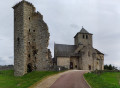
The Canal des Moines
The Canal des Moines is an irrigation canal located in the commune of Aubazines, in Corrèze, built by the monks of Obazine Abbey in the 12th century.
It is protected as a historic monument.
Drawing water from the Coiroux upstream from Aubazines, it runs along the side of the valley until it reaches the village. In some places, the monks had to cut into the rock (Saint-Étienne breach, bathtubs, bretèches) and support the installation with retaining walls in order to divert the water.
History
As the site only had a few small springs, a canal was created in the 12th century, after 1142, by the monks of the Cistercian abbey of Obazine under Étienne d'Obazine, the first abbot, in order to bring the water necessary for their abbey, for life, hygiene, the operation of mills and workshops, and the irrigation of vegetable gardens and meadows.
The canal starts from a remote location upstream of the village, where a diversion of the waters of the Coiroux has been built. At the site of this water intake, there used to be a mill and a fishpond, which have since disappeared. The canal runs along the side of the mountain to the village, with a slope of 0.5%, leaving the stream downstream to turn into a torrent.
To complete this construction, the monks had to bypass or cut into the granite rock in places (Saint-Étienne breach, bathtubs, bretèches) and support the structure with thick, watertight retaining walls in order to carry the diverted water some forty metres above the precipice.
Legend has it that the construction of the canal was halted by the presence of an enormous block of granite. Étienne then raised his hand, blessed the rock, which was then cut, and a breach appeared.
Despite the sale of the monastery during the Revolution, the canal was maintained and continues to supply a large number of plots in the commune. It was listed as a historic monument on 12 April 1965 and then on 24 January 1966, but the storm of 1999 and the heatwave of 2003, combined with the passage of tourists and climbers, greatly weakened it, leading to a restoration operation carried out from 2006 to 2010.
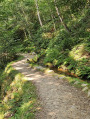
The canal is accessible along its entire length via a path that runs alongside it. The water picks up speed due to a steep slope, arriving under the building of the former abbey mill and ending its course in a large rectangular basin, the former fishpond, located under the windows of the refectory.
The Coyroux women's monastery
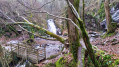
Of the 12th-century buildings, only the ruined walls of the church remain. It is in a green setting in the hollow of the Coiroux river, surrounded by trees, that the remains of this women's monastery can be pleasantly discovered during a walk in the undergrowth, starting from the abbey, passing by old houses and crossing the Coiroux waterfalls.
Aubazines Abbey
The founder of the abbey, Étienne, retired as a hermit around 1125 to the thick woods covering the spur on which the village now stands. "Physically separated from everyone, but spiritually united with all," he inaugurated the spiritual adventure of Aubazine. This was marked by the founding of a double monastery, one for men and one for women, and membership in the Cistercian Order. Through the ups and downs that every institution experiences, the Cistercian adventure continued there until the French Revolution, imbuing the stones of the abbey with a luminous serenity that still strikes visitors today.
At the beginning of the 20th century, the abbey, which had been home to the religious congregation of the Sacred Heart of Mary for some time, also housed a famous resident in the orphanage run by the sisters: Gabrielle Chanel. During the Second World War, the sisters' orphanage served as a cover to shelter and save a number of young Jewish women and girls from death.
Since 1965, the abbey has been part of the Greek Melkite Catholic Church, a Byzantine Church united with Rome.
The abbey church
The abbey church, begun in 1156, was consecrated in 1176 and was one of the largest churches in the Limousin region.
In 1731, as maintenance costs were too high, the monks had the façade and six bays of the nave demolished, i.e. 36 metres out of 92.
The current façade is a Limousin bell tower with a triangular gable pierced by three openings for the bells.
The nave, which has three bays, is covered by a barrel vault broken by transverse arches. It is bordered by aisles with groin vaults, the arcades resting on square pillars flanked by engaged columns.
In accordance with the Cistercian plan, the transept is as wide as the nave, and the shallow choir, which has no ambulatory, has a polygonal chevet lit by three semi-circular windows.
On either side of the choir are three rectangular chapels, each with its own stone altar, which are arranged symmetrically on the west side.
In the left wall of the nave, the three windows contain the oldest stained glass in France.
During the French Revolution, Aubazine became a commune, separating from the parish of Cornil, and the abbey church became a parish church.
Towards the end of the 19th century, the church was listed as a Historic Monument.
On 18 February 1978, a postage stamp worth 1.25 francs was issued, depicting the abbey church of Aubazine.
The tomb of Saint Étienne d'Obazine
The tomb of Saint Étienne d'Obazine, dating from the 13th century, is located at the end of the south transept. It is a large limestone shrine in the shape of a sanctuary, which houses the recumbent statue of the saint in priestly vestments.



 Country:

 City:
City:





 A very enjoyable hike, superb green landscapes, Aubazines is an interesting village, as is the passage to the ruins of the Women's Monastery!
 Visorando Member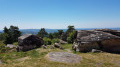

 Easy
Easy