Country:

 City:
City:


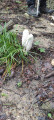
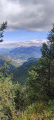
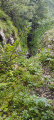
By car: from the centre of Montaud (38), follow the D218 (south) towards Le Coing. On leaving the hamlet, park in a logging lay-by on the right, just above the junction of the D218 and the Route du Pré de la Grange on your left.
(S/E) From the car park, return to the junction and follow the Route du Pré de la Grange, which begins at a bend. After 200 m, you will reach the third bend.
(1) Leave the road and take the sunken, stony and often muddy track opposite, marked (Yellow/Green). Climb initially between two rows of trees, then enter the forest. At around 1,000 m, the path passes to the right of a track and continues straight on (south) to a fork (1,050 m). Ignore the steep, unmarked forest track on the left and follow the marked path turning right. About 100 metres further on, you’ll reach a junction (1,080 m).
(2) Ignore the path opposite. Turn left (south-east) onto the marked path and, after about 500 m and a few bends, you will reach the D218 road (alt. 1160 m).
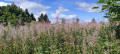
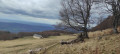
(3) Turn left onto the road and follow it for about 200 m. Look out for an unmarked grassy path on the right. It starts at the beginning of a clearing to the left of the road. (Yellow Cross on a tree). Photo: Start of the forest track.
(4) Leave the road and head fully to the right onto this level path (alt. 1200 m), leaving the ravine on the slope behind you. After about 150 m, ignore the unmarked path descending to the right and head up a track opposite into the forest. Due to forestry work, it has wide ruts and a few trees and branches lying across the path, which are easy to step over. As the slope levels out, it becomes overgrown with scrub and then continues on level ground (alt. 1260 m). 800 m further on, it begins a short descent and at the bottom joins a track on the right (alt. 1240 m). Leave this track and, opposite, after 100 m on a slight incline, reach a crossroads.
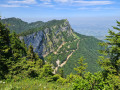
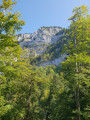
(5) Leave the track and, at the fork in the road on the left, take the first path between two cairns (south), leaving the one just to its right (south-west). Ignore, opposite, 10 m further on, a track rising diagonally which was its former approach. The path climbs straight up, becoming increasingly steep, through the forest. Via numerous hairpin bends, it ascends a scree slope from which the Pas Brochier gap comes into view. Photo: The northern barrier of the Vercors before reaching sloping slabs. Photo: The slabs.
(6) Cross them on the right via an easy climb secured by a rope (blue paint marks). Head left towards a ledge. After about thirty metres, tackle a small difficulty by crossing a slightly overhanging rock ledge, which is also roped. Continue left along exposed traverses leading to a small ladder. Photo: The small ladder. At the top is a letterbox where a logbook is available to leave a message. Continue left along an ascending ledge Photo: The Ledge, joining an exposed chimney equipped with a belay ring. Photo: The chimney. This section, which is not roped up, must be traversed with caution as its sides are smooth and the base is covered with slippery debris. At the exit, climb up a ledge to the right. Photo: Ledge after the chimney up to a tree where it turns left to emerge at Pas Brochier. Photo: Pas Brochier.
(7) At Pas Brochier (alt. 1,475 m), turn right onto theGR®9Tour du Vercors trail. The ridge path climbs a few rocky slopes and passes almost level across grassy ground dotted with trees before reaching the Bec de l’Orient (alt. 1,554 m).
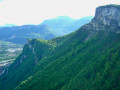
(8) From the Bec de l'Orient, follow the path down towards the north, heading for the cliff. From the platform marked by a large metal cross, enjoy a superb view. Photo: View from the Bec de l'Orient.
Return to Pas Brochier via the sameGR®®9path (north-east) which runs along the ridge.
(7) Continue straight on, pass a path on the right, then, about 500 m further on, reach a flat, open area marked by a sign (alt. 1460 m).
(9) At the signpost, continue along theGR®®9straight ahead towards the Pas de la Clé (north-east), ignoring the path on the right. TheGR®®9winds along the ridge and, as you approach the Pas de la Clé, on a short descent, ignore a path on the right heading due south; just after this, keep left to reach the Pas de la Clé junction (alt. 1509 m).
(10) Here you have a choice for descending the rocky ridge.
- Either via the path (Yellow/Green) which climbs east of the Pas de la Clé along the ridge and to the left ofthe GR®®9. It makes a hairpin bend to the left before crossing a gap, then descends to reach a gently sloping path.
- Or go straight down (the option chosen on the map), passing through the Col du Pas de la Clé gap (Yellow Cross/Green Cross) and taking a slide on the right to join the gently sloping path. Photo: The slide. This slide was carved into the rocky outcrop to haul logs down to the Isère valley. Descend with your back to the slope to find handholds on the walls, which are less smooth than the bottom, with your arms braced out to the sides. Although fun, do not underestimate the risk of slipping, especially on wet rock.
(11) At the junction at the bottom of the slide (alt. 1,490 m), follow the marked path (Yellow/Green) which descends gently (east) for about 250 m before turning (north-west) into the forest on a steeper slope. In a level clearing, it meets a forest track (alt. 1280 m).
(12) At the signpost, take the track to the left towards Montaud le Coing and ignore the path opposite. Often steep-sided and muddy, 200 m further on in a left-hand bend, it leaves a path opposite (alt. 1245 m) to head south-west and join the D218 road.
Heading down this road, on the left, you’ll come to the junction that completes the circular route and marks the return route.
(4) Follow the route back in the opposite direction to the outward journey to reach the car park further down (S/E).



 Visorando Member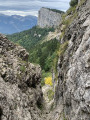

 Moderate