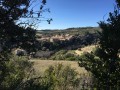
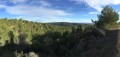
The Brahunal Balcony

Between 55 and 45 million years ago, a warm, shallow sea flooded the older terrain forming the Montagne Noire, covering it with limestone rich in foraminifera (microscopic organisms encased in a calcareous shell). This limestone forms the Causses du Minervois. Rivers flowing down from the Montagne Noire cross these plateaus and carve out narrow valleys: the canyons. This network of canyons is home to numerous karstic caves and caves harbouring ancient traces of human presence and rare animal species. Bats, which inhabit the Grotte de l’Aldène in the Cesse Gorges, the peregrine falcon, the Montagu’s harrier and the red-backed shrike all contribute to the biodiversity of this site.
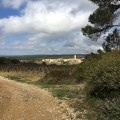
This walk remains on the limestone plateau, amongst vineyards and valleys, and offers an exceptional view of the Brahunal Gorges, a stream that joins the Cessière.
See warning in the practical information tab

Details

93484913
Creation:
Last update:
Last review:
  • Walking
    Activity: Walking
  • ↔
    Distance: 6.76 km
  • ◔
    Average duration: 2h 20 
  • ▲
    Difficulty: Moderate

  • ⚐
    Back to start: Yes
  • ↗
    Ascent: + 145 m
  • ↘
    Descent: - 144 m

  • ▲
    Highest point: 264 m
  • ▼
    Lowest point: 130 m

Description of the walk

From Aigues-Vives (D907), turn right towards Agel (D20) then left to reach Paguignan. On leaving the hamlet, look for a small road on the left that descends towards Cailhol. Follow it and park behind the Paguignan cemetery.

GRP® Around St-Jean-de-Minervois (yellow-red markings)
This GR® de Pays is one of five circular routes grouped under the name “Tours en Minervois, Saint-Chinian, Faugères”, forming a 232-kilometre route through the wine-growing regions of western Hérault.

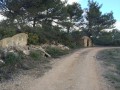
(S/E) From the cemetery, return to the road and take it to the right heading north-west, crossing a first bridge. Cross another small bridge (green railing), and continue uphill to the hamlet of Cailhol.

(1) At the wayside shrine on the left, leave the road and head down to the right into the hamlet via Rue du Centre. Drinking water point on the low wall. Walk right through the hamlet. On leaving, cross a small bridge and turn left onto the dirt track that climbs uphill.

Leave the GRP®

(2) At the entrance to a house (chain), take the unmarked path to the left of a fig tree opposite. Afirst tree blocking the path requires you to go round it on the left. The others will soon follow! (see warning).

(3) Then look out for the small, barely visible path (small cairn with a trace of paint) on the left, which leads downhill. Cross the Combe Naurèle and climb back up a fairly steep and stony slope.

(4) Pass several vantage points as you walk along the edge of the cliff, above the Ruisseau de Brahunal, a tributary of the Cessière. You will come to a plot of uprooted vines. Go round the fallow plot on the left.

(5) Look out for a path ‘marked’ by a bucket hanging from a tree on the left. Cross several steep sections of the Champs des Champez before returning to the edge of the cliff. Head north.

(6) At a fork, take the left-hand path to stay as close as possible to the edge of the plateau.

(7) At the crossroads, you’ll come across the signposting for an “oenorando” (post). Turn right onto a more comfortable path. Walk alongside the walls of an old building, and head east before veering slightly to the right. Ignore two successive tracks coming in from the right, before athird junction.

(8) Turn right and pass between plots of vines, whose vines grow on white pebbles but which have made the reputation of the "Muscat petits grains" grape variety. Arrive at a triangular junction.

GRP® Around St-Jean-de-Minervois (yellow-red markings)

(9) Join the GRP® on the right and head southwards. Ignore the track as it bends to keep straight ahead on the GRP®, weaving through a narrow path. Wander through low vegetation before reaching a track at the start of the Combe Naurèle.

(10) At the T-junction, turn right, then head back south, staying on the GRP® for a while. Leave it when it veers off to the right, staying on the track lined with trees felled by the storm. Pass beneath a mobile phone mast, and eventually reach the Paguignan cemetery (S/E).

Waypoints

  1. S/E : km 0 - alt. 130 m - Paguignan – Cemetery. Towards the - Cessière (rivière) - Affluent de la Cesse
  2. 1 : km 0.66 - alt. 144 m - Cailhol Cross
  3. 2 : km 1.29 - alt. 170 m - End of track – Figuier
  4. 3 : km 1.68 - alt. 185 m - Path on the left – Combe Naurèle
  5. 4 : km 2.06 - alt. 207 m - Viewpoint over the Brahunal Canyon
  6. 5 : km 2.45 - alt. 217 m - Path on the left
  7. 6 : km 2.8 - alt. 241 m - Fork – Left
  8. 7 : km 3.04 - alt. 252 m - “Eonorando” crossroads
  9. 8 : km 3.69 - alt. 262 m - Junction with the PR
  10. 9 : km 3.96 - alt. 258 m - Triangular junction
  11. 10 : km 5.04 - alt. 203 m - T-junction
  12. S/E : km 6.76 - alt. 131 m - Paguignan – Cemetery

Notes

Warning:
During the recce (22/03/26), the path along the cliff edge between points 2 and 6 is blocked by several pine trees that were uprooted during the last storm. This means you have to work your way around them as best you can, which slows down your progress on this section. Not recommended for children or those with little off-trail experience. The difficulty of the hike has been reclassified as ‘moderate’ due to these obstacles, which are not insurmountable, however.

Water point at Cailhol sur Muret

Worth a visit

St-Jean-de-Minervois wine cellar, famous for its Muscat (to be enjoyed in moderation). Start of an 8 km (2½ hours) marked route (yellow line) known as the “Oenorando® du Petit Grain”

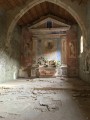
In Paguignant: Church of St-Martin-le-Vieux
All that remains today of the majestic church of “Saint-Martin-le-Vieux” are ruins. Built at the beginning of the Common Era, during the Gallic Revolt, it was repeatedly subjected to looting and arson. It was in the 13th century, during the terrible Cathar period, that Franciscan and Dominican monks were tasked with evangelising the heretics in the Aude valley. They settled in Paguignan, erecting a church in the Southern Gothic style. Saint-Martin-le-Vieux stands as a testament to this era of church builders, whose influence extended as far as Majorca.

Always be cautious and plan ahead when you're outdoors. Visorando and the author of this route cannot be held responsible for any accidents occurring on this route.

The GR® and PR® markings are the intellectual property of the Fédération Française de Randonnée Pédestre.

Reviews and comments

4 / 5
Based on 1 review

Reliability of the description
4 / 5
Ease of following the route
4 / 5
Route interest
4 / 5
Bru34
Bru34

Overall rating : 4 / 5

Date of your route : Apr 18, 2026
Reliability of the description : ★★★★☆ Good
Ease of following the route : ★★★★☆ Good
Route interest : ★★★★☆ Good
Very busy route : No

This walk, which is not difficult apart from a few steep sections and the need to climb over trees felled by the storm between points 2 and 6 – as clearly mentioned in the warning – offers a chance to explore this wild valley. The route is completely unshaded, so best avoided in hot weather! You can continue along the gorges from the 7th kilometre by following the yellow markings of the Petit Grain Oenorando trail; you’ll rejoin the GRP near St Jean: a pleasant detour without adding too much to the hike, total distance 8 km!

Machine-translated

Other walks in the area

For more walks, use our search engine .

The GPS track and description are the property of this route's author. Please do not copy them without permission.