Country:

 City:
City:


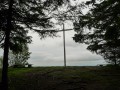
Arrival via the D 570a. Leave your vehicle at the Col de la Charousse (altitude 1,250 m).
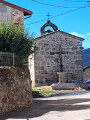
(S/E) Take theGR®7on the side of the road where the signs are, with the large calvary on the other side of the road. Follow the path up to the first crossroads.
Ignore the road that branches off to the right and follow the red and white markings ofthe GR®7.
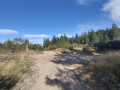
(1) At the second crossroads, continue to follow theGR®7, a very stony path that branches off to the right. Although this path is normally closed to motor vehicles, it suffers from heavy use and is in poor condition (muddy ruts, loose soil, etc.).
You will arrive at the small Felletin clearing where there are five possible routes. TheGR®7trail you have just come from continues straight ahead. There is a road coming up behind you on your left (the one you left at the second fork), a path leading off to the right towards the Fultin farm, and finally a path leading off to the left ofthe GR®7.
(2) Take the path that branches off to the left towards "Monestier" and "Saint-Julien Vocance".
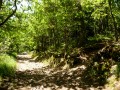
This is where the fantastic trail begins. The route is marked by signs showing a smiling foot with arms (yes, well, that's how it's described... but you'll see what we mean). Keep your eyes and ears open, look up, down, right and left, and don't hesitate to turn around to discover some of the curiosities. This part should be done slowly if you want to uncover the unexpected, the bizarre, the work of nature, aided or not by man's artistic sense, and tell yourself stories (I'll keep mine to myself... it's up to you to create your own), to enter a quirky universe... A disc-eating tree, another lyre or zigzag, an "open book" tree or a sentinel await you along the way... I won't say any more. Not all my photos are here, otherwise it wouldn't be any fun...
Busy observing and imagining, you won't even notice the climbs. And don't forget to look between the branches of the trees lining the path to see glimpses of the panorama that you'll enjoy once you reach Grand Felletin, to encourage you to climb up there.
(3) After a slight incline, the path turns right. Just before that, indicated by a typical sign along the route (the foot...), a very grassy path, initially obstructed by low branches, climbs up to the right. Take it. The earth turned over in places bears witness to the activity of wild boars. You will cross undergrowth and a very wet area (not to say flooded in places) linked to a large unchannelled water network. This protects it from exploration by motorised vehicles (which would get stuck in the mud).
This small path, which first climbs and then descends after a hairpin bend at a scree slope (marked by a remarkable pile of stones), is the site of works born of human imagination. But that's not all...
(4) Returning to the path you left, continue to the right. A large, remarkable rock formation is reminiscent of Egypt... a sphinx of the woods?
The path arrives at Col de la Clef, disfigured (alas!) by large muddy tracks bearing witness to the activity of forestry machinery with a deposit of logs. A little further on, on the left, a signpost perched on a mound tries to stand upright among the flowers. There is no need to go and look at it, as the path to follow for the rest of the walk is immediately to the right.
(5) Take this forest track, following its left-hand bend (straight ahead is a towpath that leads nowhere).
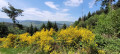
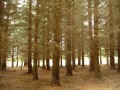
The slope is quite steep, and you'll know you're on the right track when you pass through a forest of blue pea trees. Leave the forestry vehicle tracks on your right and continue quietly along the path that climbs in front of you and becomes more pleasant. You will come to another path marked "PR® 93" (Regional Country Path No. 93) on a beautiful tree on the left. You will see a tree opposite you on the other side of the path with white and yellow markings.
(6) Take this path on your right, heading uphill. You now need to reach the highest point of this massif (1388m). The climb eases off onto a gentle, grassy slope that is ideal for camping, then resumes in the undergrowth. A flat, grassy path marked in red will tempt you to the right. Continue up the stony path to reach the Grand Felletin boundary marker, indicated by a wrought iron calvary (departmental boundary between Ardèche and Haute Loire).
(7) Descend the path on your right, taking care not to trip over the exposed pine roots.
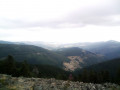
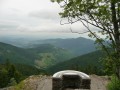
You will arrive at the edge of Grand Felletin, where there are two benches on which you can finally sit down and enjoy a break with a panorama worthy of a poster, overlooking the Vercors, the Vanoise and Mont Blanc. A large metal cross "sings" when you knock on it, as if you were knocking on a door. Below on the left, an orientation table awaits you in the scree, which is easier to climb up than down (caution).
Head back down the main path, leaving the orientation table on your right, until you reach theGR®7trail that you left on the way up.
(8) Turn right and head for the Felletin crossroads where you took the fantastic path (it is now on your right).
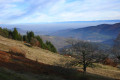
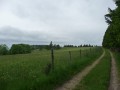
(2) Take the path on the left towards the buildings of Fultin, then quickly turn right onto the carriage road that runs along the edge of the Grand Bois forest towards La Charousse. On a clear day, you can enjoy a superb panoramic view of the Haute Loire and its first mountains. You will walk alongside fields rich in flowers in spring. You will then enter the edge of the "Grand Bois" forest, which is a little sparse: fuchsia-coloured pine trees await you there.
You will arrive at a forest road, which you will take to the right to end up on the path you took at the start.
(1) Descend to the left to the Col de la Charousse to return to your vehicle (S/E).





 Visorando Member
 Very difficult
 Easy
Easy