Country:
 City:
City:





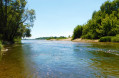
The starting point for the hike is on the Mail de Meung sur Loire, at the corner of Rue du Pont and Quai du Mail.
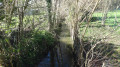
(S/E) Follow a route parallel to Quai du Mail until you reach Chemin des Grèves. Turn left for a few metres, then at the fork, turn right onto the street that runs alongside the sports facilities on the left and the vegetable gardens on the right, following the river 'La Mauve' on its left bank (GR®655marked in white and red). Continue on the 'La Loire à vélo' path marked by a green arrow.
(1) At the intersection with Chemin de l'Île, turn right and cross La Mauve, then turn left at the intersection with the wide path. Follow La Mauve on its right bank, staying on the 'La Loire à vélo' route and ignoring the paths on the right, until you reach the confluence of La Mauve and the Loire.
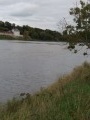
(2) At the crossroads, stay on the 'Loire à Vélo' route, continuing straight ahead along the right bank of the Loire. In summer, the 'La Corne des Pâtures' open-air café is open for business. Stay as close to the river as possible.
(3) At the crossroads, continue straight ahead on the wide path, ignoring the various turnings on the left and right, until you reach the tarmac Chemin des Accruaux.
(4) Take Chemin des Accruaux on the left (GR®3) and cross the Accruaux meadow, ignoring the paths on either side. The path crosses another branch of the Mauve. Take a look at the very old Beaugency Bridge, the first parts of which date back to the 14th century.
Continue straight ahead, following the Loire as closely as possible, until you reach the bridge (D925) to cross to the left bank of the river. At the junction, continue left on the Route de Lailly-en-Val, leaving the D925 on your right, then the path leading to the campsite on your left.
(5) Just after the Pont du Guidon bridge, turn left onto the embankment, which is open to walkers. This embankment, which is regularly maintained, is designed to contain the Loire's ten-year floods (which occur on average every ten years). Continue along the levee, which is easily recognisable, observing the Val de Flux and its pastures. This distinctive landscape is a reminder that it is located in a flood zone, as the levee cannot contain hundred-year floods, which then spread throughout the valley. Hikers can enjoy beautiful views of the Loire as the levee approaches the river. Then it moves away again, leaving an area that has been left wild since the closure of a sandpit that operated in the minor bed (ordinary bed) a few decades ago.
(6) At kilometre marker 70D, after the 'Le Morier' farm on the right, leave the embankment by taking a path downhill to the left towards the Loire, just after a small wood. This path, which becomes grassy in the valley, is only visible from the embankment after this small wood. It is therefore necessary to remain vigilant. Leave the communal path on the right to get as close as possible to the Loire.
(7) After the old sandpit, turn right onto the path that was once used to transport sand. You will then discover a wild riverbank. Follow this route, which occasionally evokes its original function when it becomes tarmac. The vegetation and numerous burrows are evidence of abundant wildlife. Continue as close as possible to the Loire.
(8) When the path ends at a sandpit, this time in the floodplain (operation ceased in August 2018), descend towards the Loire and resume the path, avoiding the one that descends to the riverbank, which is often flooded.
(9) At the intersection, continue straight ahead, leaving the best-marked path on your right, just after a huge black poplar tree. The wild beauty of the river on your left is a reminder that the bank is regularly flooded. Ignore the paths on your right until you reach a right-hand bend where you meet the Vielle Rivière. You will come to the D718.
(10) Turn left towards the Meung-sur-Loire bridge. Cross the bridge to return to the starting point, at the corner of Rue du Pont and Quai du Mail (S/E).



 A lovely walk along beautiful, very pleasant paths!
 Visorando Member

 Easy
Easy