The fortress of the cutlers

Thiers is a city of challenges. In this grandiose and isolated location in the heart of Auvergne, the inhabitants of Thiers have had to contend with a turbulent river, the Durolle, and the steep slopes of its gorges. Over time, thanks to numerous developments, this partially tamed river has ensured the industrial prosperity of the town, which is known as the cutlery capital of France.

Details

969458
Creation:
Last update:
Last review:
  • Walking
    Activity: Walking
  • ↔
    Distance: 5.58 km
  • ◔
    Average duration: 2h 15 
  • ▲
    Difficulty: Easy

  • ⚐
    Back to start: Yes
  • ↗
    Ascent: + 218 m
  • ↘
    Descent: - 210 m

  • ▲
    Highest point: 437 m
  • ▼
    Lowest point: 309 m

Description of the walk

In Thiers, park in the Parc de l'Orangerie car park at the bottom of the town, on the edge of Rue du Moutier.

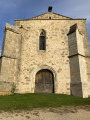
(S/E) Head east on Rue du Moutier for a short round trip to the Church of Saint-Symphorien, a former abbey church and Cluniac site. The interior of this beautiful church is colourful and features a very original Way of the Cross with naive motifs in enamelled lava. You will also find information panels about the church and the Cluniac site in Thiers. On the other side of Avenue Joseph Claussat is the former abbey house, which accommodated up to 24 monks in the 13th century (information panel in front of the house).

Retrace your steps along Rue du Moutier, then turn right onto Rue des Usines. At the beginning of this street, you will find an information panel about the "Quartier du Moutier- Ilot Navarron" (Moutier district - Navarron block). Cross a diversion canal of the Durolle, which was used to power the mills, whose wheels can still be seen. Note the information panels on "La roue par en dessous" (The wheel below) and "Les seigneurs de la vallée" (The lords of the valley). Shortly afterwards, ignore a street on the left and arrive at the bridge over the Durolle.

On the right, go down to a small esplanade to read the information panel "Cultiver l'eau" (Cultivating water). Then take the bridge to cross the Durolle and find the sign "Crospailhat et Faux Martel". Turn right onto Rue Abbé Quesne (note the signs for "Pâtière du Moutier" and "Le long circuit du couteau") then continue uphill via the steps (sign for "approvisionnement et expéditions") to reach Rue des Rochers (sign for "Art de composer avec la pente").

(1) Turn right onto the path, following the sign for "Creux de l'Enfer" on a small sign on the ground. Further on, turn right onto the bridge to cross the Durolle. On the other bank, continue left (towards "Creux de l'Enfer", small sign on the ground) to follow the river. Pass the information signs about the "Creux de l'Enfer", "L'usine d'Entraygues", which was built on the river because the banks were so cluttered with factories, and "L'usine du Creux de l'Enfer". When you reach the Contemporary Art Centre, continue along the Durolle for a short detour to the "Les forges Mondière" sign.

Back at the Contemporary Art Centre, go back down below the Maison de l'Aventure Industrielle to cross the Durolle on the footbridge, then take the steps to the right of the museum. At the top, continue to the right, overlooking the factories. Pass the information panels on the "Sheds and skylights", "Peddles and gardens", "The two faces of the upper town", "Saint-Jean du Passet" and "The Croix de Fer factory", as well as panels that take you back to the atmosphere of the 19th century with excerpts from George Sand's book "La Ville Noire". You will come to Rue Daguerre. Turn right and follow the road down towards the river.

(2) At the end of the street (small sign on the ground), do not take the footbridge but go through the green gate to continue into the Jardin de l'Ancien l'Hôpital, on the path that runs along the river on your right. In this park, note the information panels on "Industrial plants" and "Along the Durolle". At the end of the park, come out onto Impasse des Tanneries and look for an information sign about "le quartier du Pont de Seychalles" (the Pont de Seychalles district).

At the end of the cul-de-sac, turn right towards the bridge to see information panels on the Pont de Seychalles and the Pont de Seychalles factory, one of the city's most famous factories, also known as the Paquebot (ocean liner) due to its position in the middle of the river.

(3) Retrace your steps and continue along Rue Durolle, which runs parallel to the bridge. At the fork, turn left onto Rue des Murailles, a street that runs alongside the Jardins de l'Ancien Hôpital (Old Hospital Gardens) above. Pass the information signs for "Les maisons ateliers" (workshop houses) and "La seigneurie de Thiers" (the seigneury of Thiers). You will arrive at the intersection with Rue Daguerre at the Porte Saint-Jean (small sign under the fire hydrants).

(4) Turn right to walk alongside the Eglise Saint-Jean and feel free to take a look around the adjoining cemetery overlooking the valley (information signs for "La société thiernoise" and "Le Père Lachaise auvergnat"). Leave the cemetery, continue straight ahead and take Rue du Quatre Septembre on the left. Shortly afterwards, ignore Rue d'Alger on the left. At the next crossroads at Place Lafayette, turn right onto Rue Mancel et Chabot.

Further on, notice a fountain built into a façade on your left. Then ignore the stairs on your left and continue until you reach a crossroads with Rue du Piroux on your left and Rue Durolle on your right. On your left, you will see a half-timbered passageway above Rue du Piroux. Continue straight ahead on Rue Alexandre Dumas, lined on the right with some beautiful façades, particularly at number 14. Ignore the narrow streets on your right and continue to Place Antonin Chastel.

Turn right to pass in front of the Jacquemart and continue to the end of the square where a sundial stands on an esplanade overlooking the Durolle valley. Retrace your steps to the town hall, then cross Rue François Mitterrand and take Rue Traversière on the other side. Continue to the junction with Rue des Grammonts. Turn right and enter Square de Verdun. On the other side, climb the steps to reach Place Duchasseint. Turn right to enjoy a view of the valley at the end of the square.

(5) Turn back towards the Ophis. On the left, at the start of the gate overlooking the square, you will see an information panel about the "Historic Centre". Go back down the hill on the left of the Ophis to Rue des Grammonts. Cross the road, walk a few metres to the left and then turn right into Rue Conchette, which is lined with some beautiful half-timbered houses. Ignore Rue Abbé Delotz on your right and continue straight ahead along the pedestrianised section of Rue Conchette. Ignore two streets on your left to return to Place Antonin Chastel, where you will see a beautiful sculpture entitled "La coutellerie dans le monde" (Cutlery around the world).

Continue straight ahead on Rue du Bourg. Shortly afterwards, you will see a beautiful door carved from Volvic stone next to one of the many cutlery shops that line this street. Ignore the streets on the right and left to arrive at Place du Piroux, where you will find the Tourist Office in a beautiful old house. Walk a few metres to the left and notice Rue du Piroux, on the other side of the half-timbered passage you saw on the way in. Then turn right onto Place du Palais.

Shortly afterwards, turn left onto the square in front of the Church of Saint-Genès (which you can visit), walk past the church and take the few steps on the right to return to Place du Palais. Just ahead of you, you will see a beautiful building with a salmon-coloured façade and an ornate door (No. 1 Rue du Palais). Take Petite Rue du Palais on the right. You will soon reach Rue de la Coutellerie.

(6) Turn right (see alternative route in "Practical information") and continue to the junction with Rue Grenette. Follow this street to the left and notice the beautiful door frame at No. 8 as you round the bend. Ignore Rue des Vieilles Écoles on your right and turn left onto Place des Martyrs.

Ignore Rue du Docteur Lachamp on your left, but a few metres further on, turn left onto Rue Chauchat to discover another Thiers speciality that we have avoided until now: staircase streets! Go down until you reach Rue Gambetta, turn left and then go up Rue des Forgerons. Cross Rue du Docteur Lachamp and continue up Rue de Lorraine opposite. You will come out again on Rue de la Coutellerie.

(6) Turn right and you will immediately see the Cutlery Museum on your right. Continue along Rue de la Coutellerie, lined with several half-timbered houses, until you reach Place Lafayette, where you will find another Cutlery Museum on your left. Turn right onto Rue Gambetta and, further on, turn left onto Rue de Coagne. At the next intersection, continue straight ahead on Rue des Rochers (sign on the ground, towards "Saint-Jean") to reach the top of the stairs you took on the way there.

(1) Go back down the stairs and continue along the same route as on the way there until you cross the Durolle. About 20 metres further on, at the fork, leave Rue des Usines and turn right onto Rue Vaucanson. You will end up in a factory courtyard where you will see information signs for "Les maîtres du papier" and "Navarron Aîné". Cross the footbridge and continue straight ahead to the Parc de l'Orangerie car park (S/E).


Waypoints

  1. S/E : km 0 - alt. 310 m - Parking at the Parc de l'Orangerie
  2. 1 : km 0.38 - alt. 337 m - Turn right on the way there and back.
  3. 2 : km 1.11 - alt. 344 m - Straight ahead into the park.
  4. 3 : km 1.65 - alt. 351 m - Seychalles Bridge
  5. 4 : km 2.24 - alt. 370 m - Saint-Jean Church
  6. 5 : km 3.68 - alt. 436 m - Viewpoint
  7. 6 : km 4.45 - alt. 391 m - Less steep alternative
  8. S/E : km 5.58 - alt. 310 m - Parking at the Parc de l'Orangerie

Notes

Easy urban hike, comfortable shoes recommended.

Alternative route: At (6), to avoid a small loop in the circuit, the main interest of which is to allow you to appreciate the steep nature of the town, when you reach Rue de la Coutellerie via Petite Rue du Palais, turn left.

Worth a visit

Discover more walks in this area with a description or the Visorando app here

Some photos here

Thiers' motto is "Labor omniat vincit", "work conquers all", which couldn't be more apt.

The Cluniac boom in Thiers began in 1011 under the impetus of the then Lord of Thiers, Guy II, while the Abbey of Saint Symphorien du Moûtier had long been established on this site. In the lower town, at the mouth of the Durolle, the site now consists of the parish church of Saint Symphorien and the former abbey lodgings. Until the 11th century, this lower part constituted the actual town of Thiers, the upper part consisting only of the seigneurial stronghold. The church is Romanesque in style and its oldest part dates back to before the year 1000. It was one of the largest in Auvergne, but the Wars of Religion and a devastating flood of the Durolle in 1707 dealt a fatal blow to the abbey, which closed in 1782. The church was renovated in 1882 and again in 2005.
Founded in 910, Cluny Abbey in Burgundy gave rise to the largest monastic complex in Western Europe. It was a melting pot of artistic, spiritual, social and political renaissance and creativity from the 10th to the 12th century.

The Durolle, a capricious river barely 50 kilometres long, with devastating floods and narrow gorges, was tamed in the 15th century. Numerous devices dispersed the hydraulic energy and gave the river the appearance of a staircase of waterfalls. In addition to its role as a hydraulic motor, its waters were used to temper metal, as retting ponds for hemp and as running water for papermakers, tanners and washerwomen! Since the river "retired", it has become much cleaner and more pleasant, as can be seen in the Jardin de l'Ancien l'Hôpital.

The Valley of Factories. It was in this valley of the Durolle that, more than six centuries ago, the activities that would give Thiers its industrial vocation began to take root: millers, tanners, papermakers and then grinders when cutlery production became predominant around 1850. The cutlers then colonised the banks of the Durolle, using every available plot of land. Over a distance of just over three kilometres, 140 locks tame the turbulent river.

The Pont de Seychalles is the oldest bridge over the Durolle. It is said to be nine centuries old and was instrumental in the town's economic development. It was built on the old carriage road linking Thiers to the road to Lyon and was used by travellers, merchants and other peddlers.

The Pont de Seychalles or Paquebot factory: In 1836, it was a paper mill producing banknotes and stamped paper for the State. In 1910, it was converted into a cutlery factory, the largest in the town, under the aegis of the prestigious Société Générale de Coutellerie et d'Orfèvrerie.

In the 10th century, the powerful lords of Thiers built a fortified castle on the granite spur overlooking the Durolle. It was an eagle's nest that was easy to defend in troubled times when invaders of all kinds regularly ravaged the region. The 11th century was a time of great invasions. In order to protect lords and priests, a first wall was erected around the castle and the church of Saint-Genès. A century later, the Muraille du Bourg (town wall) completed the defences, this time protecting the inhabitants. In the 14th century, the Hundred Years' War broke out, but the town prospered by attracting craftsmen and merchants to the shelter of its protective walls. As the town grew, the walls were extended and enlarged until the Mallorie wall encompassed even the suburbs. Rue des Murailles follows the exact route of the 15th-century ramparts, the last to be built. They are flanked by towers and pierced by gates such as the Porte Saint-Jean.

The Saint-Jean cemetery, on its rocky spur, is perched above the Limagne plain. It has funeral chapels made of Volvic stone with wrought iron interlacing and stained glass windows. This is where the city's great men are buried. Its romantic side is said to have inspired painters.

The Jacquemart is a monument symbolic of the spirit of Thiers, as it evokes the town's industrial history: metalworking. The blacksmith appears with his anvil every hour (especially in summer). He is installed above a fountain and is powered by a water wheel. It is a work by artists Michell and Hartmann, which was inaugurated in 2008.

The meridian sundial is a special type of sundial that indicates the precise solar time when the sun passes the meridian of the location. A diagram on the base of the dial explains more precisely how it works. To compensate for the possible lack of sunlight at midday, the time slot is extended to two hours before and after the midday line. This measure was regulated by a circular from the Ministry of the Interior in 1839, recommending that municipalities crossed by the postal service should, several times a week, align the indications of the sundial with those of the clock.

Reviews and comments

4.2 / 5
Based on 9 reviews

Reliability of the description
4 / 5
Ease of following the route
4.1 / 5
Route interest
4.6 / 5
rico28
rico28

Overall rating : 4.3 / 5

Date of your route : Jul 08, 2025
Reliability of the description : ★★★★☆ Good
Ease of following the route : ★★★★★ Very good
Route interest : ★★★★☆ Good
Very busy route : No

It is indeed impossible to access the steps on the other side of the Durolle at the Centre d'Art Contemporain. You can continue along the Durolle and turn onto Rue Daguerre, where you will find point no. 2 on the other side of a footbridge.
Enjoy your visit to Thiers.

Machine-translated

Daniel Maciocia
Daniel Maciocia

Overall rating : 4.3 / 5

Date of your route : Feb 06, 2025
Reliability of the description : ★★★★☆ Good
Ease of following the route : ★★★★☆ Good
Route interest : ★★★★★ Very good
Very busy route : No

It is impossible to cross the Durolle at the contemporary art centre. We had to turn back and return to point 4 to finally retrace our steps to point 2. This made the hike longer, but it didn't bother us.

Machine-translated

Caelia
Caelia

Overall rating : 4.7 / 5

Date of your route : Dec 26, 2023
Reliability of the description : ★★★★★ Very good
Ease of following the route : ★★★★★ Very good
Route interest : ★★★★☆ Good
Very busy route : No

A pleasant walk that allows you to discover Thiers.

Machine-translated

BaudouinB
BaudouinB

Overall rating : 4 / 5

Date of your route : Jul 25, 2022
Reliability of the description : Not used / Not applicable
Ease of following the route : ★★★★☆ Good
Route interest : ★★★★☆ Good
Very busy route : No

First of all, thank you for this hike, which offers an interesting route for discovering Thiers and its knife-making heritage.

We didn't use the description but downloaded the GPX file to our GPS. However, in town, the GPS sometimes lost its bearings, so we consulted the map on the Visorando app. As mentioned in the comment dated 21 June 2021, there is an error in the route between points 1 and 2, when you retrace your steps after going to the Fontenille Pataud cutlery shop. You need to go back down below the Maison de l'Aventure Industrielle to cross the Durolle.

There is a second error on the way back to the starting point. After the bridge over the Durolle, you cannot turn right. This is private property and the road is closed to traffic. These two errors are not a problem, as it is easy to find your way back.

We particularly liked the route through the industrial part of the valley. We enjoyed the town a little less, as it was difficult to tell whether it was an old town or a town that had been left to fall into disrepair. However, some neighbourhoods were very beautiful. Finally, after point 6, we continued straight ahead on Rue Gambetta to return to point 1. It was very hot and we were a little tired of walking all over the town.

A must-do tour for those who love heritage!

Machine-translated

Gérald 45
Gérald 45

Overall rating : 4 / 5

Date of your route : Sep 27, 2021
Reliability of the description : ★★★☆☆ Average
Ease of following the route : ★★★★☆ Good
Route interest : ★★★★★ Very good
Very busy route : Yes

The proposed route is very interesting, covering the history of the factories in Thiers, the use of the river and the lives of the workers. However, it takes a good three hours of walking and is quite difficult, particularly the climbs and stairways. Rue Traversière has no place on this route as it is really unattractive and smells bad. It is better to take another street running parallel to it, which leads back to the esplanade.
This walk is for experienced walkers.

Machine-translated

Yannick_Josset
Yannick_Josset

Overall rating : 4.7 / 5

Date of your route : Jun 21, 2021
Reliability of the description : ★★★★★ Very good
Ease of following the route : ★★★★☆ Good
Route interest : ★★★★★ Very good
Very busy route : No

Hello,
Many thanks to the author for this city tour. Unfortunately, I was only passing through and couldn't do the whole thing. The factory valley is well worth a visit.
One small comment: there is a slight error in the route. On the way back, at the museum, you need to take the footbridge after the museum, not before, as indicated on the map. It's a bit confusing, but you'll find it.
Enjoy your walks.
Yannick

Machine-translated

evedu64
evedu64

Thank you for your comment, Rogers 57.

Machine-translated

evedu64
evedu64
• Edited:

Hello,

I agree. I had some difficulty at first creating the routes and adapting to the codes used to describe them.

Visorando provided a short guide on how to write the descriptions, but I can't remember which page it was on. I asked a moderator to help me resolve a few computer bugs.

Best wishes for your future hiking adventures... and computer skills.

P.S.: if you're hiking in the Thiers area again, I've suggested a short hike I did last year near Noirétable
https://www.visorando.com/randonnee-lit-...

Machine-translated

durris
durris

Perhaps I am not setting up the start and follow-up sheet correctly.

Machine-translated

evedu64
evedu64

Good evening, Durris,

I'm a little surprised to see your comments about the reliability of the description and the map, as I didn't encounter any difficulties. I looked at the seven walks you suggested, but they haven't been validated.

There must be a problem with creating the files because no description appears, nor does the mode of transport, and the time and distance travelled are rather fanciful.

Please don't take this as negative criticism. I'm just saying that a complete file would undoubtedly attract the interest of hikers, whether or not they are "Viso" users.
Best regards

Machine-translated

durris
durris

Overall rating : 2 / 5

Date of your route : Jun 22, 2020
Reliability of the description : ★☆☆☆☆ Very disappointing
Ease of following the route : ★☆☆☆☆ Very disappointing
Route interest : ★★★★☆ Good
Very busy route : Yes

Very difficult to follow the route indicated and very confusing.

Machine-translated

evedu64
evedu64

Overall rating : 5 / 5

Date of your route : Jul 17, 2019
Reliability of the description : ★★★★★ Very good
Ease of following the route : ★★★★★ Very good
Route interest : ★★★★★ Very good

Thank you to the author of this tour, which allows visitors to discover the town of Thiers. The tour is enhanced by the author's well-researched notes on the history of the town and its unique features. A green guide ++!

Machine-translated

mn54710
mn54710

Overall rating : 5 / 5

Date of your route : May 05, 2018
Reliability of the description : ★★★★★ Very good
Ease of following the route : ★★★★★ Very good
Route interest : ★★★★★ Very good

A very good tour to discover the town of Thiers, its different neighbourhoods and its history.
Thank you to the author.

Machine-translated

Other walks in the area

For more walks, use our search engine .

The GPS track and description are the property of this route's author. Please do not copy them without permission.